Summer-Heat (shǔ) — Summer-Heat Pathogen: Depleting Qi, Injuring Fluids
Part 1A Question
Have you ever noticed that on the hottest summer days, you're not just "tired"—you're "empty"? Your whole body feels drained, dizzy, thirsty, heart racing, even nauseous? Have you ever noticed that after a day in air conditioning, stepping outside for five minutes gives you heatstroke—like your body has completely lost its ability to resist heat?
Here's the crazy part: the ancients summarized the concept of "Summer-Heat pathogen" thousands of years ago, calling it "depleting Qi, injuring fluids"—scattering your vital energy, burning your body fluids. How does modern science explain it? High temperatures raise core body temperature, your body desperately sweats to cool down, but that causes massive loss of water and electrolytes. The circulatory system is overloaded, and energy metabolism collapses.
You ask: why do some people handle the same temperature fine while others collapse from heatstroke? Why isn't heatstroke just "getting too hot," but rather "depleting Qi, injuring fluids"—vital energy scattered, body fluids burned? If Summer-Heat is one of the "Six Excesses," how is it different from Wind, Cold, and Dampness? Why does Chinese medicine say "Summer-Heat often combines with Dampness"—that people suffering from heatstroke often show symptoms of Dampness as well?
And another question: when you catch a cold in winter, a bowl of ginger soup fixes it. When you get heatstroke in summer, mung bean soup and watermelon actually work. Why? Cold and heat—the body's response strategies are completely different?
What exactly is Summer-Heat? Why did the ancients list it separately as one of the "Six Excesses," instead of simply saying "heat is fire"?
Part 2Traditional Chinese Explanation
The concept of "Summer-Heat" (暑) is one of the "Six Excesses" in Chinese medicine (Wind, Cold, Summer-Heat, Dampness, Dryness, Fire). It specifically refers to the fire-heat evil of summer. The ancients observed: summer heat is not ordinary heat. It is "seasonal, explosive, and dissipating" heat—it specifically damages a person's "Qi" and "fluids," causing a specific set of symptoms.
— Yellow Emperor's Inner Canon · Basic Questions
"Summer-Heat Qi connects to the Heart."
— Yellow Emperor's Inner Canon · Basic Questions
"Summer-Heat causes Qi to leak, the pores open, and Qi escapes with sweat."
— Case Records as a Guide to Clinical Practice
The ancients' understanding of "Summer-Heat" had several core characteristics:
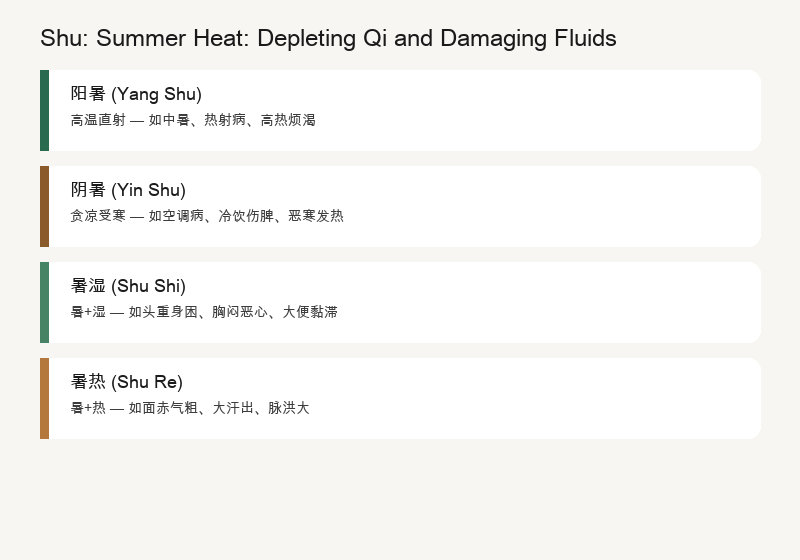
Summer-Heat is a Yang pathogen, by nature scorching hot. Summer-Heat is the "Yang-heat" evil of summer. Its nature is hot, and after invading the body, it causes high fever, red face, red eyes, restlessness, and thirst. Unlike ordinary "fire," Summer-Heat is "seasonal"—it only appears in summer, closely tied to the season.
Summer-Heat rises and disperses, depleting Qi and injuring fluids. The characteristic of Summer-Heat is "rising and dispersing"—moving upward and outward, causing the body's pores (interstitial spaces) to open and release massive sweat. Too much sweating, and "Qi escapes with sweat"—vital energy is scattered; "fluids escape with sweat"—body fluids are burned. The result: both Qi deficiency (exhaustion, shortness of breath, reluctance to speak) and fluid damage (thirst, scanty urine, dry skin).
Summer-Heat often combines with Dampness. Summer is not only hot but also humid. Summer-Heat often invades the body together with Dampness evil—"Summer-Heat-Dampness" coexist. Symptoms are: body heat that is not pronounced (fever but not high on the thermometer), heavy limbs, chest tightness and nausea, poor appetite, sticky stool. You think it's "heat," but it's actually "damp-heat" mixed together.
Summer-Heat easily attacks the Heart. Chinese medicine believes the "Heart belongs to fire," and Summer-Heat is a fire evil. Like attracts like, so Summer-Heat most easily invades the heart. Symptoms: restlessness, insomnia, mental confusion, delirium. In severe cases, "Summer-Heat enters the heart nutrient level"—high fever, mental confusion, convulsions. Modern medicine's heatstroke coma and heat stroke are exactly this state.
So what the ancients called "Summer-Heat" is not just "heat"—it is a "high-temperature physiological crisis" system: heat + dissipation + dampness + heart-brain damage.
But the ancients also distinguished between "mild Summer-Heat" and "severe Summer-Heat":
Mild Summer-Heat (light): slow onset, not high fever, sweating, thirst, fatigue, dizziness—equivalent to mild heat stress.
Severe Summer-Heat (heavy): sudden onset, high fever, no sweating, mental confusion, convulsions—equivalent to heat stroke, life-threatening.
There's another important concept: "Yin Summer-Heat" and "Yang Summer-Heat."
Yang Summer-Heat: working under the blazing sun, direct exposure to heat—this is true "Summer-Heat evil," requiring clearing heat and resolving Summer-Heat.
Yin Summer-Heat: in summer, seeking coolness too much, air conditioning too cold, too much cold drink, causing "cold wrapping fire"—cold on the outside, heat on the inside. Symptoms: fever, aversion to cold, no sweating, headache, abdominal pain. This is not true Summer-Heat; it's a "summer cold," requiring releasing the exterior and dispersing cold.
So the ancients' understanding of "Summer-Heat" was very refined—not simply "heat is Summer-Heat," but divided into light and heavy, Yin and Yang, with or without Dampness. This fine classification is precisely the embodiment of Chinese medicine's pattern differentiation and treatment.
Part 3giaogiao Modern Translation
Alright, let me translate "Summer-Heat" (Summer-Heat pathogen: depleting Qi, injuring fluids) into modern language.
I'm not going to talk about thermodynamics or physiology. Too complicated. You only need to remember one metaphor:
High-temperature environment → core body temperature rises → body initiates cooling mechanisms (sweating, blood vessel dilation) → massive sweating causes water + electrolyte loss → blood volume drops → heart burden increases → circulatory failure
At the same time: high temperature → cellular metabolism accelerates → energy (ATP) consumption surges → mitochondrial function is damaged → "Qi" (energy) is scattered
High temperature → protein denaturation → enzyme activity drops → "fluids" (body fluids) production and regulation function is damaged
Depleting Qi = energy metabolism collapse (ATP depletion, mitochondrial dysfunction)
Injuring fluids = fluid-electrolyte imbalance (dehydration, sodium-potassium loss, blood concentration)
Combining with Dampness = high-temperature, high-humidity environment, sweat evaporation is blocked → cooling efficiency drops → body temperature rises more easily; at the same time, Dampness evil affects digestive function
Summer-Heat entering the Heart = high temperature → blood-brain barrier permeability increases → brain cell edema → nerve function disorder → coma, convulsions
That's it. Simple as that. "Summer-Heat" (Summer-Heat pathogen) is essentially a "energy-fluid-metabolism" triple crisis caused by a high-temperature environment.
Specifically:
What does "depleting Qi" correspond to? It corresponds to energy metabolism collapse. In a high-temperature environment, the body needs massive energy to drive sweating, dilate blood vessels, and accelerate the heartbeat in order to dissipate heat. At the same time, high temperature itself accelerates cellular metabolism, and ATP (energy currency) consumption surges. Result: mitochondria operate at overload, energy reserves are depleted, and "Qi" is scattered. Symptoms: extreme exhaustion, shortness of breath, reluctance to speak, even collapse—this is the manifestation of an energy crisis, not a "psychological effect." Modern research: during heat stress, basal metabolic rate can rise by 20-30%, ATP consumption increases significantly, and cells need more oxygen. But under high temperature, blood is redistributed (flowing to the skin for cooling), and internal organ blood supply is relatively insufficient—forming an "energy supply-demand imbalance."
What does "injuring fluids" correspond to? It corresponds to fluid-electrolyte imbalance. High-temperature sweating can lose 1-2 liters of water per hour and large amounts of sodium, potassium, chlorine, and other electrolytes. Result: blood volume drops (blood concentration), the heart needs to pump harder; electrolyte imbalance causes changes in neuromuscular excitability (muscle cramps, convulsions); kidney blood flow decreases, urine output decreases; salivary gland secretion decreases, dry mouth and tongue. It's not "catching fire"; it's the physiological crisis of dehydration and electrolyte disorder. Modern research: when water loss reaches 2% of body weight, thirst and scanty urine appear; at 4%, dizziness, fatigue, and work efficiency decline; at 6%, temperature regulation is impaired, and heatstroke risk surges; beyond 10%, life is threatened.
What does "Summer-Heat often combines with Dampness" correspond to? It corresponds to the double blow of a high-temperature, high-humidity environment. In a high-temperature, high-humidity environment (like the rainy season in the south), air humidity is high, and sweat evaporation is blocked—sweat evaporation is the body's most important cooling method. Cooling efficiency drops, core body temperature rises more easily, and heatstroke risk increases greatly. At the same time, Dampness evil affects digestive system function—digestive enzyme activity drops under high temperature, gastrointestinal motility slows down, and with high humidity, food easily spoils, causing poor appetite, nausea, and diarrhea. It's not "Dampness evil" mysticism; it's the double blow of high temperature + high humidity on physiology. Modern research: when the wet-bulb temperature (an indicator combining temperature and humidity) exceeds 35°C, even healthy young people cannot maintain normal body temperature through sweating, and mortality rises significantly.
What does "Summer-Heat entering the Heart" correspond to? It corresponds to high-temperature damage to the central nervous system. When core body temperature exceeds 40°C, blood-brain barrier permeability increases, brain cells swell, and neurotransmitter imbalance occurs, leading to consciousness disorders, coma, and convulsions. This is the core mechanism of heat stroke—not "the heart catching Summer-Heat," but brain damage caused by high temperature. Modern research: heat stroke mortality is as high as 30-50%, and even if rescued successfully, neurological sequelae may remain.
So "Summer-Heat" is not mysticism. It is simply a "energy-fluid-metabolism" triple crisis in a high-temperature environment. The ancients used four characters, "depleting Qi, injuring fluids," to precisely summarize it. Modern people use physiology, biochemistry, and thermodynamics to explain it—the core logic is completely consistent.
Part 4Real-Life Cases
Four stories to make you instantly understand what "Summer-Heat" (Summer-Heat pathogen) is.
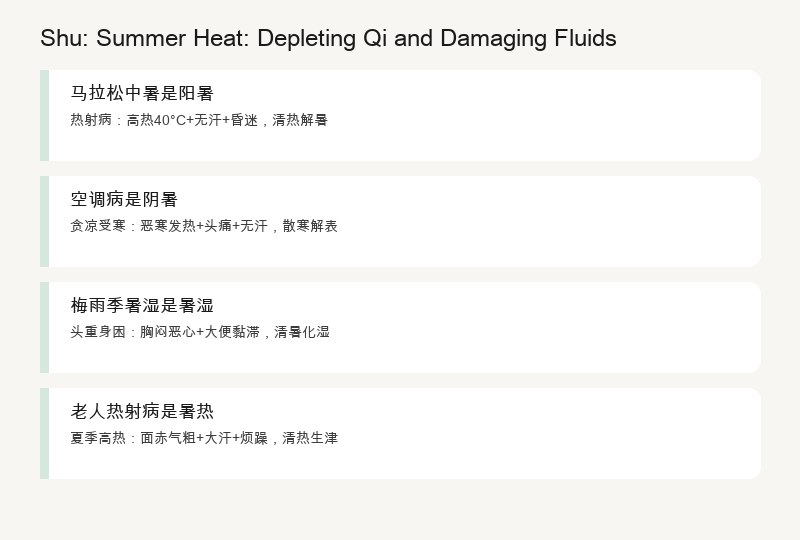
Case One: Marathon heatstroke (the limit of depleting Qi and injuring fluids).
You're running a marathon. It's 35°C. At kilometer 30, suddenly dizzy, nauseous, leg cramps, blurred consciousness. You think you're "out of strength," but actually you're suffering heatstroke. At the emergency station, body temperature is 40°C, heart rate 140, blood pressure dropping. The doctor says this is heat stroke; another half hour and you could have had kidney failure.
Truth: This is a typical "Summer-Heat pathogen depleting Qi and injuring fluids." High temperature + intense exercise, the body's heat production surges, sweating can reach 2-3 liters per hour, and water and electrolytes (sodium, potassium) are massively lost. Blood volume drops, the heart needs to pump harder, but under high temperature blood flows to the skin for cooling, and muscle blood supply is relatively insufficient—the result is: energy exhaustion (depleting Qi) + dehydration + electrolyte disorder (injuring fluids) + circulatory failure. It's not "poor physical condition"; it's a physiological crisis in a high-temperature environment. Modern sports medicine: marathon heatstroke is the number one killer of summer events, and the core mechanism is insufficient cooling + excessive fluid loss. Prevention: hydrate and replenish salt in advance, control pace, wear breathable clothing, and if necessary, quit to save your life.
Case Two: "Yin Summer-Heat" in the air-conditioned room (the modern version of cold wrapping fire).
You've been in an air-conditioned room all day, step outside for five minutes, and suddenly get a headache, aversion to cold, fever, no sweating, nausea. You think it's "heatstroke," drink Huoxiang Zhengqi liquid, and feel worse. Chinese medicine says this is "Yin Summer-Heat"—not caused by heat, but by cold.
Truth: This is a special type of "summer cold." The air-conditioned room is low temperature (20-22°C), pores are contracted, and the body is in a "heat preservation" state. Suddenly going outside, the high-temperature environment, pores don't have time to open for cooling, and the temperature regulation center is confused—hot outside, cold inside, forming "cold wrapping fire." Symptoms are similar to heatstroke (fever, nausea), but the essence is external contraction of wind-cold with internal heat stagnation. It's not "Summer-Heat pathogen"; it's temperature regulation disorder caused by excessive temperature difference. Modern research: air-conditioned environment → cold stimulus → sympathetic nerve excitement → blood vessel contraction → sudden heat exposure → rapid blood vessel dilation → blood pressure fluctuation → dizziness, nausea. Prevention: air conditioning temperature not lower than 26°C, have a transition when entering and exiting air-conditioned rooms, don't blow cold air directly. Distinguishing "Yang Summer-Heat" and "Yin Summer-Heat" is crucial: Yang Summer-Heat (true heatstroke) requires clearing heat and resolving Summer-Heat; Yin Summer-Heat (air conditioning sickness) requires releasing the exterior and dispersing cold.
Case Three: Construction worker's "Summer-Heat-Dampness" (the double blow of high temperature and high humidity).
You're working at a construction site in the south. Temperature is 38°C, humidity 80%, steaming like a sauna all day. You're not just hot; you're sticky all over, limbs heavy, chest tight and nauseous, poor appetite, sticky stool. Chinese medicine says this is "Summer-Heat-Dampness"—Summer-Heat pathogen combined with Dampness, a double blow.
Truth: This is the physiological effect of a high-temperature, high-humidity environment. At 80% humidity, sweat evaporation efficiency drops dramatically—sweat comes out, but instead of evaporating and carrying away heat, it turns into water droplets sticking to your skin. Cooling efficiency drops, core body temperature rises more easily, and heatstroke risk increases greatly. At the same time, under high-humidity conditions, food easily spoils, bacteria multiply quickly, and gastrointestinal infection risk increases; digestive enzyme activity drops under high temperature, gastrointestinal motility slows down, causing poor appetite and nausea. It's not "Dampness entering the body" mysticism; it's the double blow of high temperature + high humidity on the cooling system and digestive system. Modern occupational medicine: workers in high-temperature, high-humidity environments have twice the heatstroke risk of those in dry environments. Prevention: reduce humidity (ventilation, dehumidification), increase rest frequency, replenish salt-containing drinks, wear breathable, sweat-absorbing work clothes.
Case Four: Grandma's "Summer-Heat damaging fluids" (elderly temperature regulation crisis).
Your grandma doesn't turn on the air conditioner in summer, saying she's "afraid of catching cold." Then one day with high temperature, she sits at home and gets dizzy, thirsty, scanty urine, dry skin, confused consciousness. At the hospital, body temperature is 39.5°C, blood sodium 160 (normal 135-145), severe dehydration. The doctor says it's "classic heat stroke"—not caused by exercise, but by temperature regulation failure in a high-temperature environment.
Truth: Elderly people's temperature regulation ability is already weak—reduced sweating, decreased thirst sensation, sluggish blood vessel response. Plus grandma is afraid of catching cold and doesn't turn on the air conditioner, so indoor temperature is even higher than outside (heat island effect). The result? The body doesn't perceive the heat, but core body temperature is quietly rising until confused consciousness is discovered by family. It's not a vague statement of "old people have poor health"; it's the叠加 crisis of elderly physiological characteristics + environmental high temperature + behavioral factors (no air conditioning). Modern geriatric medicine: people over 65 have 3-5 times the heat stroke mortality of young people. Prevention: elderly people must turn on air conditioning in summer (around 26°C), even if they don't feel hot; drink water regularly (even if not thirsty); family members check on the elderly's condition daily.
Four cases, one underlying logic: Summer-Heat is the "energy-fluid-metabolism" triple crisis in a high-temperature environment. It's not as simple as "getting too hot"; it's a comprehensive challenge to the body's cooling system, circulatory system, energy system, and nervous system.
Part 5Modern Research
Does "Summer-Heat" (Summer-Heat pathogen) have scientific research?
Yes, and it's very substantial. Scientists don't use the words "depleting Qi, injuring fluids"; they use "thermal physiology" and "thermal medicine":
• Pathological mechanism of heat stroke. Modern medicine defines severe heatstroke as "heat stroke" (Heat Stroke): core body temperature exceeds 40°C, accompanied by central nervous system dysfunction (confusion, coma, convulsions). Pathological mechanism: high temperature → cellular heat damage → protein denaturation → enzyme inactivation → cell membrane rupture → inflammatory storm (massive cytokine release) → multiple organ failure (liver, kidney, heart, brain). This is highly consistent with what the ancients called "Summer-Heat entering the heart nutrient level": high fever + mental confusion + convulsions. Modern emergency treatment: rapid cooling (ice water immersion, evaporative cooling) is the primary measure, with the goal of reducing core body temperature below 39°C within 30 minutes. Research shows: for every hour of delay in cooling, mortality increases by about 30%.
• Research on fluid-electrolyte balance. Modern sports medicine research on high-temperature sweating is very precise: in a high-temperature environment, sweating can reach 1-3 liters per hour, losing 5-10 grams of sodium and 1-3 grams of potassium. Drinking plain water (without electrolytes) alone leads to dilutional hyponatremia—blood sodium concentration drops further, worsening symptoms. This is why sports drinks contain sodium, potassium, and chlorine. It's not "injuring fluids" mysticism; it's precise electrolyte balance science. WHO recommendation: high-temperature workers should replenish 500-1000 ml of salt-containing drinks per hour of work, with sodium concentration of 20-30 mmol/L.
• Wet-bulb temperature and survival limits. A 2020 study published in Science Advances: when the wet-bulb temperature (an indicator combining temperature and humidity) exceeds 35°C, even healthy young people resting in the shade cannot maintain normal body temperature through sweating—this is the limit of human survival. Research shows: multiple regions globally (Persian Gulf, South Asia) have already experienced wet-bulb temperatures exceeding 35°C. By the end of this century, over 1 billion people worldwide will face this "survival limit high temperature" annually. It's not "Summer-Heat pathogen" mysticism; it's climate science's survival limit. This is completely consistent with what the ancients said about "Summer-Heat often combining with Dampness"—high temperature + high humidity is the most dangerous.
• Global warming and heatstroke mortality. The Lancet 2023 report: globally, over 500,000 people die each year from heat-related diseases, with heatstroke (heat stroke) being the most direct cause. Elderly people, outdoor workers, and chronic disease patients are high-risk groups. As global warming continues, the frequency and intensity of heat waves are increasing, and heatstroke mortality is rising. It's not a vague statement of "natural disaster"; it's a public health crisis of climate change. The ancients didn't have the term "global warming," but they knew "Summer-Heat pathogen harms people"—summer requires special protection—this is wisdom spanning millennia.
These studies fully demonstrate: "Summer-Heat" is a concept that can be precisely described in modern scientific language. The ancients used four characters, "depleting Qi, injuring fluids," to summarize it. Modern people use physiology, biochemistry, and thermodynamics to explain it—the core logic is consistent: high temperature → cooling → dissipation → crisis.
Part 6Practical Methods
Now that you understand "Summer-Heat" (Summer-Heat pathogen), how do you prevent it? How do you treat it?
First, let's bust a few myths:
• "Got heatstroke, drink ice water to cool down." Wrong. After heatstroke, gastrointestinal function is disordered, and ice water stimulation can cause gastrointestinal spasms and diarrhea, worsening dehydration. You should drink room-temperature or slightly cool salt-containing drinks, sipping slowly. It's not "the colder the better"; it's gentle hydration + electrolytes.
• "Summer should produce heavy sweat, detoxifying." Wrong. Massive sweating causes loss of water and electrolytes, actually "injuring fluids and depleting Qi," reducing resistance. Moderate sweating is fine, but "dripping sweat" is not detoxifying; it's a fluid crisis. It's not "the more sweat the better"; it's moderate sweating, timely replenishment.
• "Old people are afraid of catching cold, so they can't use air conditioning in summer." Wrong. Elderly people are the highest-risk group for heat stroke. Not using air conditioning, indoor temperature can reach 35-40°C, with extremely high fatal risk. Air conditioning at around 26°C won't "cause a cold"; it saves lives. It's not "air conditioning is harmful"; it's appropriate temperature, life safety.
Specific methods:
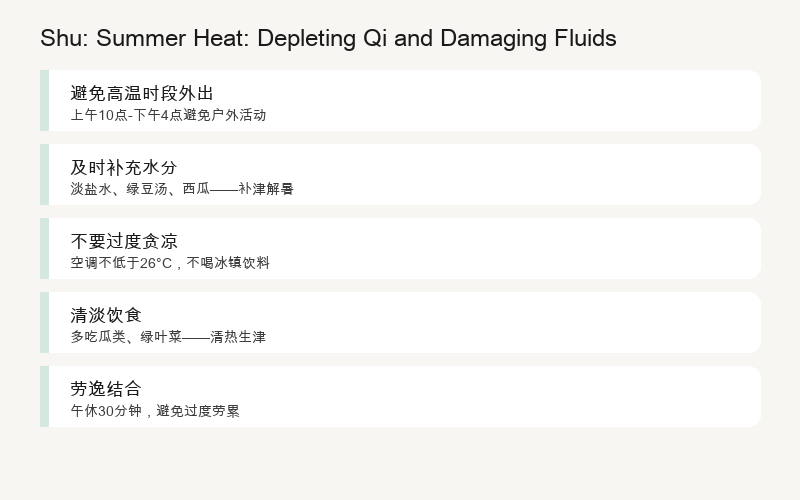
• Hydrate and replenish salt regularly on high-temperature days (prevent fluid damage). Don't wait until you're thirsty to drink water—thirst is already a signal of mild dehydration. Replenish 200-300 ml of salt-containing drinks (light salt water, sports drinks) per hour, avoiding drinking pure water alone (without electrolytes, it dilutes blood sodium). It's not as simple as "drink more water"; it's hydration + salt + small amounts, multiple times. Outdoor workers: replenish 150-200 ml every 20 minutes.
• Avoid high-temperature periods (prevent heat exposure). 10 a.m. to 4 p.m. is the hottest period of the day. Try to schedule outdoor activities for morning or evening. If you must work in high temperature, increase rest frequency: every 45-60 minutes of work, rest 15 minutes in a cool place to cool down. It's not "toughing it out"; it's avoiding the sharp edge, fighting in shifts.
• Set air conditioning to 26°C, temperature difference not exceeding 8°C (prevent Yin Summer-Heat). Set air conditioning to around 26°C, with a temperature difference from outdoors not exceeding 8°C. Have a transition when entering and exiting air-conditioned rooms (stand at the door for a while). Avoid direct air conditioning blowing (especially on the head, abdomen, and joints). It's not "the colder the better"; it's moderate temperature difference, body adaptation.
• Pay special attention on high-temperature, high-humidity days (prevent Summer-Heat-Dampness). When humidity exceeds 70%, even if the temperature isn't extremely high (32-35°C), heatstroke risk increases greatly. Because sweat evaporation is blocked, cooling efficiency drops. At this time, pay special attention: wear breathable, sweat-absorbing clothing (cotton, quick-dry fabric), increase ventilation (fans accelerate air flow), use dehumidifiers (reduce indoor humidity). It's not "if the temperature isn't high, it's fine"; it's humidity is also a killer.
• Recognize heatstroke signs and provide first aid promptly (prevent severe cases). Heatstroke has three stages: premonitory heatstroke (dizziness, thirst, excessive sweating, fatigue) → mild heatstroke (flushed face, burning skin, rising body temperature, rapid pulse) → severe heatstroke (heat stroke: high fever, no sweating, confusion, coma, convulsions). Once it enters the severe stage, you must immediately call emergency services while rapidly cooling down (ice packs on major blood vessels: neck, armpits, groin; or wipe the whole body with a wet towel + fan). It's not "resting a bit will be fine"; it's racing against time, rapid cooling. The golden first aid time for heat stroke is 30 minutes.
• Eat foods that clear heat and resolve Summer-Heat (prevent Qi depletion). In summer, appropriately eat foods that clear heat and resolve Summer-Heat: mung bean soup (clears heat and promotes urination), watermelon (generates fluids and quenches thirst), bitter melon (clears heat and resolves Summer-Heat), lotus seeds (nourishes the heart and calms the spirit), lily bulbs (moistens the lungs and clears the heart). But note: although watermelon resolves Summer-Heat, it's cold in nature; people with weak spleen and stomach should not eat too much. Mung bean soup detoxifies, but should not be drunk on an empty stomach. It's not "eating cold things resolves Summer-Heat"; it's identifying your constitution, eating in moderation.
These methods don't require you to be a medical expert. You only need to understand: Summer-Heat is an "energy-fluid-metabolism" crisis under high temperature. The core of prevention is: reduce heat exposure, replenish water and salt, ensure cooling efficiency, and recognize danger signals.
Part 6 (Continued)Practical Methods: Five Moves to Prevent Heatstroke
Part 7One-Minute Summary
🕐 Understand "Summer-Heat" in One Minute
Summer-Heat = high-temperature energy overload + fluid-electrolyte crisis + metabolic system collapse.
Summer-Heat is not "getting too hot"; it's a comprehensive physiological crisis in a high-temperature environment.
The ancients used four characters, "depleting Qi, injuring fluids," to precisely summarize it: high temperature → sweating → water and electrolyte loss → energy exhaustion.
Depleting Qi = energy metabolism collapse (ATP depletion, mitochondrial dysfunction).
Injuring fluids = fluid-electrolyte imbalance (dehydration, sodium-potassium loss, blood concentration).
Combining with Dampness = high temperature, high humidity → sweat evaporation blocked → cooling efficiency drops → body temperature rises more easily.
Summer-Heat entering the Heart = high temperature → brain damage → consciousness disorders, coma, convulsions (heat stroke).
Myths: drinking ice water for heatstroke, heavy sweating in summer for detoxification, elderly people can't use air conditioning.
Methods: hydrate and replenish salt regularly, avoid high-temperature periods, air conditioning at 26°C with temperature difference not exceeding 8°C, pay special attention on high-temperature, high-humidity days, recognize heatstroke signs and provide first aid promptly, eat foods that clear heat and resolve Summer-Heat.
The ancients called it "depleting Qi, injuring fluids." Modern people call it "heat stress → dehydration → electrolyte disorder → energy metabolism collapse → multiple organ failure."
Different names, but the body knows: high temperature is a killer, and prevention is better than cure.
The ancients had no thermometer, but they knew "Summer-Heat causes Qi to leak, the pores open, and Qi escapes with sweat."
This is probably the most朴素 wisdom of the Chinese people: follow the seasons, revere nature, know Summer-Heat and prevent Summer-Heat.

Making money is the art of living; art is the life after making money
giaogiao Decodes Traditional Chinese Wisdom · Concept 83
Using the language of modern science to help the world understand traditional Chinese wisdom.
No mysticism, no superstition, no belittlement.
Understand, rather than merely believe.
Coach Liu
Written in Florence