郁 (yù) — Stagnation: Qi Flow Obstruction
Part 1A Question
Have you ever noticed that long-term stress and low mood are not just "feeling bad" — the body also follows suit with chest tightness, stomach bloating, insomnia, headaches, and weakened immunity?
Have you noticed that sometimes the body is like a blocked water pipe — emotions are the valve, qi is the water flow, the valve is screwed shut, the water stops, and the pipe starts to rust, clog, even burst? Even more striking, what modern medicine calls "chronic stress," "HPA axis dysregulation," "autonomic nervous system disorder," and "psychoneuroimmunology" is actually talking about the same thing as the Chinese concept of "stagnation" — a "traffic jam" between emotions and body?
You ask: What exactly is the Chinese concept of "stagnation"? Is it depression? Anxiety? Autonomic nervous system disorder? Or some mysterious "qi is blocked"? If "stagnation" is real, why doesn't Western medicine have a "relieving stagnation" concept, instead talking about "psychotherapy," "antidepressants," and "cognitive behavioral therapy"?
There's another question: Why do some people become more efficient under high pressure, while others get stomach pain, diarrhea, and headaches as soon as they get nervous? Why do different people react completely differently to the same stress? Is it a personality difference, or a difference in the degree of "qi" flow smoothness?
What exactly is stagnation? Is it the ancient people's naive observation of "emotions affecting the body," or is it a mind-body state that can be precisely defined by modern science?
Part 2Traditional Chinese Explanation
The concept of "stagnation" in Chinese medicine has a long history. It is not just an "emotional problem" — it is a state of "mind-body unity," with the core being "qi flow obstruction."
— Danxi Xinfa (Danxi's Methods of the Heart)
"When qi and blood are harmonious, no disease arises; once there is depression, all diseases arise."
— Danxi Xinfa
"Anger causes qi to rise; joy causes qi to relax; sadness causes qi to dissipate; fear causes qi to descend; shock causes qi to disorder; overthinking causes qi to knot."
— Huangdi Neijing · Suwen
The ancients observed that emotions and the body are mutually influential — poor emotions lead to blocked qi; blocked qi leads to physical problems. This state is called "stagnation."
郁 = Qi flow obstruction = the "traffic jam" of emotions and body. The "stagnation" spoken of in Chinese medicine includes:
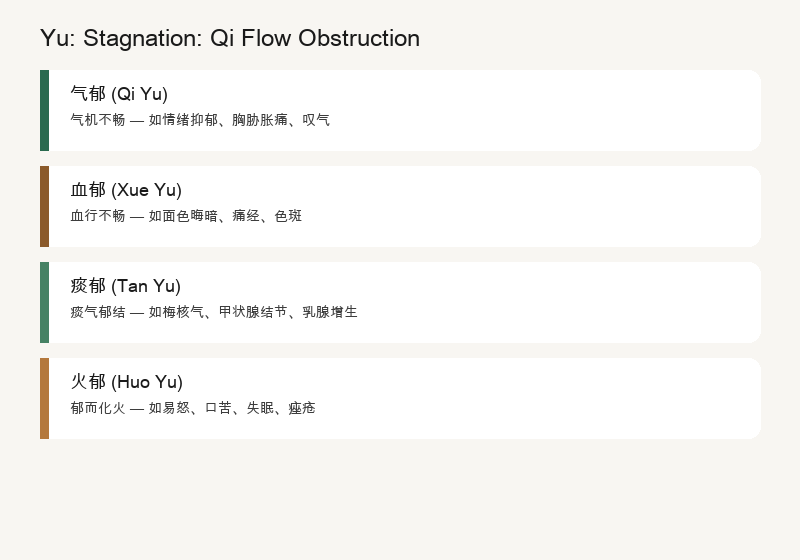
Qi stagnation (Qi Yu): Emotional suppression, qi flow obstruction — manifesting as chest tightness, rib-side pain, frequent sighing, low mood, irritability.
Blood stagnation (Xue Yu): Qi stagnation leading to blood stasis — manifesting as dull complexion, dark spots, menstrual pain, purple-dark tongue.
Phlegm stagnation (Tan Yu): Qi flow obstruction, dampness gathering into phlegm — manifesting as chest tightness with phlegm, heavy body, thick greasy tongue coating, plum pit qi (lump in throat sensation).
Fire stagnation (Huo Yu): Qi stagnation transforming into fire — manifesting as bitter mouth, dry mouth, insomnia, irritability, acne, headaches.
Food stagnation (Shi Yu): Emotions affecting digestion — manifesting as stomach bloating, belching, poor appetite, irregular bowel movements.
Damp stagnation (Shi Yu): Qi flow obstruction, dampness not being transported — manifesting as heavy sluggish body, limb swelling, sticky stool.
So the "stagnation" spoken of by the ancients is not just "depression" — it is the general term for all states of "qi flow obstruction, emotional suppression, and mind-body imbalance". It can be an emotional problem (depression, anxiety, irritability), a physical problem (chest tightness, stomach bloating, insomnia, headaches), or more commonly both intertwined — emotional problems cause physical symptoms, and physical symptoms worsen emotional problems.
But Chinese medicine has a core principle: stagnation does not leave the liver; the liver governs free flow. In Chinese medicine theory, the liver governs "free flow" — regulating the smooth flow of qi throughout the body. Emotional suppression most damages the liver's free flow function, so "relieving stagnation" first requires "soothing the liver" — restoring the liver's regulatory function. Not simply "taking some happy pills," but soothing the liver and regulating qi + regulating emotions + improving lifestyle.
Part 3giaogiao Modern Translation
Okay, now let's translate "stagnation" into modern language.
I am not going to talk about neuroendocrinology or psychoneuroimmunology. Too complicated. You only need to remember one metaphor:
Qi stagnation = Chronic stress + HPA axis dysregulation (hypothalamic-pituitary-adrenal axis dysfunction) + Autonomic imbalance (sympathetic overactivation, parasympathetic suppression)
Blood stagnation = Emotional stress-induced blood hypercoagulation + Microcirculation disorder (stress hormones cause platelet aggregation and vasoconstriction)
Phlegm stagnation = Chronic stress-induced metabolic disorder + Water-sodium retention (elevated cortisol causes insulin resistance and fluid metabolism imbalance)
Fire stagnation = Chronic stress-induced inflammatory response + Oxidative stress (long-term stress elevates inflammatory factors and free radicals)
Food stagnation = Emotions affecting gastrointestinal function (gut-brain axis disorder) — stress causes abnormal gastrointestinal motility and digestive fluid secretion
Damp stagnation = Autonomic nervous system disorder causing water-salt metabolism disorder (sympathetic nerve inhibits renal sodium excretion, causing fluid retention)
Relieving stagnation = Regulate HPA axis (stress reduction) + Balance autonomic nervous system (relaxation) + Improve gut-brain axis (diet + probiotics) + Anti-inflammatory and antioxidant + Exercise release
That simple. "Stagnation" is essentially the traffic jam of emotions and body — chronic stress causes neuro-endocrine-immune network imbalance, triggering a series of mind-body symptoms.
Specifically:
What does "Qi stagnation" correspond to? It corresponds to modern medicine's "chronic stress + HPA axis dysregulation + autonomic nervous system disorder." When under long-term stress, the hypothalamic-pituitary-adrenal (HPA) axis is continuously activated, and cortisol (stress hormone) levels are elevated. At the same time, the sympathetic nervous system is overactivated (fight or flight mode), and the parasympathetic nervous system is suppressed (rest and digest mode is turned off). Manifesting as chest tightness, heart palpitations, rapid breathing, muscle tension, insomnia, anxiety. Not "qi is blocked" mysticism, but dysfunction of the neuroendocrine system. Modern research: Long-term stress individuals have cortisol levels 30–50% higher than normal; HPA axis dysregulation is closely linked to depression, anxiety disorder, and chronic fatigue syndrome.
What does "Blood stagnation" correspond to? It corresponds to emotional stress-induced blood hypercoagulation and microcirculation disorder. Stress hormones (epinephrine, norepinephrine, cortisol) increase platelet aggregation, blood viscosity, and vasoconstriction, causing microcirculation disorder. Manifesting as dull complexion, dark spots, menstrual blood clots, headaches. Not "qi stagnation causing blood stasis" mysticism, but the effect of stress hormones on hemorheology. Modern research: Under acute stress, blood viscosity can increase by 20–30% within hours; long-term stress is an independent risk factor for cardiovascular disease.
What does "Food stagnation" correspond to? It corresponds to gut-brain axis (Gut-Brain Axis) disorder. The gut and brain communicate bidirectionally through the vagus nerve, neurotransmitters, and hormones. Emotional stress affects gastrointestinal function through the gut-brain axis — sympathetic overactivation inhibits gastrointestinal motility and digestive fluid secretion, causing stomach bloating, poor appetite, constipation or diarrhea. At the same time, gut microbiome imbalance produces neurotransmitters (such as 5-HT, GABA) that affect brain mood. Not "liver qi attacking the stomach" mysticism, but gut-brain axis neuro-endocrine-immune regulation. Modern research: 70% of depression patients have gastrointestinal symptoms; 50% of irritable bowel syndrome (IBS) patients have anxiety or depression.
What does "Fire stagnation" correspond to? It corresponds to chronic stress-induced inflammatory response and oxidative stress. Long-term stress elevates inflammatory factors (IL-6, TNF-α, CRP) and oxidative free radicals (ROS), attacking cells and tissues, manifesting as bitter mouth, dry mouth, insomnia, irritability, acne, headaches. Not "qi stagnation transforming into fire" mysticism, but chronic stress-induced inflammation and oxidative damage. Modern research: Depression patients have inflammatory factor levels 40–60% higher than normal; anti-inflammatory treatment can improve some depressive symptoms.
So, "stagnation" is not mysticism. It is simply the traffic jam of emotions and body — chronic stress causes neuro-endocrine-immune network imbalance, triggering a series of mind-body symptoms. The ancients used "qi stagnation, blood stagnation, phlegm stagnation, fire stagnation, food stagnation" to describe it; modern people use "HPA axis dysregulation, autonomic nervous system disorder, gut-brain axis disorder, inflammatory factors, oxidative stress" to describe it — the core logic is the same: when emotions are blocked, the body is blocked.
Part 4Life Examples
Four stories to make you instantly understand what "stagnation" is.
Case 1: Qi stagnation (Chronic stress + HPA axis dysregulation).
You work at high intensity for three consecutive months, twelve hours a day, answering messages on weekends. You start to have chest tightness, like to sigh, poor sleep quality, waking up in the morning as if you haven't slept, irritable mood, and difficulty concentrating. You ask: "Why does the body collapse when under stress?"
Truth: This is typical "qi stagnation" — HPA axis dysregulation + autonomic nervous system disorder. Long-term stress keeps the HPA axis continuously activated, cortisol levels remain high, causing: elevated blood sugar (insulin resistance), immune suppression (prone to colds), sleep disorders (cortisol interferes with melatonin), and emotional instability (cortisol affects prefrontal function). At the same time, sympathetic overactivation and parasympathetic suppression keep the body in "fight or flight" mode for a long time, unable to enter "rest and digest" mode. Manifesting as chest tightness, sighing, insomnia, irritability — not "qi is blocked," but the neuroendocrine system running on overload for a long time. Modern research: Chronic stress workers' cortisol awakening response (CAR) is 40% higher than normal; it is an important biomarker of burnout.
Case 2: Food stagnation (Gut-brain axis disorder).
You recently had a fight with your partner and feel down. Strangely, it's not that you can't eat, but you have stomach bloating, belching, constipation, feeling full after a little food, but hungry again after a while. You ask: "Why does the stomach act up when emotions are bad?"
Truth: This is typical "food stagnation" — gut-brain axis disorder. Emotional stress affects gastrointestinal function through the vagus nerve and neurotransmitters (5-HT, CRF): sympathetic overactivation inhibits gastric motility and gastric acid secretion, causing stomach bloating and indigestion; at the same time, stress affects the gut microbiome, pathogenic bacteria increase, producing gas and toxins, causing bloating and constipation. Not "liver qi attacking the stomach" mysticism, but gut-brain axis neuro-endocrine regulation. Modern research: Stress can prolong gastric emptying time by 30–50%; the gut microbiome can undergo significant changes within 24 hours under stress. Among functional dyspepsia patients, 60% have anxiety or depression.
Case 3: Fire stagnation (Chronic stress + Inflammatory response).
You are preparing for an important exam, sleeping only five hours a day for two consecutive weeks. You find yourself with a bitter mouth, dry mouth, tongue ulcers, acne on your face, headaches, and a restless mind. You ask: "Why does tension always cause fire?"
Truth: This is typical "fire stagnation" — chronic stress-induced inflammatory response and oxidative stress. Sleep deprivation and stress elevate cortisol and inflammatory factors (IL-6, TNF-α), while oxidative free radicals (ROS) increase, attacking oral mucosa (ulcers), skin cells (acne), and cerebral blood vessels (headaches). Not "qi stagnation transforming into fire" mysticism, but chronic stress-induced inflammation and oxidative damage. Modern research: People who sleep less than 6 hours have CRP levels elevated by 50% and IL-6 levels elevated by 30%. Exam stress can significantly elevate inflammatory markers within 24 hours.
Case 4: Blood stagnation (Emotional stress-induced blood hypercoagulation).
You have long-term emotional suppression, rarely express anger, always "swallowing your anger." Recently you noticed a dull complexion, dark spots around the eyes, many blood clots in menstrual flow, and occasional migraines. You ask: "Why does emotional suppression affect blood circulation?"
Truth: This is typical "blood stagnation" — emotional stress-induced blood hypercoagulation and microcirculation disorder. Long-term suppressed emotions keep the sympathetic nervous system continuously activated, catecholamines (epinephrine, norepinephrine) levels are elevated, causing: increased platelet aggregation, elevated blood viscosity, vasoconstriction, and microcirculation disorder. Manifesting as dull complexion, dark spots, blood clots, headaches — not "qi stagnation causing blood stasis" mysticism, but the effect of stress hormones on hemorheology. Modern research: Long-term suppressed anger individuals have blood viscosity 25% higher than normal, platelet aggregation rate elevated by 30%, and it is an independent risk factor for cardiovascular and cerebrovascular disease. Japanese research: "Anger-in" personality type has twice the coronary heart disease risk of normal people.
Four cases, one underlying logic: stagnation is the "traffic jam of emotions and body" — emotional stress affects the body through the neuro-endocrine-immune network, causing qi flow obstruction, blood hypercoagulation, gastrointestinal disorder, and elevated inflammation. Not "mysterious qi is blocked," but a measurable, intervenable mind-body state.
Part 5Modern Research
Is there scientific research on "stagnation"?
Yes, and it is very robust. Scientists do not use the word "stagnation"; they use "chronic stress," "HPA axis," "autonomic nervous system," "psychoneuroimmunology," and "gut-brain axis":
• HPA axis and chronic stress. Modern research confirms that chronic stress causes HPA axis dysregulation, with abnormal cortisol levels (too high or too low). HPA axis dysregulation is the core pathological mechanism of depression, anxiety disorder, post-traumatic stress disorder (PTSD), and chronic fatigue syndrome. The "qi stagnation" spoken of in Chinese medicine corresponds to HPA axis dysregulation — not mysticism, but a pathological state with clear neuroendocrine mechanisms. Modern research: Depression patients have cortisol levels 30–50% higher than normal; the dexamethasone suppression test (DST) abnormality rate is 3 times that of normal people.
• Autonomic nervous system and "qi stagnation". Heart rate variability (HRV) is the gold standard for assessing autonomic nervous system function. Chronic stress individuals have significantly reduced HRV, indicating sympathetic overactivation and insufficient parasympathetic function. This highly corresponds to the "qi stagnation" (qi flow obstruction) spoken of in Chinese medicine. Not "qi is not flowing smoothly" mysticism, but a measurable indicator of the autonomic nervous system. Modern research: Depression patients have HRV 20–30% lower than normal; HRV training (such as breathing exercises, meditation) can improve depressive symptoms.
• Gut-brain axis and "food stagnation". Modern neurogastroenterology research confirms that the gut and brain communicate bidirectionally through the vagus nerve, neurotransmitters, and hormones. Neurotransmitters produced by the gut microbiome (5-HT, GABA, dopamine) directly affect brain mood. Stress affects gastrointestinal function through the gut-brain axis, and gastrointestinal problems in turn affect mood through the gut-brain axis. This completely corresponds to the "food stagnation" (liver qi attacking the stomach) spoken of in Chinese medicine. Not "emotions hurt the stomach" mysticism, but the precise neuro-endocrine-immune mechanisms of the gut-brain axis. Modern research: Supplementing specific probiotics (such as Lactobacillus rhamnosus JB-1) can reduce anxiety-related behaviors, with effects comparable to antidepressants.
• Psychoneuroimmunology and "stagnation". Modern psychoneuroimmunology research confirms that chronic stress, through the neuro-endocrine-immune network, lowers immune function (decreased NK cell activity, weakened T-cell function) and elevates inflammatory factors (IL-6, TNF-α, CRP). This completely corresponds to the "long-term stagnation harms the body" (long-term emotional problems cause physical depletion) spoken of in Chinese medicine. Not "qi stagnation harms righteous qi" mysticism, but the precise mechanisms of psychoneuroimmunology. Modern research: Long-term caregivers of dementia patients (chronic stress) have 50% lower flu vaccine antibody response than normal people.
These studies fully demonstrate that "stagnation" is a concept that can be precisely described in modern scientific language. The ancients used "qi stagnation, blood stagnation, phlegm stagnation, fire stagnation, food stagnation" to describe it; modern people use "HPA axis dysregulation, autonomic nervous system disorder, gut-brain axis disorder, inflammatory factors, oxidative stress" to describe it — the core logic is the same: when emotions are blocked, the body is blocked.
Part 6Practical Methods
Now that you understand "stagnation," how do you relieve it?
First, let's dispel a few myths:
• "Stagnation is depression, and you need to take antidepressants." Antidepressants (SSRIs, etc.) are effective for moderate to severe depression, but mild "stagnation" (qi stagnation, food stagnation, fire stagnation) can be improved through lifestyle adjustments. Not "stagnation means medication," but layered intervention: mild cases adjust lifestyle, moderate cases add psychotherapy, severe cases consider medication.
• "Relieving stagnation means thinking about happy things more." Emotional regulation is not simply "cheering up"; it is a long-term process of changing neural circuits. It requires systematic methods: cognitive restructuring, behavioral activation, body relaxation. Not "happiness is enough," but neuroplasticity training.
• "Stagnation is a psychological problem, no need to care about the body." Stagnation is mind-body unity — physical symptoms (chest tightness, stomach bloating, insomnia) are the physiological expression of emotional problems, and conversely, improving the body (exercise, sleep, diet) can also improve emotions. Not "mind-body separation," but treating mind and body together.
Specific methods:
• Relieve "Qi stagnation": Stress reduction + HPA axis regulation. Regular exercise (150 minutes of moderate-intensity aerobic exercise per week) lowers cortisol and boosts brain-derived neurotrophic factor (BDNF). Mindfulness meditation (10–20 minutes per day) regulates the HPA axis and reduces sympathetic overactivation. Adequate sleep (7–8 hours) is the key time for HPA axis repair. Social connection (communicating with family and friends) reduces loneliness and boosts oxytocin. Not "cheering up," but systematic regulation of the neuroendocrine system.
• Relieve "Food stagnation": Repair the gut-brain axis. Regular eating (fixed times and amounts), avoid binge eating or dieting under stress. Increase dietary fiber (25–30 grams per day) to feed probiotics. Supplement fermented foods (yogurt, kimchi, kombucha) to increase probiotic diversity. Avoid long-term antibiotic abuse (disrupts microbiome). If necessary, perform gut microbiome testing and personalized supplementation. Not "regulating the spleen and stomach," but gut-brain axis ecosystem reconstruction.
• Relieve "Fire stagnation": Anti-inflammatory + Antioxidant. Eat more antioxidant-rich foods (dark leafy vegetables, berries, nuts, green tea), reduce pro-inflammatory foods (refined sugar, trans fats, excess alcohol). Ensure adequate sleep (liver detoxification and anti-inflammatory repair time). Learn to express emotions (don't suppress anger); long-term anger suppression elevates inflammatory factors. If necessary, use anti-inflammatory supplements (Omega-3, curcumin, NAC) under a doctor's guidance. Not "clearing fire," but an anti-inflammatory and antioxidant system lifestyle.
• Relieve "Blood stagnation": Improve circulation + Emotional expression. Regular exercise (especially aerobic exercise) promotes blood flow and lowers blood viscosity. Learn to express emotions (don't "swallow your anger"); suppressed anger is an independent risk factor for blood hypercoagulation. Eat more anticoagulant foods (deep-sea fish, onions, garlic, ginger). Avoid sitting for long periods; get up and move every hour. If necessary, use blood-activating and stasis-resolving Chinese herbs or antiplatelet medications under a doctor's guidance. Not "blood-activating and stasis-resolving," but blood flow improvement + emotional release.
• Overall strategy for relieving stagnation: Cognitive behavioral therapy (CBT) + Mindfulness. CBT helps you identify and change negative thought patterns, breaking the "emotion-body-behavior" vicious cycle. Mindfulness training helps you be aware of the present moment, reducing automatic reactions to negative emotions. Combined, the effectiveness for mild to moderate depression exceeds 60%, comparable to medication but without side effects. Not "cheering up," but psychological training based on neuroplasticity.
These methods do not require you to become a psychologist. You only need to understand: stagnation is the "traffic jam of emotions and body" — what you need to do is clear the traffic (reduce stress, relax, exercise, sleep), while repairing the road (anti-inflammatory, antioxidant, improve circulation, repair gut-brain axis).
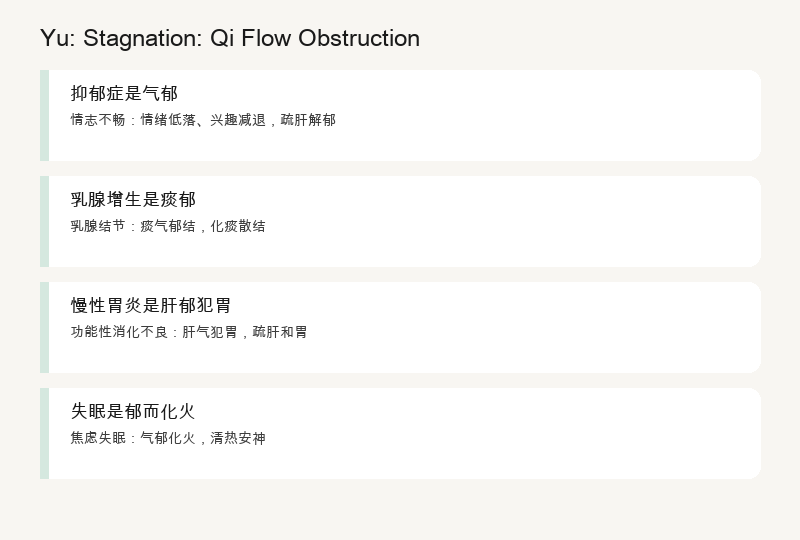
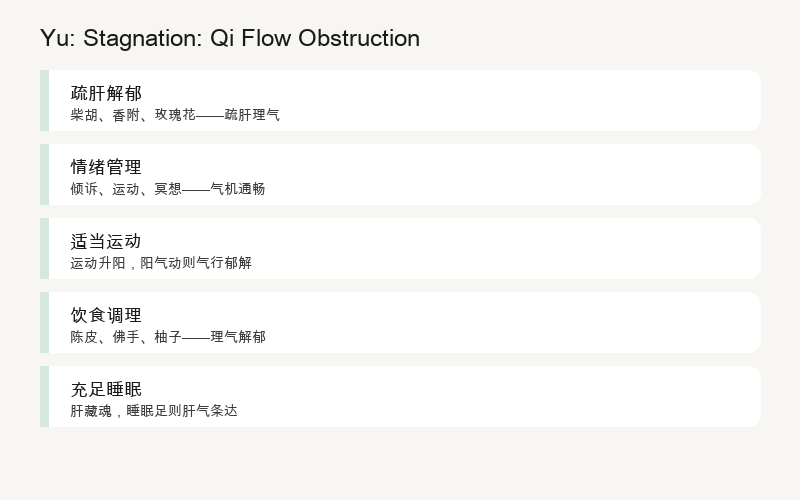
Part 6(续)Practical Methods: Five Moves to Relieve Stagnation
Part 7One-Minute Summary
🕐 Understand "Stagnation" in One Minute
郁 = Traffic jam of emotions and body.
The "stagnation" spoken of in Chinese medicine is not simply "feeling bad," but a series of mind-body symptoms triggered by chronic stress causing neuro-endocrine-immune network imbalance.
Qi stagnation = HPA axis dysregulation + Autonomic nervous system disorder (elevated cortisol, sympathetic overactivation).
Blood stagnation = Emotional stress-induced blood hypercoagulation + Microcirculation disorder (stress hormones cause platelet aggregation and vasoconstriction).
Phlegm stagnation = Chronic stress-induced metabolic disorder + Water-sodium retention (elevated cortisol causes insulin resistance).
Fire stagnation = Chronic stress-induced inflammatory response + Oxidative stress (elevated inflammatory factors and free radicals).
Food stagnation = Gut-brain axis disorder (emotions affect gastrointestinal function, and gastrointestinal problems in turn affect emotions).
Damp stagnation = Autonomic nervous system disorder causing water-salt metabolism disorder.
Myths: Stagnation is depression and requires medication; relieving stagnation means cheering up; stagnation is a psychological problem and no need to care about the body.
Methods: Exercise + meditation + sleep to regulate the HPA axis and relieve qi stagnation; dietary fiber + probiotics to repair the gut-brain axis and relieve food stagnation; anti-inflammatory diet + emotional expression to relieve fire stagnation; exercise + anticoagulant diet + emotional release to relieve blood stagnation; CBT + mindfulness training to change neural circuits.
The ancients called it "qi stagnation, blood stagnation, fire stagnation"; modern people call it "HPA axis dysregulation, autonomic nervous system disorder, gut-brain axis disorder, inflammatory response."
Different names, but medicine knows: emotions and body are two ends of the same road; when the road is blocked, both ends suffer.
Relieving stagnation is not "cheering up," but clearing this mind-body road.
The ancients did not have words like HPA axis, autonomic nervous system, or gut-brain axis, but they knew that "when qi and blood are harmonious, no disease arises; once there is depression, all diseases arise."
This is probably the most simple wisdom of the Chinese people: Emotions and body are two ends of the same road; when the road is blocked, both ends suffer. The doctor's task is not to replace the body, but to help clear this mind-body road.
Making money is the art of living; art is life after making money
Giaogiao Decodes Chinese Traditional Wisdom · Concept 90
Using modern scientific language to help the world understand Chinese traditional wisdom.
No mysticism, no superstition, no belittlement.
Understanding, not merely believing.
Coach Liu
Written in Florence