Color (sè) — Facial Complexion: A Weather Barometer of Qi and Blood
Part 1A Question
Have you ever noticed that after washing your face every morning and looking in the mirror, your complexion actually changes from day to day? Sometimes it's rosy and glowing, sometimes sallow and lusterless, sometimes even greenish or dark? Have you noticed that when you're in good shape, your face naturally glows; when you're tired or sick, your complexion looks like a layer of dust has settled on it?
Even more mind-blowing, Chinese medicine says "to know by observing is divine" — meaning, a top-tier doctor can tell what's wrong with your body just by looking at you. You're thinking, is that even possible? Diagnose by looking at a face? Is it a street trick, or is there really some science behind it? If facial complexion truly reflects health, why does modern medicine mainly rely on blood tests and imaging rather than looking at faces?
You ask: What on earth is this "Five Colors for Five Diseases" in Chinese medicine? Green, red, yellow, white, and black corresponding to liver, heart, spleen, lungs, and kidneys — is this a forced connection, or is there a complete logic behind it? Why do people with liver problems look greenish, those with heart problems look flushed, those with spleen deficiency look yellow, those with lung deficiency look pale, and those with kidney deficiency look dark? Is there really a physiological link between these color changes and the internal organs?
Another question: Modern medicine has skin tone analysis, blood oxygen saturation monitoring, anemia assessment, and bilirubin index testing — how do these relate to the Chinese medicine practice of "observing color"? Are they reaching the same destination by different paths, or are they completely separate systems? If the ancients had no microscopes, no blood analyzers, what made them think facial complexion could reflect internal organ health?
What is color, after all? Is it a naive ancient observation that "facial luster reflects health," or is it a physiological indicator that can be precisely measured by modern science?
Part 2Traditional Chinese Explanation
In Chinese medicine, "color" is not just "color" — it's a "diagnostic window," with the core idea that "facial luster reflects the abundance or decline of Qi-blood in the internal organs and the nature of pathogenic factors."
— Huangdi Neijing (Yellow Emperor's Inner Canon)
"The five colors are the splendor of Qi. Red should be like a white-wrapped cinnabar, not like ochre; white should be like goose feather, not like salt; green should be like the luster of a dark jade, not like blue; yellow should be like silk-wrapped orpiment, not like loess; black should be like repeated lacquer, not like withered earth."
— Huangdi Neijing
"Color is the banner of the spirit. The spirit can command color, and color can convey the spirit."
— Wang Zhen Zun Jing (The Classic of Observing Diagnosis)
The ancients observed that facial complexion is the external manifestation of Qi and blood — abundant Qi and blood yield a rosy, lustrous complexion; deficient Qi and blood produce a withered yellow or pale complexion; impaired Qi and blood circulation cause a greenish or dark complexion. Changes in facial color reflect the internal state of the body.
Chinese Medicine's "Five Colors for Five Diseases" Theory:
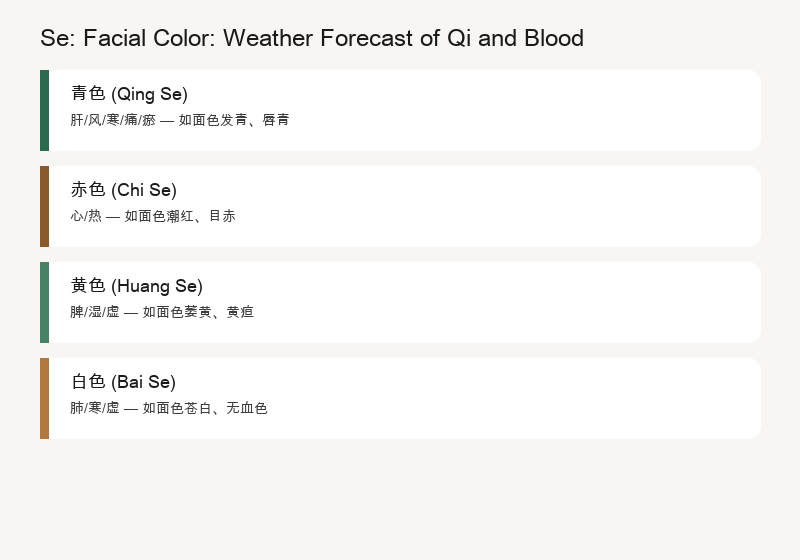
Green (Qing) — corresponds to liver, wind, cold, pain, and stagnation. A greenish complexion is mostly related to the liver: liver Qi stagnation, cold congelation, intense pain, and blood stasis. The liver governs smooth flow; when liver Qi is stagnant, Qi and blood circulation is obstructed, and the complexion turns greenish. Cold evil invades, blood vessels constrict, blood flow is impeded, and the complexion also turns greenish. During severe pain, the sympathetic nervous system is excited, facial blood vessels constrict, and the complexion instantly turns pale and greenish. With blood stasis, microcirculation is impaired, reduced hemoglobin in the blood increases, and the complexion turns dark and greenish.
Red (Chi) — corresponds to heart and heat. A flushed complexion is mostly related to the heart: heart heat, hyperactive heart fire, and external heat evil. The heart governs blood and vessels; when the heart is hot, blood heat surges to the face, and the complexion turns red. But red is divided into excess and deficiency: excess heat presents with red face and eyes, high fever and irritability; deficiency heat presents with malar flush and afternoon fever (Yin deficiency with fire). During intense exercise or emotional excitement, the heartbeat accelerates, blood vessels dilate, and the complexion also turns red — this is a normal physiological reaction, not a pathological state.
Yellow (Huang) — corresponds to spleen, dampness, and deficiency. A yellowish complexion is mostly related to the spleen: spleen deficiency, dampness obstruction, and Qi-blood deficiency. The spleen governs transformation and transportation; spleen deficiency leads to insufficient Qi-blood production, and the complexion becomes withered yellow and lusterless. Dampness trapped in the spleen causes a yellow, greasy complexion (like jaundice). People with long-term malnutrition and weak spleen-stomach often have a withered yellow complexion. But yellow is divided into "Yang yellow" and "Yin yellow": Yang yellow (damp-heat) is bright like an orange; Yin yellow (cold-damp) is dark like smoke.
White (Bai) — corresponds to lungs, cold, deficiency, and collapse. A pale complexion is mostly related to the lungs: lung Qi deficiency, cold evil, Qi-blood deficiency, and Yang Qi about to collapse. The lungs govern Qi; lung Qi deficiency produces a pale, lusterless complexion. Cold evil invasion causes blood vessel constriction and reduced blood flow, leading to pallor. During massive bleeding or shock, blood pressure drops, facial blood flow plummets, and the complexion turns pale as paper — Chinese medicine calls this "color collapse," a critical sign of Yang Qi about to desert.
Black (Hei) — corresponds to kidneys, cold, pain, stagnation, and water. A dark complexion is mostly related to the kidneys: kidney deficiency, cold congelation, blood stasis, and water retention. The kidneys govern water; kidney deficiency leads to abnormal water metabolism, and the complexion turns dark yellow (dark with yellow tinge). Kidney Yang deficiency causes internal cold generation, and the complexion becomes pale white (white with black, like dust). People with chronic diseases and declining kidney Yang often show a dark, yellowish complexion and dark circles under the eyes. Staying up late and kidney deficiency cause dark under-eye circles — also a manifestation of kidney deficiency.
So, what the ancients called "Five Colors for Five Diseases" is not a simple "color corresponds to organ" mapping — it's a complete diagnostic system based on Qi-blood circulation, organ function, and pathogenic nature. It judges the abundance or decline of Qi and blood, the excess or deficiency of organs, and the nature of pathogenic factors by observing the hue, brightness, moisture, and luster of the facial complexion.
But Chinese medicine has a core principle: color follows the splendor of Qi, where Qi arrives, color arrives. Facial complexion is the external manifestation of Qi and blood; Qi and blood are the internal foundation of complexion. Without Qi and blood, there is no complexion; with abundant Qi and blood, the complexion is naturally rosy; with deficient Qi and blood, the complexion inevitably becomes withered yellow or pale. Therefore, the essence of "observing color" is "observing Qi and blood" — using the window of facial complexion to see the internal Qi-blood state of the body.
Part 3giaogiao's Modern Translation
Alright, now let's translate "color" into modern language.
I'm not going to talk about skin physiology or blood rheology. Too complicated. You only need to remember one metaphor:
Green = Microcirculation disorder + reduced blood oxygenation (increased reduced hemoglobin) + blood vessel constriction (cold evil/pain/excessive sympathetic nerve excitation)
Red = Blood vessel dilation + increased blood oxygen saturation (exercise/emotional excitement) or elevated inflammatory factors (infection/fever)
Yellow = Abnormal bilirubin metabolism (jaundice) + carotenemia + reduced hemoglobin from malnutrition (withered yellow)
White = Anemia (reduced hemoglobin) + blood vessel constriction (cold/shock) + insufficient skin blood perfusion (low blood pressure/Qi deficiency)
Black = Abnormal melanin metabolism (adrenal insufficiency/Addison's disease) + chronic renal insufficiency (dark uremic complexion) + periocular venous congestion (dark circles/kidney deficiency)
Observing color = Skin tone analysis + Blood oxygen monitoring + Anemia assessment + Bilirubin index + Microcirculation observation
That's it. "Color" is essentially the optical characteristics of facial skin — visual signals determined by blood composition, blood flow state, skin pigment, and tissue thickness, reflecting the internal physiological and pathological state of the body.
Specifically:
What does "green" correspond to? It corresponds to microcirculation disorder and reduced blood oxygenation. When local blood vessels constrict (cold evil, pain, excessive sympathetic nerve excitation), blood flow decreases, tissue becomes hypoxic, and reduced hemoglobin in the blood increases, causing the skin to appear cyanotic (greenish-purple). In modern medicine, this is a typical manifestation of tissue hypoxia — such as Raynaud's syndrome, heart failure, and shock. It's not the mysticism of "liver wind"; it's an objective physiological indicator of microcirculation and blood oxygenation. Modern research: when reduced hemoglobin exceeds 50 g/L, cyanosis (greenish-purple skin) is visible to the naked eye.
What does "red" correspond to? It corresponds to blood vessel dilation and blood oxygen changes. When body temperature rises (infection, inflammation), emotions are excited, or during exercise, the sympathetic nervous system is activated, skin blood vessels dilate, blood flow increases, and the complexion turns red. In addition, inflammatory factors (such as prostaglandins and histamine) cause blood vessel dilation and facial redness (such as acne and rosacea). The "malar flush" of Yin deficiency with fire corresponds to facial blood vessel dilation caused by autonomic nervous system dysfunction (sympathetic-parasympathetic imbalance). It's not the mysticism of "hyperactive heart fire"; it's a measurable indicator of vascular response and inflammatory state.
What does "yellow" correspond to? It corresponds to abnormal bilirubin metabolism and malnutrition. When liver function is impaired (hepatitis, cirrhosis), bilirubin metabolism is obstructed, blood bilirubin levels rise, and it deposits in the skin and sclera, causing jaundice (yellow). The "withered yellow" caused by spleen deficiency corresponds to malnutrition anemia — reduced hemoglobin and smaller red blood cell volume, with a withered yellow and lusterless complexion. Excessive carotene intake can also cause yellow skin (carotenemia), but the sclera does not turn yellow, which is different from jaundice. It's not the mysticism of "spleen deficiency with dampness"; it's an objective indicator of bilirubin metabolism and blood composition. Modern research: when serum total bilirubin exceeds 34.2 μmol/L (2 mg/dL), jaundice is visible to the naked eye.
What does "white" correspond to? It corresponds to anemia and blood vessel constriction. When hemoglobin is reduced (iron deficiency anemia, blood loss), the blood color in the skin becomes lighter, and the complexion turns pale. During cold or shock, blood vessels constrict, skin blood perfusion decreases, and the complexion also turns pale. The pale complexion of "Yang Qi deficiency" described in Chinese medicine corresponds to insufficient tissue perfusion caused by low blood pressure and heart failure. The "color collapse" during massive bleeding corresponds to hemorrhagic shock — blood pressure plummets, and facial blood flow almost stops. It's not the mysticism of "lung Qi deficiency"; it's a measurable indicator of hemoglobin level and blood perfusion. Modern research: when hemoglobin is below 90 g/L, pallor is visible to the naked eye; below 60 g/L, pallor is obvious.
What does "black" correspond to? It corresponds to abnormal melanin metabolism and chronic renal insufficiency. Addison's disease (adrenal insufficiency) causes elevated melanocyte-stimulating hormone (MSH), leading to skin and mucous membrane melanin pigmentation, with a dark yellow complexion. Chronic renal insufficiency (uremia) causes deposition of metabolic products like urea in the skin, leading to a dark, sallow complexion. Dark under-eye circles (black eye circles) correspond to periocular venous congestion, blood vessel dilation, and pigmentation — related to sleep deprivation, kidney deficiency, and allergies. It's not the mysticism of "kidney Yang deficiency"; it's an objective indicator of endocrine and metabolic function. Modern research: ACTH levels are significantly elevated in patients with adrenal insufficiency, stimulating melanocytes and causing skin pigmentation.
So, "color" is not mysticism. It's simply a weather barometer of Qi and blood — the optical characteristics of facial skin are determined by blood composition, blood flow state, skin pigment, and tissue thickness, reflecting the internal physiological and pathological state of the body. The ancients used "green, red, yellow, white, and black" to describe it; modern people use "skin tone analysis, blood oxygen saturation, anemia level, bilirubin index, and melanin detection" — the core logic is the same: facial complexion is the "display screen" of the body's internal state.
Part 4Real-Life Cases
Four stories to make you instantly understand what "color" is.
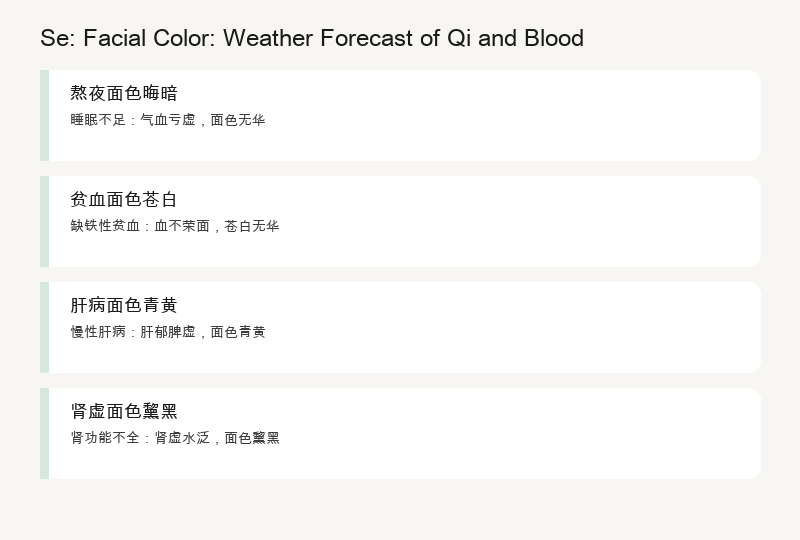
Case 1: Dark complexion after staying up late (Kidney deficiency / blood stasis — Endocrine disorder + microcirculation disorder).
You stay up until 2 a.m. for a whole week, sleeping less than six hours a day. On the seventh morning, you look in the mirror and find your complexion dark and sallow, with dark circles under your eyes, and rough, lusterless skin. You ask: "Why does staying up late make my complexion look bad?"
The truth: This is a typical "dark complexion from kidney deficiency" — endocrine disorder + microcirculation disorder. Staying up late disrupts the circadian rhythm, causing cortisol (stress hormone) rhythm disturbance, with elevated cortisol at night, inhibiting melatonin secretion and affecting sleep quality. At the same time, insufficient sleep leads to: reduced growth hormone secretion (skin repair is hindered), persistently elevated cortisol (breaks down collagen, accelerates skin aging), and microcirculation disorder (periocular venous congestion, melanin deposition). Manifested as dark, sallow complexion, dark under-eye circles, and rough skin. It's not the mysticism of "kidney deficiency"; it's endocrine and microcirculation disorder caused by circadian rhythm disruption. Modern research: people who sleep less than six hours a day for a week show a 30% decrease in skin barrier function, a 20% decrease in skin hydration, and a 40% increase in periocular melanin deposition.
Case 2: Pale complexion from anemia (Lung Qi deficiency / blood deficiency — Reduced hemoglobin).
You've been on a long-term diet, eating only vegetables and fruits every day, no red meat or staple food. Three months later, you find your complexion pale, your lips pale, and you tire easily and feel dizzy. You ask: "Why does eating less make my complexion pale?"
The truth: This is a typical "pale complexion from lung Qi deficiency / blood deficiency" — iron deficiency anemia. Iron is the core component of hemoglobin; iron deficiency leads to reduced hemoglobin synthesis, decreased oxygen-carrying capacity of red blood cells, and lighter skin and mucous membrane color (pallor). At the same time, anemia causes tissue hypoxia; the body compensates by increasing heart rate, but still cannot meet demand, manifested as fatigue, dizziness, and shortness of breath. It's not the mysticism of "lung Qi deficiency"; it's a measurable indicator of reduced hemoglobin. Modern research: hemoglobin below 110 g/L (women) or 120 g/L (men) is anemia; below 90 g/L, obvious pallor is visible to the naked eye. The prevalence of iron deficiency anemia in women is about 20%, mostly caused by unbalanced diet.
Case 3: Greenish-yellow complexion from liver disease (Liver stagnation / blood stasis — Elevated bilirubin + coagulation disorder).
You drink heavily, half a catty of white liquor every day. Recently, you noticed your complexion turning yellow and the whites of your eyes also yellowing. Your colleagues say your face looks greenish. You went to the hospital and found abnormal liver function, elevated transaminases, and elevated bilirubin. You ask: "Why does a bad liver make my complexion yellow and greenish?"
The truth: This is a typical "greenish-yellow complexion from liver disease" — bilirubin metabolism disorder + microcirculation disorder. Liver cells are damaged, bilirubin metabolism is obstructed, and both direct and indirect bilirubin in the blood rise, depositing in the skin and sclera, causing jaundice (yellow). At the same time, decreased liver function leads to reduced synthesis of clotting factors, coagulation dysfunction, and portal hypertension, causing facial microcirculation disorder, presenting a dark, greenish complexion ("liver disease facial appearance"). It's not the mysticism of "liver stagnation"; it's an objective indicator of liver function damage. Modern research: when serum bilirubin in hepatitis patients exceeds 34.2 μmol/L, jaundice is visible to the naked eye; cirrhosis patients often show a dark or sallow complexion due to melanin metabolism disorder.
Case 4: Dark complexion from kidney deficiency (Kidney Yang deficiency — Adrenal insufficiency / chronic kidney disease).
Your father is sixty, with long-term soreness and weakness in the waist and knees, cold intolerance in the limbs, and frequent nocturnal urination. Recently, you noticed his complexion turning dark and his eye sockets black. You ask: "Why does a bad kidney make the complexion dark?"
The truth: This is a typical "dark complexion from kidney deficiency" — adrenal insufficiency or chronic renal insufficiency. Kidney Yang corresponds to modern medicine's adrenal cortical function — reduced adrenal cortical hormone secretion, elevated melanocyte-stimulating hormone (MSH), stimulating melanin synthesis, and skin pigmentation (dark yellow). During chronic renal insufficiency, metabolic products like urea deposit in the skin, causing a dark, sallow complexion. Dark eye circles (black eye circles) are related to periocular venous congestion, blood vessel dilation, and sleep disturbance. It's not the mysticism of "kidney Yang deficiency"; it's an objective indicator of endocrine and metabolic function. Modern research: Addison's disease (adrenal insufficiency) patients show significantly elevated MSH and ACTH levels, causing generalized skin pigmentation, especially in exposed and friction areas.
Four cases, one underlying logic: color is the "weather barometer of Qi and blood" — changes in facial complexion are determined by blood composition, blood flow state, skin pigment, and tissue thickness, reflecting the internal physiological and pathological state of the body. It's not a "mysterious color change"; it's a measurable, observable physiological indicator.
Part 5Modern Research
Does "color" have scientific research?
Yes, and it's very thorough. Scientists don't use the term "Five Colors for Five Diseases"; they use "skin tone analysis," "blood oxygen saturation," "facial colorimetry," and "photoplethysmography (PPG)":
• Facial Colorimetry Analysis. Modern research uses high-precision colorimeters and digital cameras to quantitatively analyze the hue, brightness, and saturation of facial skin. Studies have found that healthy people's facial complexion falls within a specific range in the L*a*b* color space, while anemic, jaundiced, liver disease, and kidney disease patients show significant deviations. This is consistent with the core logic of Chinese medicine's "observing color" — facial complexion is an objective indicator of health state. It's not the mysticism of "color diagnosis"; it's a scientific method with precise measurement standards. Modern research: L*a*b* colorimetric analysis can distinguish normal complexion, anemic complexion (elevated L*, reduced a*), and jaundiced complexion (significantly elevated b*), with an accuracy rate exceeding 85%.
• Blood Oxygen Saturation and Complexion (SaO₂). Pulse oximetry calculates blood oxygen saturation by measuring the ratio of oxygenated hemoglobin to reduced hemoglobin in the blood. When blood oxygen saturation falls below 90%, cyanosis (greenish-purple) of the lips and nail beds is visible to the naked eye. This perfectly corresponds to Chinese medicine's "green corresponds to cold, pain, and stagnation." It's not the mysticism of "observing color to know disease"; it's a physiological indicator with precise measurement standards. Modern research: for every 1% decrease in blood oxygen saturation, the risk of tissue hypoxia increases by 10%; below 85%, tissue hypoxia is severe and requires immediate intervention.
• Photoplethysmography (PPG). PPG technology detects pulse waves and blood flow states by measuring changes in reflected light from the skin. Modern smartwatches and oximeters use PPG technology to non-invasively monitor heart rate, blood oxygen, and heart rate variability (HRV). Facial PPG technology can analyze facial microcirculation state and detect changes in microvascular blood flow. This is consistent with the logic of Chinese medicine's "observing color" to observe facial Qi-blood state. It's not the mysticism of "mysterious Qi and blood"; it's a microcirculation detection technology with precise measurement standards. Modern research: PPG signals can reflect microvascular function, arteriosclerosis degree, and autonomic nerve state, and are an important tool for assessing cardiovascular health.
• AI Complexion Diagnosis. Artificial intelligence and deep learning technology are used for facial complexion analysis. Researchers train convolutional neural network (CNN) models to identify anemia, jaundice, liver disease, and heart disease by analyzing facial photos. Model accuracy has reached 80-90%. This is realizing the top diagnostic ability of Chinese medicine's "to know by observing is divine" — using the eyes to see and judge disease — through AI technology. It's not the mysticism of "divine doctor"; it's the precise application of computer vision and machine learning. Modern research: AI models analyzing facial photos to diagnose anemia have an accuracy rate of 88%, and diagnosing jaundice has an accuracy rate of 92%, and are already being applied to telemedicine and screening.
• Dermoscopy. Dermoscopy is a non-invasive examination technique that can magnify and observe pigment, blood vessels, and structural changes on the skin surface. Chinese medicine's "observing color" observes subtle changes in facial luster, while dermoscopy uses optical magnification and digital imaging to achieve more precise observation. The core logic of both is consistent: observing the optical characteristics of the skin surface to infer internal states. Modern research: dermoscopy can detect early melanoma, vascular lesions, and inflammatory reactions, and is an important tool for skin disease diagnosis.
These studies fully demonstrate that "color" is a concept that can be precisely described in modern scientific language. The ancients used "green, red, yellow, white, and black" to describe it; modern people use "colorimetric analysis, blood oxygen saturation, PPG, and AI diagnosis" to describe it — the core logic is consistent: facial complexion is the "display screen" of the body's internal state, and by observing facial complexion, the internal physiological and pathological states can be inferred.
Part 6Practical Methods
Now that you understand "color," how do you apply it in daily life?
First, let's debunk a few myths:
• "Diagnosing by looking at the face is superstition; modern medicine doesn't rely on this". While modern medicine doesn't rely on facial complexion as the sole diagnostic basis, facial complexion is still an important part of physical examination — when a doctor first sees a patient, they observe whether the complexion is pale, yellowish, or cyanotic. Facial complexion is an important tool for rapid screening, not superstition, but a preliminary diagnostic method with scientific basis.
• "A bad complexion means you're sick and need to take medicine immediately". Facial complexion is affected by many factors: insufficient sleep, emotional fluctuations, dietary changes, ambient temperature, and cosmetics — all can temporarily change the complexion. Changes in complexion need to be judged comprehensively with other symptoms; it's not "yellow means treat the liver, white means supplement blood." It's observing trends, not judging by a single moment.
• "Only old Chinese medicine doctors can observe color; ordinary people can't learn it". Basic methods of observing color — observing whether the complexion is rosy, yellowish, greenish, or dark — can be completely learned by ordinary people. Observing your own complexion in the mirror after washing your face in the morning, under natural light, without makeup, is the simplest health self-check method. It's not "the exclusive patent of divine doctors"; it's a health observation skill that everyone can master.
Specific methods:
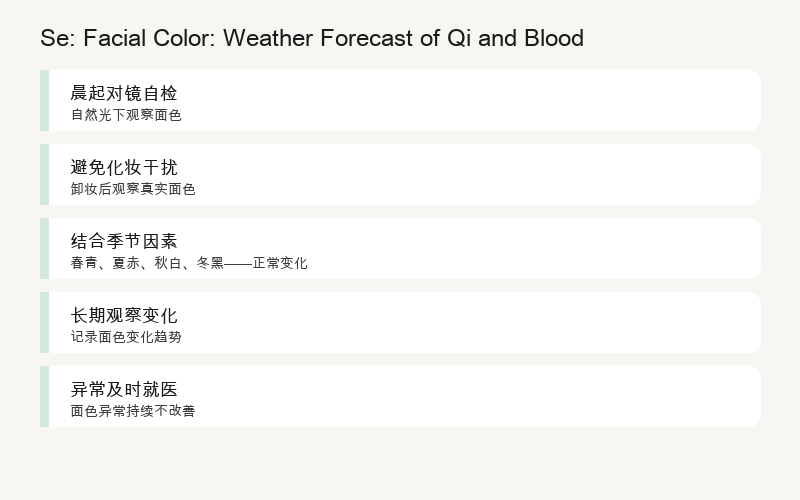
• Morning Mirror Self-Check. Every morning after washing your face, under natural light (not under yellow or white light), observe your own complexion. Note: don't wear makeup, don't apply foundation or concealer — cosmetics will mask the true complexion. Observation points: overall tone (rosy/withered yellow/pale/dark), eye area color (whether dark circles are present), lip color (rosy/pale/purple-dark), and whether there are localized spots or pigmentation. Keep recording; if you discover long-term changes in complexion, seek medical attention promptly. It's not "fortune-telling"; it's daily health monitoring.
• Avoid Cosmetic Interference. Cosmetics (foundation, concealer, blush) will change facial color and mask the true complexion. If you want to observe your complexion for health status, have at least one day a week completely without makeup, letting your facial skin "breathe" and observing the true complexion. It's not "not wearing makeup"; it's regularly giving your skin a "bare-faced physical exam".
• Factor in Seasonal Changes. Facial complexion changes with the seasons: summer blood vessels dilate, complexion tends to be reddish; winter blood vessels constrict, complexion tends to be pale; spring liver Qi rises, complexion tends to be greenish; late summer dampness is heavy, complexion tends to be yellowish. These are normal seasonal changes, not pathological states. But if the complexion is obviously abnormal after seasonal changes (such as yellowing that shouldn't occur in winter, or pallor that shouldn't occur in summer), it needs attention. It's not "color change means disease"; it's distinguishing between normal changes and abnormal changes.
• Long-Term Observation of Changes. Short-term changes in complexion (such as dullness after staying up late, rosiness after exercise) are normal physiological fluctuations. But long-term changes (such as persistent withered yellow, gradually darkening, or long-term pallor) often reflect chronic internal problems. I suggest you take a bare-faced facial photo every month and compare to observe the trend of complexion change. It's not "taking selfies"; it's objective recording of health archives.
• Seek Medical Attention Promptly for Abnormalities. If you observe the following complexion abnormalities, I suggest seeking medical examination promptly: sudden pallor (possible anemia, bleeding), sudden yellowing (possible liver and gallbladder disease, hemolysis), cyanotic or purplish complexion (possible cardiopulmonary function problems, hypoxia), persistent darkening (possible kidney disease, adrenal problems), and asymmetric facial spots (possible endocrine problems). It's not "scaring yourself"; it's early detection, early diagnosis, and early treatment.
• Don't Over-Interpret. Facial complexion is only one window of health, not the whole picture. A rosy complexion doesn't necessarily mean health (possible hypertension), and a pale complexion doesn't necessarily mean disease (possibly naturally fair skin). Facial complexion needs to be judged comprehensively with other symptoms, signs, and examinations. It's not "knowing at a glance"; it's one observation window, not the entire diagnosis.
These methods don't require you to become a Chinese medicine doctor. You only need to understand: color is the "weather barometer of Qi and blood" — facial complexion is the "display screen" of the body's internal state. What you need to do is spend 30 seconds every day, under natural light, observing your bare-faced complexion, recording long-term trends, and seeking medical attention promptly when abnormalities are found. At the same time, improve your lifestyle — regular sleep, balanced diet, moderate exercise, and emotional management — to fundamentally improve your Qi-blood state, and your complexion will naturally be rosy.
Part 6 (continued)Practical Methods: Five-Color Self-Check
Part 7One-Minute Summary
🕐 Understand "Color" in One Minute
Color = The weather barometer of Qi and blood = The body's internal state "display screen."
Chinese medicine's "color" is not simply "whether the face looks good or not"; it's about judging the abundance or decline of Qi-blood in the internal organs and the nature of pathogenic factors through changes in facial luster.
Green = Microcirculation disorder + reduced blood oxygenation (increased reduced hemoglobin) — corresponds to liver, wind, cold, pain, and stagnation.
Red = Blood vessel dilation + blood oxygen changes + elevated inflammatory factors — corresponds to heart and heat.
Yellow = Abnormal bilirubin metabolism + malnutrition — corresponds to spleen, dampness, and deficiency.
White = Anemia + blood vessel constriction + insufficient blood perfusion — corresponds to lungs, cold, deficiency, and collapse.
Black = Abnormal melanin metabolism + chronic renal insufficiency + periocular venous congestion — corresponds to kidneys, cold, pain, stagnation, and water.
Myths: Diagnosing by face is superstition; a bad complexion means you need medicine; only old doctors can observe color.
Methods: Morning bare-faced mirror self-check, avoid cosmetic interference, judge normal changes with seasonal factors, long-term photo recording for comparison, seek medical attention promptly for abnormalities.
The ancients called it "green, red, yellow, white, and black"; modern people call it "skin tone analysis, blood oxygen saturation, bilirubin index, anemia level, and melanin detection."
Different names, but medicine knows: facial complexion is the "display screen" of the body's internal state. When the display screen flashes a red light, something is wrong internally.
Observing color is not "fortune-telling"; it's your body reporting to you.
The ancients didn't have colorimeters, oximeters, or PPG tools, but they knew that "the five colors are the splendor of Qi."
This is probably the most down-to-earth wisdom of the Chinese: the body never lies, and facial complexion is the letter the body writes to you. A doctor's job is not to replace the body, but to learn to read this letter written in color.

Making money is the art of living; art is the life after making money
giaogiao Interpreting Chinese Traditional Wisdom · Concept 93
Using the language of modern science to help the world understand Chinese traditional wisdom.
No mystery, no superstition, no belittlement.
Understand, rather than merely believe.
Coach Liu
Written in Florence