Shēng (Sound): The Echo of Qi
Part 1A Question
Have you ever noticed that when you get sick, your voice changes without you realizing it? Hoarse when you have a cold, scratchy when you have a fever, faint when you're weak, high-pitched when you're angry? Have you noticed that the same sentence, spoken in different states, sounds completely different?
Even more surprising, traditional Chinese medicine says "one who knows by listening is a sage" — meaning, a top-tier doctor can diagnose what's wrong with your body just by listening to your voice. You might ask: is that even possible? Diagnosing by listening to sound? Is it a quack trick, or is there real scientific basis behind it? If sound truly reflects health, why does modern medicine rely mainly on blood tests and imaging rather than listening to your voice?
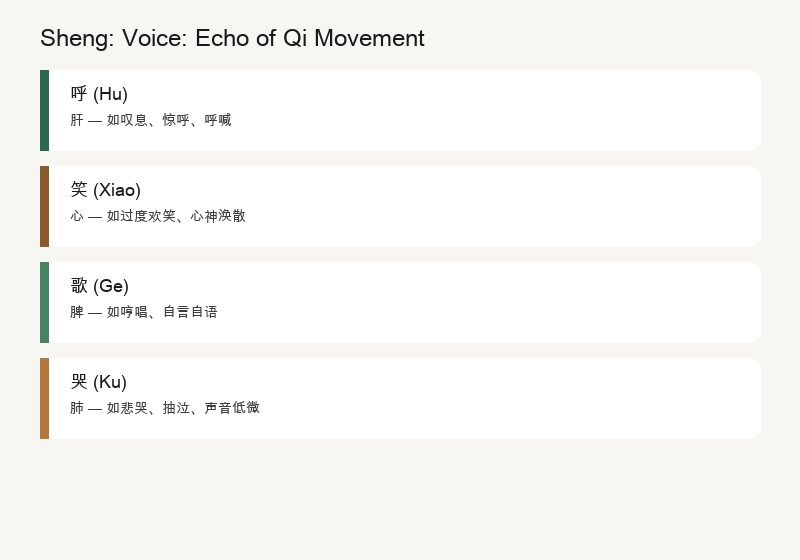
You ask: what exactly are the "Five Sounds" in traditional Chinese medicine? Shouting for the liver, laughing for the heart, singing for the spleen, weeping for the lungs, and groaning for the kidneys — is this forced correlation, or is there a complete logic behind it? Why do people with liver problems tend to sigh, those with heart issues have abnormal laughter, those with spleen weakness sing weakly, those with lung problems have faint crying sounds, and those with kidney deficiency tend to groan? Is there really a physiological link between these sound changes and the organs?
Another question: modern medicine has acoustic analysis, voice biomarkers, and AI voice diagnosis — what's their relationship with traditional Chinese medicine's "listening to sound"? Converging paths, or completely different systems? If the ancients had no spectrographs, no microphones, on what basis did they believe sound could reflect internal organ health?
What is Shēng, really? Is it a naive observation that "sound reflects health," or is it a physiological indicator that can be precisely measured by modern science?
Part 2Traditional Chinese Explanation
"Shēng" in traditional Chinese medicine is not just "sound" — it is a "diagnostic signal," with the core idea that "the pitch, strength, and clarity of sound reflect the state of organ Qi and blood."
— Yellow Emperor's Inner Canon, Suwen
"The five sounds are the voices of the five organs. The liver shouts, the heart laughs, the spleen sings, the lungs weep, the kidneys groan."
— Yellow Emperor's Inner Canon, Suwen
"Speech is the voice of the heart; sound is the movement of Qi. When Qi is abundant, sound is loud; when Qi is deficient, sound is timid."
— Golden Mirror of Medicine
The ancients observed that sound is the outward manifestation of Qi — when Qi is abundant, the voice is loud and strong; when Qi is deficient, the voice is faint and weak; when Qi is rebellious, the voice is high-pitched or hoarse. Changes in sound reflect the internal state of Qi in the body.
The "Five Sounds" theory of traditional Chinese medicine:
Shouting (liver sound). The liver governs free flow and discharge. When liver Qi stagnates, people tend to sigh or shout to release the constrained Qi. When liver Qi is excessive or liver wind stirs internally, breathing becomes rapid with "huffing" sounds. During great anger, liver Qi rises rebelliously, and the voice becomes high-pitched and sharp like shouting. Clinically, liver patients often show sighing (frequent deep sighs) — a way to release liver stagnation. This is not "the liver can talk" mysticism; it is the liver Qi state affecting breathing patterns and vocal characteristics.
Laughter (heart sound). The heart governs the spirit and mind. When the heart spirit is joyful, one laughs; when the heart spirit is abnormal, one may laugh uncontrollably or cry uncontrollably. When heart fire is hyperactive, the spirit becomes restless, manifesting as uncontrollable laughter (manic laughter). When heart Qi is weak, the spirit is listless, and laughter is faint and weak. The heart governs blood vessels; when heart blood is abundant, the complexion is rosy and the voice is clear and bright; when heart blood is insufficient, the voice is timid. But "laughter" also has normal and pathological forms: normal laughter is emotional expression, while pathological laughter is loss of heart spirit control — such as "laughing uncontrollably" (manic laughter), which is mostly due to heart fire disturbing the spirit, and "forced laughter" (laughing with difficulty), which is mostly due to heart Qi deficiency.
Singing (spleen sound). The spleen governs transformation and transportation. When spleen Qi is abundant, the voice is round and strong, and one likes to sing or speaks with a loud voice. When spleen Qi is weak, the voice is faint, speech is weak, and one is "lazy to talk." The spleen is the source of Qi and blood production; when the spleen is weak, Qi and blood are insufficient, and the vocal cords cannot get enough nourishment, resulting in a timid voice. "Singing" here is not just "singing" — it refers to the round, smooth quality of the voice, reflecting abundant spleen Qi and plentiful Qi and blood. A person with spleen weakness speaks weakly, like a "mosquito buzzing," and is not willing to talk much.
Weeping (lung sound). The lungs govern Qi and control breathing; sound is produced by lung Qi and the vocal cords together. When lung Qi is abundant, the voice is loud and strong; when lung Qi is weak, the voice is faint, and even the "crying" sound is weak (here "crying" does not mean weeping, but refers to the weak, mournful quality of the voice). When external wind-cold attacks and lung Qi cannot disperse, the voice becomes hoarse. When lung heat is congested, the voice is loud but rough. People with weak lung Qi speak with a low, weak voice, with breath that doesn't connect, and sometimes have to split a sentence into several breaths. The lungs govern sorrow; excessive sorrow leads to "weeping" — this is the interaction between emotion and lung Qi.
Groaning (kidney sound). The kidneys govern storage of essence and are the foundation of congenital constitution. When the kidneys are deficient, essence is insufficient, and the body has various discomforts — sore waist, weak knees, bone pain — unconsciously emitting "groaning" sounds. Groaning is the body's self-protective response to pain, and also a manifestation of kidney Qi deficiency and essence depletion. People who are chronically ill and weak, or elderly with kidney deficiency, often unconsciously groan in a low voice, or emit "ouch" sounds when turning over or getting up. This is a manifestation of kidney essence deficiency and loss of nourishment to bones and muscles. Not "the kidneys can groan" mysticism; it is kidney deficiency leading to bodily pain and discomfort, which in turn produces groaning.
So, the "Five Sounds" the ancients spoke of were not a simple "sound corresponds to organ" mapping — it is a complete diagnostic system based on the movement of Qi, organ function, and the state of Qi and blood. It judges the abundance or decline of Qi and the deficiency or excess of organs by observing the pitch, strength, clarity, and continuity of sound.
Besides the "Five Sounds," traditional Chinese medicine also judges illness from "speech":
Excessive talking — heat pattern, excess pattern. Yang Qi is hyperactive, the heart spirit is excited, talking is abundant, speech is fast, and the voice is loud. Like manic patients, whose words flow endlessly.
Little talking — cold pattern, deficiency pattern. Yang Qi is insufficient, the heart spirit is suppressed, too lazy to talk, voice is faint. Like Qi deficiency or Yang deficiency patients, who are "silent and reserved."
Delirious speech — heat entering the pericardium, unclear consciousness. During high fever, talking nonsense, incoherent speech, high-pitched voice. This is the manifestation of heat toxin disturbing the heart spirit, belonging to critical and severe illness.
Zheng sound (repetitive speech) — heart Qi deficiency, declining spirit. The voice is faint, repeating the same sentence ("speaking with gravity"), like "last words" before death. This is a critical sign of heart Qi about to desert and loss of spirit control.
But traditional Chinese medicine has a core principle: speech is the voice of the heart, sound is the movement of Qi. Sound is the outward manifestation of Qi, and Qi is the driving force of sound. Without Qi, there is no sound; when Qi is abundant, sound is loud; when Qi is deficient, sound is timid; when Qi is smooth, sound is clear; when Qi is rebellious, sound is hoarse. Therefore, the essence of "listening to sound" is "listening to Qi" — through this audio signal of sound, one listens to the internal state of Qi movement in the body.
Part 3giaogiao Modern Translation
Okay, now let's translate "Shēng" into modern language.
I'm not going to talk about acoustic physics or phonetics. Too complicated. You only need to remember one analogy:
Pitch of sound = vocal fold vibration frequency (fundamental frequency F0) — higher frequency means sharper voice; lower frequency means deeper voice
Strength of sound = lung capacity and airflow speed (subglottal pressure) — greater airflow means louder voice; less airflow means weaker voice
Clarity of sound = vocal fold closure quality and resonator state (oral cavity, nasal cavity, pharynx) — good resonance means clear and bright voice; poor resonance means muddy voice
Continuity of sound = breathing rhythm and muscle endurance (breath support) — stable breathing means continuous voice; weak breathing means discontinuous voice
Listening to sound = voice acoustic analysis + vocal fold vibration frequency measurement + breath sound analysis + voice biomarker detection
That simple. "Shēng," essentially, is airflow passing through the vocal folds producing vibration, amplified by the resonator to form an acoustic signal — its frequency, amplitude, waveform, and rhythm are determined by the respiratory system, vocal fold structure, resonator state, and nervous system, reflecting the body's internal physiological and pathological states.
Specifically:
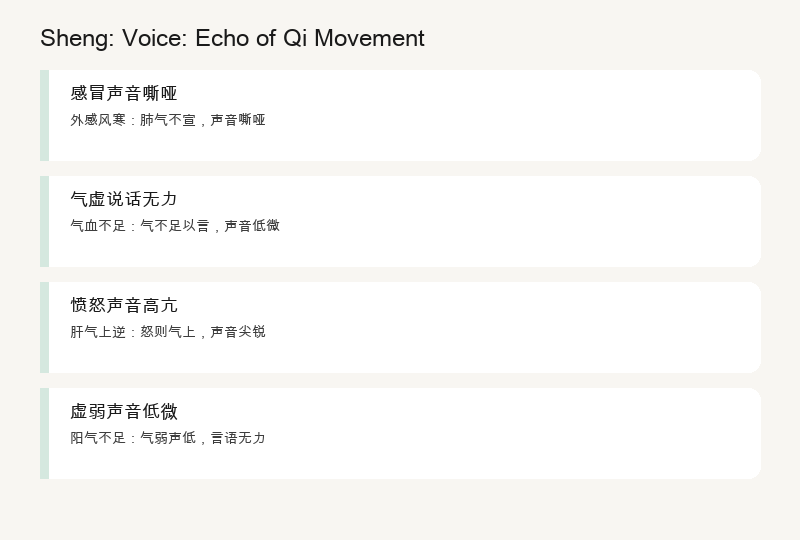
What does "high-pitched voice" correspond to? It corresponds to excessive sympathetic nervous excitement and elevated vocal fold vibration frequency. When emotionally excited (anger, fear, anxiety), having a fever, or hyperthyroidism, the sympathetic nervous system is excited, heart rate increases, breathing becomes rapid, muscles tense, vocal fold tension increases, and vibration frequency rises (fundamental frequency F0 increases), making the voice higher and sharper. Traditional Chinese medicine considers "high voice" as belonging to heat and excess, corresponding to a state of excessive sympathetic nervous excitement. Not "rebellious Qi" mysticism; it is a measurable indicator of nervous system excitation state. Modern research: during emotional excitement, F0 can rise 50–100 Hz; hyperthyroid patients' F0 is 15–30% higher than normal.
What does "faint voice" correspond to? It corresponds to parasympathetic dominance, decreased vocal fold vibration frequency, and reduced lung capacity. When the body is weak, Qi deficient, Yang deficient, or fatigued, the sympathetic nervous system is inhibited, parasympathetic dominance prevails, breathing becomes shallow and slow, airflow weakens, vocal fold tension decreases, and vibration frequency drops (F0 decreases), making the voice faint and weak. Traditional Chinese medicine considers "low voice" as belonging to cold and deficiency, corresponding to parasympathetic dominance and insufficient energy. Not "Qi deficiency" mysticism; it is a measurable indicator of autonomic nervous state and energy level. Modern research: chronic fatigue syndrome patients' F0 is 20–40 Hz lower than normal, and lung capacity is reduced by 15–30%.
What does "hoarse voice" correspond to? It corresponds to vocal fold inflammation, edema, or incomplete closure. When catching a cold, having laryngitis, or overusing the voice, the vocal fold mucosa becomes congested and edematous, vibration becomes irregular, and the voice becomes hoarse. Nerve damage (such as recurrent laryngeal nerve damage) causes vocal fold paralysis and incomplete closure, resulting in a hoarse and weak voice. Traditional Chinese medicine considers "hoarse voice" as "metal solid not ringing" (external pathogen closing the lungs) or "metal broken not ringing" (lung Qi deficiency and damage), corresponding to organic or functional vocal fold lesions. Not "lung Qi not dispersing" mysticism; it is an objective indicator of vocal fold structure and function. Modern research: vocal fold nodules, polyps, and inflammation can be directly observed via laryngoscopy, and acoustic analysis can quantitatively assess hoarseness (such as perturbation, hoarseness index).
What does "discontinuous voice" correspond to? It corresponds to insufficient breath support and decreased muscle endurance. When lung capacity is reduced (emphysema, pulmonary fibrosis), respiratory muscles are weak (myasthenia gravis, neuromuscular diseases), or heart failure occurs, breath support is insufficient, frequent breathing is needed while speaking, and the voice is discontinuous. Traditional Chinese medicine considers "broken voice" as "Qi deficiency" or "lung and kidney deficiency," corresponding to an objective decline in respiratory and muscle function. Not "Qi not connecting" mysticism; it is a measurable indicator of respiratory function and muscle endurance. Modern research: peak expiratory flow (PEF) and forced vital capacity (FVC) are positively correlated with speaking duration; heart failure patients' speaking duration is 40% shorter than normal.
What do "excessive talking" and "little talking" correspond to? They correspond to the excitability of the nervous system and energy level. "Excessive talking" corresponds to increased levels of excitatory neurotransmitters like dopamine and norepinephrine — such as in manic states, hyperthyroidism, and high fever. "Little talking" corresponds to inhibitory neurotransmitters like serotonin and GABA being dominant, or insufficient energy metabolism — such as in depression, hypothyroidism, and chronic fatigue. Traditional Chinese medicine considers "excessive talking" as heat and excess, and "little talking" as cold and deficiency, corresponding to the objective state of neurotransmitters and energy metabolism. Not "heart spirit" mysticism; it is a measurable indicator of neurotransmitters and energy metabolism. Modern research: manic patients' dopamine levels are 30–50% higher than normal; depression patients' serotonin levels are reduced by 20–40%.
So, "Shēng" is not mysticism. It is simply the echo of Qi — sound is the vibration signal produced by airflow passing through the vocal folds, and its frequency, amplitude, waveform, and rhythm are determined by the respiratory system, vocal fold structure, resonator state, and nervous system, reflecting the body's internal physiological and pathological states. The ancients described it with "shouting, laughing, singing, weeping, and groaning," while modern people describe it with "fundamental frequency F0, amplitude, perturbation, formants, and voice biomarkers" — the core logic is the same: sound is the "audio signal" of the body's internal state.
Part 4Real-Life Cases
Four stories to help you instantly understand what "Shēng" is.
Case One: Hoarse voice from a cold (metal solid not ringing — vocal fold inflammation and edema).
You catch a cold, your throat hurts, and your voice becomes hoarse, like a duck's quack. You ask: "Why does a cold make my voice hoarse?"
The truth: this is a typical "metal solid not ringing" — vocal fold inflammation and edema. The cold virus infects the upper respiratory tract, the laryngeal mucosa becomes congested and edematous, and the vocal folds also swell, making vibration irregular and the voice hoarse. At the same time, nasal congestion blocks nasal resonance, and the voice loses nasal resonance, becoming even more dull. Not "lung Qi not dispersing" mysticism; it is objective physiological changes of vocal fold inflammation and resonator obstruction. Modern research: acute laryngitis patients' vocal fold mucosa thickness increases by 50–100%, glottal closure is incomplete, air leakage increases, and acoustic perturbation index rises 2–3 times. Cold-induced hoarseness usually recovers within 7–10 days; if it persists beyond two weeks, other causes need to be investigated (such as vocal fold polyps, reflux laryngitis).
Case Two: Weak speech from Qi deficiency (spleen and lung Qi deficiency — respiratory muscle weakness + low vocal fold tension).
You've been under a lot of work pressure lately, not getting enough sleep, and you feel like you "don't even have the strength to talk." During meetings, your voice is faint, and you have to exert effort to raise your volume; you get tired after speaking for a while. You ask: "Why does being tired make my voice smaller?"
The truth: this is a typical "Qi deficiency with low voice" — respiratory muscle weakness + low vocal fold tension. Fatigue and sleep deprivation lead to: decreased energy metabolism (reduced ATP synthesis), reduced respiratory muscle (diaphragm, intercostal muscles) endurance, and decreased vocal fold muscle tension. At the same time, parasympathetic dominance and sympathetic inhibition make breathing shallow and slow, and airflow weak. This manifests as a faint voice, effortful speech, and easy fatigue. Not "Qi deficiency" mysticism; it is an objective decline in energy metabolism and muscle function. Modern research: after 48 hours of continuous sleep deprivation, lung capacity drops by 10–15%, vocal fold F0 decreases by 15–25 Hz, and speaking duration shortens by 30%. After resuming sleep, these indicators return to normal within 24–48 hours.
Case Three: High-pitched voice from anger (liver Qi rising rebelliously — excessive sympathetic nervous excitement).
You get into an argument with a colleague, and in your anger, your voice rises an octave without you realizing it, your speech speeds up, and your tone becomes sharp. Afterwards, you yourself feel "that voice didn't sound like me." You ask: "Why does anger change my voice?"
The truth: this is a typical "liver Qi rising rebelliously, high voice" — excessive sympathetic nervous excitement. Anger activates the sympathetic nervous system, releasing adrenaline and norepinephrine, causing: increased heart rate (100–180 beats per minute), rapid breathing (ventilation increases 2–3 times), muscle tension (including vocal fold muscles), increased vocal fold tension, and elevated F0. At the same time, facial and neck muscle tension changes the resonator, and the voice becomes sharp and harsh. Not "rebellious Qi" mysticism; it is a measurable indicator of sympathetic nervous excitement state. Modern research: in an angry state, F0 rises by an average of 80–120 Hz, speech rate increases by 30–50%, and amplitude increases by 20–40%. These acoustic features have been used to develop "emotion recognition AI" — judging a person's emotional state through voice.
Case Four: Faint voice from weakness (heart and kidney deficiency — parasympathetic dominance + insufficient energy).
Your grandfather is eighty years old and has always been weak. When you visit him, you find that his voice is faint, and you have to lean in to hear him; he pants after a few words, and often unconsciously sighs or groans. You ask: "Why do old people's voices get smaller?"
The truth: this is a typical "kidney deficiency with faint voice, heart Qi deficiency with low voice" — parasympathetic dominance + insufficient energy metabolism. In the elderly: lung capacity declines (30–50% lower than when young), respiratory muscle strength weakens, vocal fold muscles atrophy (reduced elasticity), and nervous system response slows. At the same time, basal metabolic rate decreases, ATP synthesis is reduced, and overall energy is insufficient. This manifests as a faint, discontinuous voice, needing frequent breaths, and unconscious sighing (compensating for shallow breathing through deep breaths). Not "kidney deficiency" mysticism; it is an objective decline in physiological function due to aging. Modern research: the average F0 of people over 80 is 40–60 Hz lower than that of 30-year-olds (more pronounced in males), lung capacity is reduced by 40–60%, and peak expiratory flow is reduced by 50%. Sighing is a compensatory mechanism of the respiratory system — increasing alveolar ventilation through deep sighs to compensate for the inefficiency of shallow breathing.
Four cases, one underlying logic: Shēng is "the echo of Qi" — sound is produced by airflow, vocal folds, resonators, and the nervous system together, and its characteristic changes reflect the body's internal physiological and pathological states. Not "mysterious voice changes," but measurable, analyzable physiological indicators.
Part 5Modern Research
Does "Shēng" have scientific research?
Yes, and it is very substantial. Scientists don't use the term "Five Sounds"; they use "voice acoustic analysis," "vocal fold vibration frequency," "breath sound analysis," and "voice biomarkers":
• Voice Acoustics Analysis. Modern research uses professional acoustic analysis software to quantitatively measure various parameters of sound: fundamental frequency (F0, pitch), amplitude (loudness), perturbation (Jitter, frequency stability), shimmer (amplitude stability), and noise ratio (NHR, glottal noise). These parameters can objectively assess voice quality and diagnose vocal fold lesions, nervous system diseases, and emotional states. This is consistent with the core logic of traditional Chinese medicine's "listening to sound" — sound is an objective indicator of health state. Not "diagnosing illness by listening" mysticism; it is a scientific method with precise measurement standards. Modern research: acoustic analysis achieves 85% accuracy in diagnosing vocal fold polyps, 90% accuracy in diagnosing Parkinson's disease, and 80% accuracy in assessing depressive mood.
• Vocal Fold Vibration Frequency (Fundamental Frequency, F0). Fundamental frequency F0 is the basic frequency of vocal fold vibration, determining pitch. Under different physiological states, F0 has characteristic changes: F0 rises during emotional excitement, F0 decreases during fatigue, F0 rises in hyperthyroidism, and F0 becomes unstable during laryngitis (increased perturbation). Traditional Chinese medicine's "high voice" corresponds to elevated F0, and "low voice" corresponds to decreased F0 — not mysticism, but a physiological indicator with precise measurement standards. Modern research: normal adult male F0 is about 85–180 Hz, female about 165–255 Hz; during anger, F0 rises by 50–100 Hz, and during fatigue, F0 decreases by 20–40 Hz.
• Breath Sound Analysis (Respiratory Sound Analysis). Modern research uses electronic stethoscopes and digital signal processing to analyze the characteristics of breath sounds: frequency, intensity, rhythm, and adventitious sounds (rales, wheezing, snoring). Through machine learning algorithms, it can identify pneumonia, asthma, chronic obstructive pulmonary disease (COPD), and pulmonary fibrosis. This is consistent with the logic of traditional Chinese medicine's "listening to breathing" (listening to breath sounds). Not "auscultation" mysticism; it is a diagnostic technology with precise measurement standards. Modern research: AI analysis of breath sounds achieves 87% accuracy in diagnosing pneumonia and 92% accuracy in diagnosing asthma, and is already being applied in telemedicine and primary screening.
• Voice Biomarkers. Voice biomarkers are objective indicators in voice characteristics that correlate with specific diseases or health states. Researchers have found that Parkinson's disease patients have specific acoustic features (monotone, hoarse, reduced volume); Alzheimer's disease patients have specific linguistic features (reduced vocabulary, slower speech rate, increased pauses); and depression patients have specific emotional features (reduced F0, slower speech rate, decreased energy). This is consistent with traditional Chinese medicine's top diagnostic ability of "knowing illness by listening" — using the ears to judge disease — and is being realized with AI technology. Not "miracle doctor" mysticism; it is the precise application of bioinformatics and machine learning. Modern research: voice biomarkers achieve 89% accuracy in detecting Parkinson's disease, 85% in detecting Alzheimer's disease, and 81% in detecting depression.
• AI Voice Diagnosis. Artificial intelligence and deep learning are used for voice analysis. Researchers train neural network models to diagnose diseases, assess emotions, and monitor health states by analyzing voice features. For example, IBM's Watson can analyze voice features to predict heart attack risk; Israel's Beyond Verbal can analyze emotional states; Chinese tech companies are developing voice-based traditional Chinese medicine "intelligent auscultation" systems. This is consistent with traditional Chinese medicine's top diagnostic ability of "one who knows by listening is a sage" — using sound to judge health — and is being realized with technology. Not "miracle doctor" mysticism; it is the precise application of artificial intelligence and signal processing. Modern research: AI voice diagnosis systems have already demonstrated high accuracy in clinical trials and are expected to be widely applied in telemedicine and health management within the next 5–10 years.
These studies fully demonstrate that "Shēng" is a concept that can be precisely described in modern scientific language. The ancients described it with "shouting, laughing, singing, weeping, and groaning," while modern people describe it with "fundamental frequency F0, amplitude, perturbation, formants, and voice biomarkers" — the core logic is the same: sound is the "audio signal" of the body's internal state, and by analyzing sound, one can infer the body's internal physiological and pathological states.
Part 6Practical Methods
Now that you understand "Shēng," how do you apply it in daily life?
First, dispel a few misconceptions:
• "Diagnosing by listening to sound is superstition; modern medicine doesn't rely on this." Modern medicine may not rely on sound as the sole diagnostic basis, but sound is still an important part of physical examination — doctors listen with a stethoscope (heart sounds, breath sounds, bowel sounds), ENT specialists examine (laryngoscopy to check vocal folds), and voice assessment (nervous system examination). Sound is an important tool for rapid screening, not superstition, but a preliminary diagnostic method with scientific basis.
• "If my voice changes, I must be sick and need to take medicine immediately." Voice is affected by many factors: emotional excitement, fatigue, sleep deprivation, environmental temperature, and overusing the voice — all can temporarily change the voice. Voice changes need to be judged comprehensively with other symptoms; it's not "treat the throat when hoarse, supplement Qi when low." It is observing trends, not listening to a single moment.
• "Listening to sound can only be done by old Chinese doctors; ordinary people can't learn it." Basic methods of listening to sound — paying attention to the pitch, strength, clarity, and fatigue of your own voice — are completely learnable by ordinary people. When you speak every day, being aware of your own voice state is the simplest form of health self-check. Not a "miracle doctor's patent," but a health observation skill that everyone can master.
Specific methods:
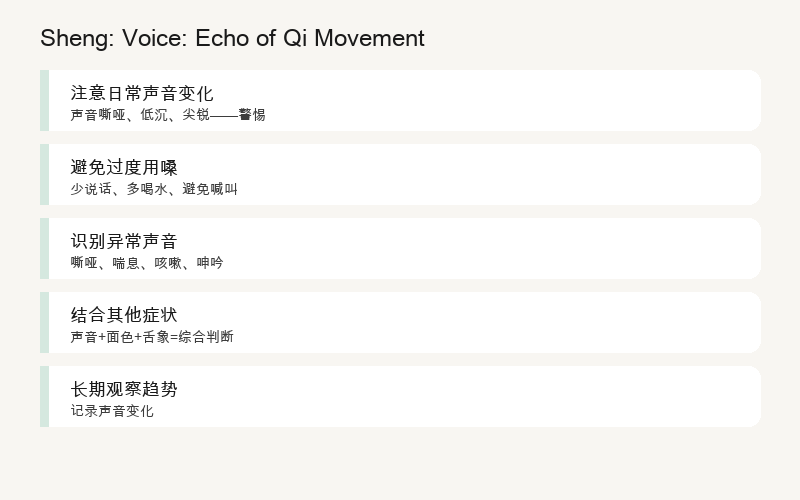
• Pay attention to daily voice changes. When you speak every day, pay attention to your own voice state: is it clear? Is it strong? Do you need to exert effort to raise your volume? Do you get tired after speaking for a while? Record the trend of voice changes: if your voice is continuously hoarse for a period (possible laryngitis, reflux, vocal fold lesion), or if your voice is continuously faint for a period (possible fatigue, Qi deficiency, thyroid problem). If you discover long-term voice abnormalities, seek medical attention promptly. Not "fortune-telling by listening to sound," but daily health monitoring.
• Avoid overusing your voice. The vocal folds are precise vibration organs; overusing your voice (shouting, talking for long periods, throat-clearing) can cause vocal fold damage, nodules, and polyps. If you need to talk for long periods (teachers, salespeople, customer service), pay attention: take a 10-minute break every hour to let your vocal folds recover; drink plenty of water to keep your vocal folds moist; avoid talking loudly in noisy environments (this is called the Lombard effect — noisy environments unconsciously make you raise your volume); minimize talking when you have a cold to let your vocal folds rest. Not "forbidden speech," but scientific protection of the vocal folds.
• Recognize abnormal sounds. The following voice abnormalities require vigilance: voice continuously hoarse for more than two weeks (investigate vocal fold polyps, laryngeal cancer, reflux laryngitis); sudden voice change (investigate nervous system diseases, thyroid problems); voice getting smaller and smaller (investigate Parkinson's disease, myasthenia gravis, decreased lung function); abnormal breath sounds (wheezing — asthma, moist rales — pneumonia, snoring — sleep apnea). Not "paranoia," but early detection and early diagnosis.
• Combine with other symptoms. Voice changes are only one window into health, not the whole picture. Hoarse voice + difficulty swallowing (possible esophageal cancer), hoarse voice + neck lump (possible thyroid cancer), faint voice + fatigue + weight gain (possible hypothyroidism), high-pitched voice + palpitations + weight loss (possible hyperthyroidism). Voice needs to be judged comprehensively with other symptoms, signs, and examinations. Not "knowing by listening alone," but one observation window, not the whole diagnosis.
• Observe long-term trends. Short-term voice changes (such as high-pitched voice after emotional excitement, faint voice after fatigue) are normal physiological fluctuations. But long-term changes (such as persistent hoarseness, gradually decreasing volume, long-term weakness in speaking) often reflect chronic internal problems. I recommend regularly recording a segment of yourself reading aloud and comparing voice change trends over time. Not "recording obsession," but objective records for a health档案.
• Use technology to assist monitoring. There are now some apps that can analyze your voice characteristics: fundamental frequency F0, amplitude, stability, and noise ratio. Although these apps cannot replace a doctor's diagnosis, they can help you understand your own voice baseline and detect abnormal changes. For example, if an app continuously detects your F0 decreasing and perturbation increasing over a week, it may indicate vocal fold fatigue or inflammation, and you should seek medical attention. Not "relying on apps," but technology-assisted health monitoring.
These methods don't require you to become a Chinese medicine doctor. You only need to understand: Shēng is "the echo of Qi" — sound is the "audio signal" of the body's internal state. What you need to do is, when you speak every day, be aware of your own voice state, pay attention to long-term change trends, and seek medical attention promptly if you discover abnormalities. At the same time, improve your lifestyle — regular sleep, balanced diet, moderate exercise, and emotional management — to fundamentally improve your Qi and blood state, and your voice will naturally be loud and strong.
Part 6 (continued)Practical Methods: Voice Self-Check
Part 7One-Minute Summary
🕐 Understand "Shēng" in One Minute
Shēng = the echo of Qi = the body's "audio signal" of internal state.
What traditional Chinese medicine calls "Shēng" is not simply "whether the voice sounds good or not," but judging the state of organ Qi and blood and the nature of pathogenic factors through the pitch, strength, clarity, and continuity of sound.
Shouting (liver) = liver Qi stagnation / liver wind stirring internally — corresponds to changed breathing patterns and vocal characteristics during emotional fluctuations.
Laughter (heart) = heart spirit state — corresponds to the acoustic characteristics of nervous system excitability and emotional expression.
Singing (spleen) = abundant spleen Qi / plentiful Qi and blood — corresponds to vocal fold muscle strength, voice roundness, and endurance.
Weeping (lungs) = abundance or decline of lung Qi — corresponds to lung capacity, airflow speed, voice loudness, and clarity.
Groaning (kidneys) = kidney essence deficiency / bodily pain — corresponds to the groaning response of chronic illness, aging, and loss of nourishment to bones and muscles.
Speech: excessive talking = heat / excess (excessive sympathetic nervous excitement); little talking = cold / deficiency (parasympathetic dominance); delirious speech = heat entering the pericardium (high fever with unclear consciousness); Zheng sound = heart Qi deficiency (heart Qi about to desert).
Misconceptions: diagnosing by listening to sound is superstition; voice changes require immediate medication; only old Chinese doctors can listen to sound.
Methods: pay attention to daily voice changes, avoid overusing your voice, recognize abnormal sounds (persistent hoarseness, decreasing volume, abnormal breath sounds), judge comprehensively with other symptoms, regularly record and compare trends, and use technology to assist monitoring.
The ancients called it "shouting, laughing, singing, weeping, and groaning"; modern people call it "fundamental frequency F0, amplitude, perturbation, formants, and voice biomarkers."
Different names, but medicine knows: sound is the echo of Qi, the body's "audio signal" of internal state.
Listening to sound is not "fortune-telling"; it is the body speaking in its own frequency.
The ancients had no spectrographs, microphones, or AI, but they knew "speech is the voice of the heart, and sound is the movement of Qi."
This is probably the most down-to-earth wisdom of the Chinese people: the body never lies, and sound is the song the body sings to you. The doctor's task is not to replace the body, but to learn to listen to this song written with Qi.

Making money is the art of living; art is the life after making money
giaogiao Interprets Traditional Chinese Wisdom · Concept 94
Using modern scientific language to help the world understand traditional Chinese wisdom.
No mysticism, no superstition, no belittlement.
Understanding, not just believing.
Coach Liu
Written in Florence