Wei (wèi) — Taste: The Password of Your Organs
Part 1A Question
Have you ever noticed that sometimes your mouth has a weird taste out of nowhere? Not from something you ate — it's bubbling up from inside. Sometimes a faint bitterness, like unsweetened herbal tea, that no amount of brushing can get rid of. Sometimes sweet, like you have a piece of rock candy on your tongue even though you haven't eaten sugar. Sometimes salty, like seawater on your tongue. Sometimes sour, like you just ate a lemon. Sometimes so bland you can't even taste plain water.
Have you noticed these taste changes often sync with your body state? When you're "fire-up" (inflamed), the bitterness is intense. When your digestion is off, everything tastes bland. When you're stressed and sleep-deprived, your mouth gets sticky-sweet. What's wild is, when you see a TCM doctor, they don't ask what you ate — they ask "what does your mouth taste like?" Then they tell you: "Bitter? Damp-heat in the liver and gallbladder." "Bland? Spleen deficiency." "Sweet? Damp-heat in the spleen and stomach." Why does the taste in your mouth reflect the state of your internal organs?
Here's another thing: modern research shows taste sensitivity is genetically determined — TAS1R genes control sweet sensitivity, TAS2R genes control bitter sensitivity. There are 700+ bacterial species in your mouth; imbalance causes taste disorders. Diabetics have altered sweet thresholds, liver patients have bile acid metabolism affecting taste, kidney patients have electrolyte disorders causing salty taste. These modern discoveries and TCM's "taste reflects organ function" — are they talking about the same thing?
So how did the ancients, without microscopes, genetic tests, or oral microbiome analysis, know that "bitter belongs to the liver and gallbladder" and "salty belongs to kidney deficiency"? Is this empirical observation, or a physiological mechanism that modern science can verify? If "wei" is a real password, why doesn't Western medicine have "taste pattern diagnosis" but instead says "taste disorder," "taste abnormality," or "go see a dentist"?
What is wei, really? Chemical sensation on the tongue, or a "remote display" of your organ function?
Part 2Traditional Chinese Explanation
In TCM, "wei" has two layers: the "five flavors" of food itself (sour, bitter, sweet, pungent, salty), and the "taste in the mouth" that people spontaneously perceive (sour mouth, bitter mouth, sweet mouth, pungent mouth, salty mouth). The core logic is the same: flavor is intimately connected to organs, and abnormal taste changes reflect organ dysfunction.
— Yellow Emperor's Inner Canon (Su Wen)
"The spleen qi connects to the mouth; when the spleen is harmonious, the mouth can taste the five grains."
— Yellow Emperor's Inner Canon (Ling Shu)
"Bitter mouth is gallbladder heat rising; sweet mouth is spleen heat steaming; sour mouth is liver-stomach disharmony; salty mouth is kidney deficiency with water rising."
— TCM Diagnostics
The ancients observed that taste is not an isolated sensory experience — it's a "window" into organ states. The flavor in your mouth reflects internal heat, cold, excess, or deficiency. This observation was compiled into a complete "taste-organ" correspondence system.
The Five Flavors Enter the Five Organs: flavor-meridian theory.
Sour enters the liver: Sour foods (like hawthorn, vinegar) astringe liver qi. Moderate consumption nourishes the liver; excess harms it. The liver governs free flow; sourness astringes, restraining excessive liver rising.
Bitter enters the heart: Bitter foods (like bitter melon, lotus seed heart) clear heart fire. Moderate consumption nourishes the heart; excess harms it. The heart governs blood; bitterness drains heart fire and calms the spirit.
Sweet enters the spleen: Sweet foods (like red dates, licorice) supplement spleen qi. Moderate consumption strengthens the spleen; excess harms the spleen (sweetness generates dampness). The spleen governs transformation; sweetness supplements digestive energy.
Pungent enters the lung: Pungent foods (like ginger, scallion) diffuse lung qi. Moderate consumption nourishes the lung; excess harms it. The lung governs diffusion; pungency disperses wind-cold and opens lung qi.
Salty enters the kidney: Salty foods (like kelp, seaweed) soften hardness and dissipate nodules. Moderate consumption nourishes the kidney; excess harms it. The kidney governs water; saltiness softens hardness, moistens dryness, and promotes bowel movement.
But that's just "food flavor." More important is "self-perceived taste" — the abnormal taste that spontaneously appears in the mouth, which is a direct signal of organ dysfunction:
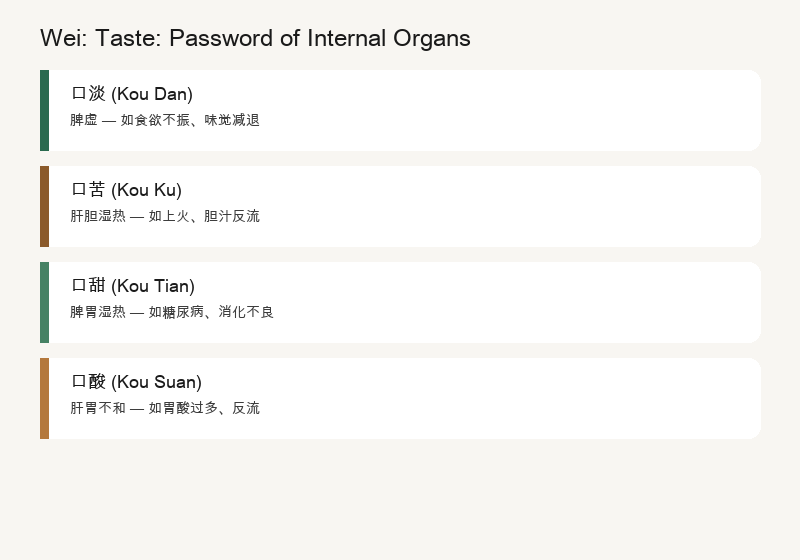
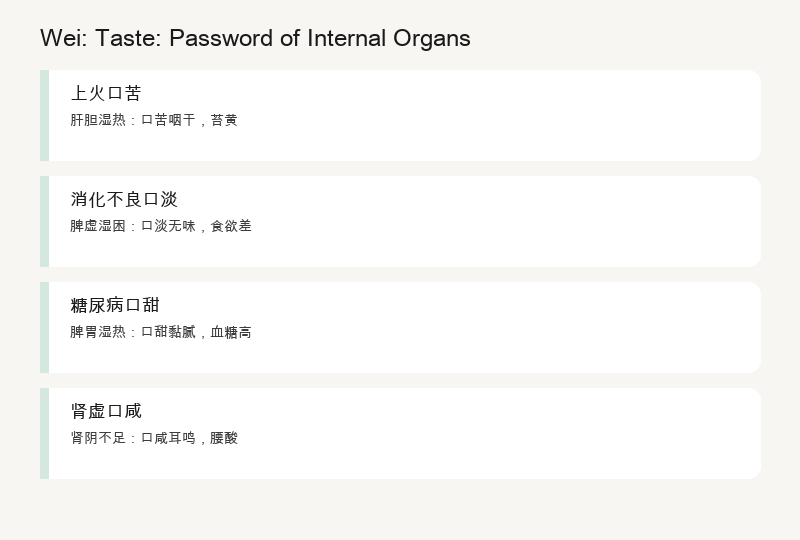
Bland taste (spleen deficiency): Mouth is bland and flavorless, like drinking plain water. Cause: spleen qi weakness, weak transformation, water-grain essence can't ascend to the mouth, oral cavity doesn't get enough nourishment. Often accompanied by poor appetite, abdominal bloating, loose stools, fatigue.
Bitter taste (liver-gallbladder damp-heat): Persistent bitterness in mouth, like holding coptis. Cause: liver-gallbladder damp-heat, bile rising to the mouth. Bile is bitter; normally it descends to the intestine, but when damp-heat steams, it reverses upward. Often accompanied by rib-side pain, irritability, red eyes, yellow urine.
Sweet taste (spleen-stomach damp-heat): Mouth is sticky-sweet, like holding sugar. Cause: spleen-stomach damp-heat, fermented grain food produces sweet qi that steams upward. Often accompanied by abdominal bloating, nausea, sticky stools, thick greasy tongue coating.
Sour taste (liver-stomach disharmony): Mouth is sour, like drinking vinegar. Cause: liver qi stagnation, horizontal invasion of the stomach, stomach acid rising. Often accompanied by stomach bloating, belching, rib-side pain, emotional depression.
Salty taste (kidney deficiency): Mouth is salty, like seawater. Cause: kidney deficiency, kidney fluids (electrolyte-containing body fluids) rising to the mouth. Often accompanied by lower back soreness, tinnitus, frequent night urination, aversion to cold or tidal fever.
Astringent taste (dryness-heat damaging fluids): Mouth is dry and astringent, like eating a raw persimmon. Cause: dryness-heat damages fluids, insufficient fluids, oral mucosa loses moisture. Often accompanied by dry mouth, dry throat, dry skin, dry stools.
Sticky taste (turbid dampness internally harbored): Mouth is sticky and uncomfortable, like coated with paste. Cause: turbid dampness internally harbored, phlegm-dampness obstructing, abnormal oral secretions. Often accompanied by heavy body, dizzy head, thick greasy tongue coating.
So what the ancients called "wei" is not just "taste" — it's a diagnostic system about the relationship between taste and organs. It holds that abnormal taste in the mouth is a "remote signal" of organ dysfunction; by distinguishing taste, one can infer the internal heat, cold, excess, or deficiency of organs.
But TCM has a core principle: the spleen opens into the mouth. The spleen governs transformation; spleen qi connects to the mouth, so taste abnormalities are first considered a spleen-stomach problem. But other organ disorders also affect the mouth through meridians, qi, and blood — liver damp-heat, kidney deficiency, heart fire can all reflect in taste. It's not simply "bland = spleen deficiency" — it's a comprehensive judgment with the spleen as primary while considering other organs.
Part 3giaogiao's Modern Translation
Alright, let's translate "wei" into modern language.
I'm not going to talk about taste neurobiology or oral microbiomics. Too complex. Just remember one metaphor:
Bland taste = Decreased taste receptor sensitivity + reduced saliva secretion (spleen deficiency's insufficient digestive enzyme secretion)
Bitter taste = Bile acid reflux + altered oral microbiome (liver-gallbladder damp-heat's inflammatory response)
Sweet taste = Elevated blood sugar + oral bacterial fermentation (spleen-stomach damp-heat's metabolic disorder)
Sour taste = Stomach acid reflux + esophageal sphincter relaxation (liver-stomach disharmony's autonomic nervous imbalance)
Salty taste = Electrolyte imbalance + renin-angiotensin system disorder (kidney deficiency's endocrine function decline)
Astringent taste = Reduced saliva secretion + mucosal damage (dryness-heat damaging fluids' dehydrated state)
Sticky taste = Increased oral mucus secretion + microbiome imbalance (turbid dampness internally harbored's inflammatory state)
Taste diagnosis = Inferring whole-body metabolic, endocrine, digestive, and immune status through taste changes
That's it. "Wei" is essentially the body's internal "remote display" — the oral cavity serves as a "window" for whole-body status, reflecting organ metabolism, endocrine function, and digestive function through taste changes.
Specifically:
What does "bland taste" correspond to? It corresponds to decreased taste receptor sensitivity and reduced saliva secretion. When the spleen is weak, digestive enzyme secretion is insufficient, salivary amylase decreases, the oral mucosa doesn't get enough nourishment, and taste receptor sensitivity drops. Meanwhile, malnutrition causes taste bud atrophy and raised taste thresholds. Manifests as bland taste and poor appetite — not "spleen qi deficiency" mysticism, but insufficient digestive enzyme secretion and taste bud function decline. Modern research: chronic indigestion patients have 30-40% lower salivary amylase activity and 20-25% lower taste bud density than normal people.
What does "bitter taste" correspond to? It corresponds to bile acid reflux and altered oral microbiome. When there's liver-gallbladder damp-heat, bile secretion is abnormal, bile acids reflux to the stomach and esophagus, even reaching the mouth. Bile salts stimulate bitter taste receptors (TAS2R family), producing persistent bitterness. Meanwhile, damp-heat conditions alter oral microbiome; certain bacteria (like anaerobes) produce bitter metabolites. Manifests as bitter taste and rib-side pain — not "gallbladder heat rising" mysticism, but abnormal bile acid metabolism and altered oral microbiome. Modern research: gallbladder disease and bile reflux patients have a bitter taste incidence of 60-70%, with significantly elevated anaerobe proportions in oral microbiome.
What does "sweet taste" correspond to? It corresponds to elevated blood sugar and oral bacterial fermentation. When there's spleen-stomach damp-heat, sugar metabolism is disordered, blood sugar rises, glucose concentration in saliva increases, stimulating sweet receptors (TAS1R family). Meanwhile, damp-heat environments favor oral bacterial fermentation, producing sweet metabolites. Manifests as sweet taste and thick greasy tongue coating — not "spleen heat steaming" mysticism, but abnormal blood sugar metabolism and oral bacterial fermentation. Modern research: diabetic patients have lowered sweet thresholds (more sensitive to sweetness), with elevated Streptococcus and Lactobacillus proportions in the mouth, closely correlated with sweet taste sensation.
What does "sour taste" correspond to? It corresponds to stomach acid reflux and esophageal sphincter relaxation. When there's liver-stomach disharmony, autonomic nervous imbalance (sympathetic-parasympathetic imbalance) causes gastroesophageal sphincter relaxation, stomach acid refluxing to the esophagus and mouth. Stomach acid (hydrochloric acid) stimulates sour receptors (OTOP1 channels), producing sour taste. Often accompanied by emotional tension — not "liver qi invading stomach" mysticism, but autonomic nervous imbalance causing gastroesophageal reflux. Modern research: 40% of GERD patients have sour taste symptoms, and anxiety and stress are major GERD triggers.
What does "salty taste" correspond to? It corresponds to electrolyte imbalance and renin-angiotensin system disorder. When there's kidney deficiency, kidney function declines, sodium and potassium excretion is abnormal, blood electrolyte concentration changes affect saliva electrolyte composition, stimulating salty receptors (ENaC channels). Meanwhile, renin-angiotensin system disorder, aldosterone secretion abnormality, affects sodium-potassium balance. Saliva sodium ion concentration rises, stimulating salty receptors. Manifests as salty taste and lower back soreness — not "kidney deficiency water rising" mysticism, but electrolyte metabolism abnormality and endocrine regulation disorder. Modern research: stage 3+ CKD patients have 40-60% higher saliva sodium concentration than normal people, positively correlated with serum creatinine levels.
What does "astringent taste" correspond to? It corresponds to reduced saliva secretion and mucosal damage. When dryness-heat damages fluids, dehydration or salivary gland hypofunction reduces saliva secretion, the oral mucosa loses lubrication, producing astringency. Meanwhile, certain diseases (like Sjögren's syndrome) destroy salivary glands, causing mucosal atrophy. Manifests as dry mouth and dry throat — not "insufficient fluids" mysticism, but reduced saliva secretion and mucosal damage. Modern research: Sjögren's syndrome patients have 50-70% reduced saliva flow rate, severe oral mucosal damage, with astringent taste being the most prominent symptom.
What does "sticky taste" correspond to? It corresponds to increased oral mucus secretion and microbiome imbalance. When turbid dampness is internally harbored, chronic inflammation stimulates oral mucosa, mucus secretion increases, producing stickiness. Meanwhile, microbiome imbalance causes certain bacteria (like Gram-negative bacteria) to produce mucopolysaccharide metabolites. Manifests as sticky taste and thick greasy tongue coating — not "phlegm-dampness obstruction" mysticism, but inflammatory response and microbiome metabolic abnormality. Modern research: oral mucosal inflammation patients have 2-3x elevated salivary mucin content, with specific bacteria (like Prevotella) closely correlated with mucus secretion.
So "wei" is not mysticism. It's just the body's internal "remote display" — the oral cavity serves as a "window" for whole-body metabolism, endocrine, digestive, and immune status, reflecting organ function through taste changes. The ancients described it with "bland, bitter, sweet, sour, salty, astringent, sticky"; modern people describe it with "taste receptors, oral microbiome, electrolyte imbalance, stomach acid reflux, bile metabolism" — the core logic is the same: taste is the password of the organs.
Part 4Life Stories
Five stories to instantly get what "wei" is.
Story 1: Bitter taste (liver-gallbladder damp-heat + bile acid reflux).
You've been working overtime for a week, eating lots of greasy takeout, and your mouth starts tasting bitter. Brushing several times doesn't help. Meanwhile, your ribs ache slightly, your eyes are red, your urine is yellow, and you're irritable. You ask: "Why does being 'fire-up' cause bitter taste?"
The truth: This is classic "bitter taste" — liver-gallbladder damp-heat + abnormal bile acid metabolism. Staying up late and greasy food increase liver burden, bile secretion becomes abnormal, bile acids reflux to the mouth, stimulating bitter receptors. Meanwhile, increased liver metabolic stress raises inflammatory factors, further altering oral microbiome. Not "gallbladder heat rising" mysticism, but excessive liver metabolic load causing bile acid reflux and microbiome changes. Modern research: after 3 consecutive days of staying up late, liver function markers (ALT, AST) can rise 15-20%, bile acid levels rise 25%, and bitter taste symptoms positively correlate with bile acid concentration. After high-fat meals, cholecystokinin (CCK) secretion increases, raising bile reflux risk by 40%.
Story 2: Bland taste (spleen deficiency + insufficient digestive enzymes).
You've recently lost your appetite. Everything tastes bland, even your favorite braised pork can't get you interested. Meanwhile, you feel bloated, have loose stools, fatigue, and low energy. You ask: "Why does poor digestion make my mouth bland?"
The truth: This is classic "bland taste" — spleen deficiency + insufficient digestive enzyme secretion. When the spleen-stomach is weak, salivary gland secretion decreases, salivary amylase activity drops, taste buds don't get enough nourishment and stimulation, and sensitivity decreases. Meanwhile, gastrointestinal digestive and absorptive function declines, nutrient intake is insufficient, further affecting taste bud metabolism and function. Not "spleen qi weakness" mysticism, but insufficient digestive enzyme secretion and taste bud function decline. Modern research: chronic gastritis patients have 35% lower salivary amylase activity and 20% lower taste bud density than normal people. After digestive enzyme supplementation, bland taste symptoms can improve within 1-2 weeks.
Story 3: Sweet taste (spleen-stomach damp-heat + abnormal blood sugar metabolism).
You've been entertaining a lot lately, eating rich food and drinking alcohol every meal, and you notice your mouth is sticky-sweet with a thick greasy yellow tongue coating. Meanwhile, you're bloated, nauseous, and have sticky stools. Your physical exam shows elevated blood sugar. You ask: "Why does my mouth taste sweet?"
The truth: This is classic "sweet taste" — spleen-stomach damp-heat + abnormal blood sugar metabolism. High-sugar, high-fat diet causes blood sugar fluctuations, glucose concentration in saliva rises, stimulating sweet receptors. Meanwhile, damp-heat environments favor oral bacteria (like Streptococcus) fermenting sugars, producing sweet metabolites. Thick greasy tongue coating is a sign of bacterial overgrowth. Not "spleen heat steaming" mysticism, but abnormal sugar metabolism and oral bacterial fermentation. Modern research: type 2 diabetic patients have lowered sweet thresholds (more sensitive to sweetness), with elevated Streptococcus mutans and Lactobacillus proportions in the mouth, positively correlated with blood sugar levels. After blood sugar control, sweet taste symptoms significantly improve.
Story 4: Sour taste (liver-stomach disharmony + gastroesophageal reflux).
Work pressure has been high lately, you had a fight with your partner, and you're emotionally down. Strangely, not only is your mood bad, but your mouth tastes sour, your stomach burns, especially after meals. You ask: "Why does bad mood make my mouth sour?"
The truth: This is classic "sour taste" — liver-stomach disharmony + autonomic nervous imbalance causing gastroesophageal reflux. Emotional stress affects the autonomic nervous system through the brain-gut axis, sympathetic nerves excite, parasympathetic nerves inhibit, causing gastroesophageal sphincter relaxation, stomach acid refluxing to the esophagus and mouth. Stomach acid stimulates sour receptors, producing sour taste. Not "liver qi invading stomach" mysticism, but autonomic nervous imbalance causing gastroesophageal reflux. Modern research: anxiety and stress can reduce lower esophageal sphincter pressure by 30-50%, increasing gastroesophageal reflux risk 2-3x. Anti-anxiety treatment significantly improves reflux symptoms.
Story 5: Salty taste (kidney deficiency + electrolyte imbalance).
You've been feeling lower back soreness, tinnitus, frequent night urination, and your mouth inexplicably tastes salty, like seawater on your tongue. You ask: "Why does kidney deficiency cause salty taste?"
The truth: This is classic "salty taste" — kidney deficiency + abnormal electrolyte metabolism. When kidney function declines, sodium and potassium excretion is abnormal, blood electrolyte concentration changes affect saliva electrolyte composition. Meanwhile, renin-angiotensin-aldosterone system (RAAS) disorder, aldosterone secretion abnormality, causes sodium retention and potassium excretion increase. Saliva sodium ion concentration rises, stimulating salty receptors. Not "kidney deficiency water rising" mysticism, but electrolyte metabolism abnormality and endocrine regulation disorder. Modern research: stage 3+ CKD patients have 40-60% higher saliva sodium concentration than normal people, positively correlated with serum creatinine levels. Salty taste is one of the most common oral symptoms in CKD patients.
Five stories, one underlying logic: wei is "the password of the organs" — the oral cavity serves as a "window" for whole-body status, reflecting organ metabolism, endocrine, and digestive function through taste changes. Not "mysterious taste mysticism," but measurable, verifiable physiological phenomena.
Part 5Modern Research
Is there scientific research on "taste reflects organs"?
Yes, and it's very robust. Scientists don't use the term "taste pattern diagnosis"; they use "taste receptor genes," "oral microbiome," "taste electrophysiology," and "metagenomics":
• Taste receptor genes and individual differences. Modern research confirms that humans have 25 bitter receptor genes (TAS2R family), 2 sweet receptor genes (TAS1R2/3), and 1 umami receptor gene (TAS1R1/3). Polymorphisms in these genes determine individual taste sensitivity. For example, TAS2R38 gene variants cause extreme sensitivity to certain bitter compounds (like phenylthiocarbamide) in some people, while others feel nothing. TCM's "taste abnormality" can be partially explained by changes in taste receptor gene expression. Not "constitution difference" mysticism, but genetic and epigenetic phenomena with clear molecular mechanisms. Modern research: TAS2R38 gene variants are associated with chronic sinusitis and upper respiratory tract infection susceptibility, because bitter receptors also exist in respiratory mucosa, participating in innate immunity.
• Oral microbiome and systemic disease. The oral cavity is the body's second largest microbial habitat, with 700+ bacterial species, totaling 1.5 grams. Modern metagenomics research confirms that oral microbiome is closely related to systemic disease: periodontal bacteria (like Porphyromonas gingivalis) can enter the bloodstream, increasing cardiovascular disease risk; oral microbiome imbalance is associated with diabetes, kidney disease, liver disease, and Alzheimer's disease. TCM's "sweet mouth," "sticky mouth," and "bitter mouth" correspond highly to specific compositional changes in oral microbiome. Not "damp-heat" mysticism, but measurable microbiome ecological changes. Modern research: in diabetic patients, Actinobacteria and Streptococcus mutans proportions are significantly elevated, positively correlated with blood sugar control levels.
• Taste electrophysiology and disease diagnosis. Modern taste electrophysiology research can objectively assess taste function by recording gustatory evoked potentials (GEP). Research finds that multiple diseases are accompanied by abnormal taste electrophysiology: diabetic patients have prolonged sweet GEP latency; kidney disease patients have reduced salty GEP amplitude; liver disease patients have abnormal bitter GEP. This completely corresponds to TCM's "taste pattern diagnosis" concept — taste changes can reflect internal organ disease. Not "mysterious diagnosis" mysticism, but objective measurement with electrophysiological basis. Modern research: taste electrophysiological detection has 70% sensitivity for early diabetic neuropathy and can be used as an auxiliary diagnostic tool.
• Taste disorder and neurological disease. Modern neurological research confirms that the taste pathway (from taste buds to the solitary tract nucleus in the brainstem, then to the thalamus and insula) is related to multiple neurological diseases. Parkinson's disease patients can have taste decline early; Alzheimer's disease patients have reduced taste discrimination ability; COVID-19 virus infection causes taste disorder because the virus invades nerve cells supporting taste conduction. This echoes TCM's ancient understanding that "the heart opens into the tongue" and "the tongue is the sprout of the heart." Not "the heart governs the spirit" mysticism, but precise anatomical and physiological mechanisms of the taste nerve pathway. Modern research: olfactory and taste disorders are among the earliest non-motor symptoms of Parkinson's disease, appearing 5-10 years before motor symptoms.
These studies fully demonstrate that "wei" is a concept that can be precisely described in modern scientific language. The ancients described it with "bland, bitter, sweet, sour, salty, astringent, sticky"; modern people describe it with "taste receptors, oral microbiome, electrolyte imbalance, stomach acid reflux, bile metabolism" — the core logic is consistent: taste is the password of the organs, the body's internal remote display.
Part 6Practical Methods
So you understand "wei." How do you use it?
First, dispel some misconceptions:
• "Bitter mouth means fire-up, just drink some chrysanthemum tea." Occasional bitter taste may be related to diet, but persistent bitter taste (over 2 weeks) needs to rule out liver-gallbladder disease, bile reflux, oral infection, etc. Not "simple fire-clearing," but needs to distinguish physiological from pathological.
• "Bland mouth means spleen deficiency, just eat more supplements." Bland taste may be spleen deficiency, or it may be anemia, zinc deficiency, dehydration, or medication side effects (like antibiotics, blood pressure medications). Not "bland = supplement," but needs comprehensive judgment of the cause.
• "Taste changes don't matter, it's not a serious disease anyway." Taste changes may be early signals of disease. Early diabetes can have sweet taste, early kidney disease can have salty taste, gastroesophageal reflux can have sour taste, Sjögren's syndrome can have astringent taste. Not "making a fuss," but the body is sending signals, pay attention.
Specific methods:
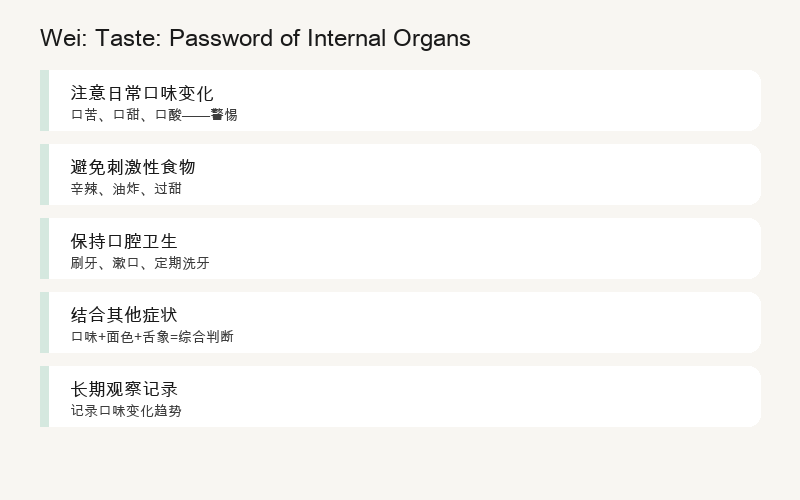
• Pay attention to daily taste changes. Every morning when you wake up and before bed, notice the taste in your mouth. Normally, the mouth should be fresh and tasteless. If you have persistent bitter, sweet, sour, salty, astringent, or sticky taste, record when it appears, how long it lasts, and accompanying symptoms (like abdominal bloating, lower back soreness, rib-side pain, emotional changes, etc.). Not "being paranoid," but establishing a daily habit of body awareness.
• Avoid irritating foods. Spicy, overly salty, overly sweet, overly sour foods irritate oral mucosa and taste buds, masking or confusing real taste signals. Especially when taste abnormality is already present, avoid coffee, alcohol, strong tea, chili peppers, etc. Eat light for 3-5 days to help restore the mouth's true sensation. Not "dietary superstition," but reducing interference to hear the body's signals clearly.
• Maintain oral hygiene. Brush teeth, use dental floss, clean tongue coating to reduce excessive bacterial growth in the mouth. But note: excessive use of antibacterial mouthwash disrupts oral microbiome balance, instead causing taste abnormality. Suggest choosing gentle mouthwash, or rinsing with light salt water. Regular dental cleaning (every 6-12 months). Not "just brush more," but maintaining oral microecological balance.
• Combine with other symptoms. Taste abnormality is not an isolated symptom. Bland taste with abdominal bloating and fatigue — consider spleen deficiency; bitter taste with rib-side pain and irritability — consider liver-gallbladder damp-heat; sweet taste with high blood sugar — consider diabetes; sour taste with heartburn — consider gastroesophageal reflux; salty taste with lower back soreness and frequent night urination — consider kidney deficiency; astringent taste with dry eyes and dry skin — consider Sjögren's syndrome or dryness-heat damaging fluids. Not "simple matching," but comprehensive pattern differentiation combining tongue appearance, pulse, and whole-body symptoms.
• Long-term observation and recording. Establish a "taste diary," recording daily taste changes, diet, emotions, sleep, bowel movements, etc. Continuous recording for 2-4 weeks can reveal patterns linking taste with diet, emotions, and lifestyle. This is very valuable for understanding your own body condition, and can also be provided to doctors for reference when seeking medical care. Not "obsessive-compulsive disorder," but establishing a personal health data habit.
• When to seek medical attention. Taste abnormality persists for over 2 weeks; accompanied by obvious weight loss, fever, jaundice, or severe abdominal pain; sudden taste change (like suddenly becoming bitter or sweet from normal); accompanied by other neurological symptoms (like dizziness, numbness, vision changes). In these cases, don't self-treat, seek medical examination promptly. Not "over-medicalization," but necessary steps to rule out organic disease.
These methods don't require you to become a doctor. You just need to understand: wei is "the password of the organs" — what you need to do is learn to "read the password" (pay attention to taste changes), eliminate interference (avoid irritating foods, maintain oral hygiene), combine context (other symptoms), track long-term (establish records), and when necessary, ask an expert to decode (seek medical care).
Part 6 (Continued)Practical Methods: Five Tricks to Read Taste
Part 7One-Minute Summary
🕐 Understand "Wei" in One Minute
Wei = The Password of Your Organs = The body's internal remote display.
What TCM calls "wei" is not just "taste" — it's a diagnostic system about the relationship between taste and organs. Abnormal taste in the mouth reflects organ dysfunction.
Bland taste = Decreased taste receptor sensitivity + reduced saliva secretion (spleen deficiency's insufficient digestive enzyme secretion).
Bitter taste = Bile acid reflux + altered oral microbiome (liver-gallbladder damp-heat's inflammatory response).
Sweet taste = Elevated blood sugar + oral bacterial fermentation (spleen-stomach damp-heat's metabolic disorder).
Sour taste = Stomach acid reflux + esophageal sphincter relaxation (liver-stomach disharmony's autonomic nervous imbalance).
Salty taste = Electrolyte imbalance + renin-angiotensin system disorder (kidney deficiency's endocrine function decline).
Astringent taste = Reduced saliva secretion + mucosal damage (dryness-heat damaging fluids' dehydrated state).
Sticky taste = Increased oral mucus secretion + microbiome imbalance (turbid dampness internally harbored's inflammatory state).
Misconceptions: Bitter = drink tea, bland = eat supplements, taste changes don't matter.
Methods: Pay attention to daily taste changes + avoid irritating foods + maintain oral hygiene + combine with other symptoms for comprehensive judgment + long-term observation and recording + seek medical care when necessary.
The ancients called it "bland, bitter, sweet"; modern people call it "taste receptors, oral microbiome, electrolyte imbalance, stomach acid reflux."
Different names, but medicine knows: the tongue is the body's remote display, taste changes are passwords the body sends.
Learn to read this password, and you gain an extra pair of eyes to observe your body.
The ancients had no taste receptor genes, no oral microbiome analysis, but knew "the spleen qi connects to the mouth; when the spleen is harmonious, the mouth can taste the five grains."
This is probably the most朴素 (simple) wisdom of the Chinese people: the tongue is the body's remote display, taste changes are passwords the body sends. Learn to read this password, and you gain an extra pair of eyes to observe your body.
Making money is the art of living; art is life after making money
giaogiao Decodes Chinese Traditional Wisdom · Concept 95
Using modern scientific language to help the world understand Chinese traditional wisdom.
Not mysterious, not superstitious, not dismissive.
Understand, rather than merely believe.
Coach Liu
Written in Florence