Xing (xíng) — Form: The Portrait of Constitution
Part 1A Question
Have you ever noticed that there are always some people around you who eat meat and fish at every meal yet stay as thin as a bamboo pole, never gaining weight? While others, just by drinking cool water, put on weight — eat a little more, and the scale balloons like an inflating balloon? Have you ever wondered why the same diet produces such huge differences in body shape?
Have you observed why some people walk with the wind at their backs, spine straight as a rod, while others are hunched and dragging their feet? Why some people sit like a bell, upright and centered; while others are like a puddle of mud, collapsing into the chair the moment they sit down? Why some people are bursting with energy, fidgeting nonstop; while others are listless all day, too lazy even to lift their eyelids?
Even more outrageous: TCM summarized a "body shape–constitution" mapping system two thousand years ago: "obese people have more phlegm" — overweight people have heavy damp-phlegm internally; "thin people have more fire" — thin people have yin deficiency with internal fire; "robust" — qi and blood are abundant; "frail" — qi and blood are insufficient. And there is posture diagnosis: upright sitting with labored breathing indicates lung qi congestion; laziness and desire to lie down indicate spleen deficiency with dampness trapping; curled-up sleeping with aversion to cold indicates yang deficiency with severe cold; restless agitation indicates intense heat disturbing the spirit. You ask: the ancients had no bathroom scales, no body fat meters, no 3D posture scanners — how did they know all this? Is this fortune-telling, or an assessment method that modern science can validate?
And another question: modern medicine says a BMI over 28 is obesity, a body fat rate over 25% for men and 30% for women is obesity. Postural analysis says a hunchback is muscle imbalance, and gait analysis says unsteady gait is a neuromuscular problem. These modern medical discoveries and TCM's "knowing the organs by observing form" are actually talking about the same thing?
You ask: what exactly is TCM's "form"? Is it fortune-telling? Is it judging by appearance? Or is it a constitution and organ-function assessment system based on body morphology? If "form" truly exists, why does Western medicine not have a "form observation" diagnostic method, but instead speaks of "body composition analysis," "gait analysis," and "postural assessment"?
What is form, after all? Is it the ancients' naive observation that "body shape reflects constitution," or a scientifically definable assessment system of bodily state?
Part 2Traditional Chinese Explanation
The concept of "form" (xing) has a long history in TCM. It is not merely an "external description" — it is a "constitutional diagnostic system," whose core is to infer organ qi-blood and constitution types by observing body shape, posture, and movement.
—— Jing Yue Quan Shu (Complete Works of Zhang Jingyue)
"Obese people have more phlegm, thin people have more fire."
—— Ge Zhi Yu Lun (Further Discussions on the Investigation of Things)
"When form and qi are in harmony, life is sustained; when form and qi are out of harmony, death ensues."
—— Huangdi Neijing Suwen
The ancients observed that body shape, posture, and movement are not accidental but external manifestations of the state of internal organs and qi-blood. Through "observing form," one can infer the constitution and organ function. This observation was summarized into a complete "form–constitution–organ" mapping system.
Body shape: the external outline of the body, reflecting constitution and qi-blood state.
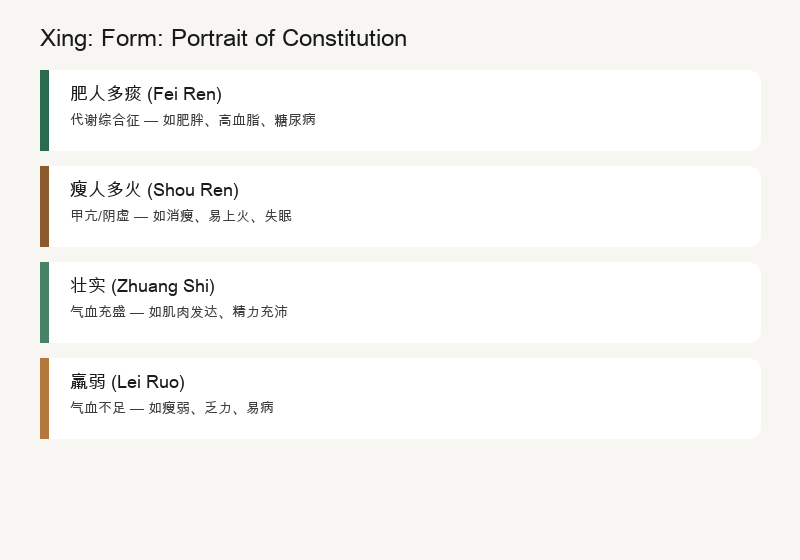
Obese people have more phlegm (metabolic syndrome): obese body shape, soft and flabby muscles, abdominal fullness. The cause is weakened spleen-stomach transformation and transportation, water-dampness stagnating into phlegm, and phlegm-dampness accumulating internally. Such people easily tire, are short of breath, sweat a lot, and have high blood lipids and blood sugar. It is not simply "eating too much" but weakened spleen-stomach transformation with metabolic waste accumulating. Often accompanied by thick greasy tongue coating, sticky stools, and heavy body sensation.
Thin people have more fire (hyperthyroidism / yin deficiency): thin and weak body, pale complexion flushed or with red cheekbones. The cause is insufficient yin fluid, internal fire generated from deficiency, and hyperactive metabolism. Such people easily have dry mouth, irritability, insomnia, hot palms and soles, and increased appetite without gaining weight. It is not "good digestion" but yin deficiency with internal fire, metabolic imbalance. Often accompanied by red tongue with little coating, fine and rapid pulse, and easy flare-ups.
Robust (qi and blood abundant): well-proportioned body, firm muscles, rosy complexion, and abundant energy. The cause is abundant qi and blood, coordinated organ function, and balanced yin-yang. This is the ideal constitutional state, with strong disease resistance and good recovery ability. It is not "muscular" but harmonized qi-blood and coordinated organs. Often accompanied by loud voice, steady gait, and good sleep quality.
Frail (qi and blood insufficient): small and thin body, muscle atrophy, pale or sallow complexion, and languid spirit. The cause is insufficient qi and blood, low organ function, and malnutrition. Such people easily tire, feel cold, have poor immunity, and recover slowly. It is not "naturally thin" but qi-blood deficiency with organs lacking nourishment. Often accompanied by low voice, shortness of breath upon exertion, and poor appetite.
Posture: the body's position and movement, reflecting organ state.
Upright sitting (lung qi congestion): the patient sits upright, unable to lie flat, breathing rapidly, mouth open and shoulders lifted. The cause is lung qi congestion, abnormal diffusion and descending, and difficulty breathing; the patient must sit upright to reduce pressure on the lungs. This is the typical posture of severe pulmonary heart disease, heart failure, and severe asthma. It is not "sitting properly" but lung qi congestion and difficulty breathing.
Laziness (spleen deficiency with dampness trapping): the patient is listless, reluctant to move, prefers lying or sitting, and limbs feel heavy and trapped. The cause is weakened spleen transformation and transportation, internal water-dampness stagnation, failure of clear yang to ascend, and heavy fatigue. It is not "lazy personality" but spleen deficiency with dampness trapping, clear yang failing to ascend. Often accompanied by poor appetite, abdominal bloating, loose stools, and thick greasy tongue coating.
Curling up (yang deficiency with severe cold): the patient lies curled up, likes warmth and fears cold, and limbs are not warm. The cause is insufficient yang qi, unable to warm the limbs; the body curls up to reduce heat loss. It is not "sleeping posture" but yang deficiency with severe cold, self-protection. Often accompanied by aversion to cold, diarrhea, clear and abundant urine, and pale complexion.
Restlessness (intense heat disturbing the spirit): the patient is restless and agitated, fidgeting, and even talking deliriously with restless limbs. The cause is intense internal heat evil disturbing the heart spirit and restless consciousness. It is not "impatient personality" but intense heat disturbing the spirit, consciousness agitated. Often accompanied by high fever, thirst, flushed face, and red tongue with yellow coating.
So, what the ancients called "form" is not merely "appearance" — it is a diagnostic system about the relationship between form and constitution, and between form and organs. It holds that body shape, posture, and movement are the "external portrait" of the state of internal organ qi-blood; by observing form, one can infer the cold, heat, deficiency, and excess of internal organs, and the abundance or decline of qi and blood.
But TCM has a core principle: unity of form and spirit. Form is the external manifestation of the body; spirit is the external manifestation of mental activity. Unity of form and spirit is the sign of health; robust form with declining spirit (obese body but listless spirit), thin form with vigorous spirit (thin body but hyperactive spirit), and decline of both form and spirit (both body and spirit are listless) are all pathological states. So "observing form" must be combined with "observing spirit" — looking at the eyes, the mental state, and the responsiveness. It is not simply "judging by appearance" but a comprehensive system of observing the state of the body and the spirit.
Part 3giaogiao Modern Translation
Okay, now let me translate "form" into modern language.
I am not going to talk about body composition analysis and gait dynamics. Too complicated. You only need to remember one analogy:
Obese people have more phlegm = Obesity-type metabolic syndrome (BMI ≥ 28, high body fat rate, abundant visceral fat, insulin resistance, dyslipidemia)
Thin people have more fire = Hypermetabolic state (hyperthyroidism, yin deficiency with internal fire, elevated basal metabolic rate, high lean body mass but too low body fat)
Robust = Ideal body composition (BMI 18.5–24, normal body fat rate, sufficient muscle mass, reasonable fat distribution)
Frail = Malnutrition / sarcopenia (BMI < 18.5, insufficient muscle mass, too low body fat, low basal metabolic rate)
Upright sitting = Cardiopulmonary function restricted (orthopnea, indicating heart failure, pulmonary heart disease, severe asthma)
Laziness = Chronic fatigue / low metabolism (hypothyroidism, anemia, chronic fatigue syndrome, depressive state)
Curling up = Thermoregulatory disorder / low metabolism (hypothermia, hypothyroidism, early shock, severe malnutrition)
Restlessness = Neuropsychiatric abnormality (delirium, high fever, poisoning, brain injury, psychomotor excitement)
Observing form = Body composition analysis + Postural assessment + Gait analysis + Motor function testing
That is it. "Form" is essentially the "direct dashboard" of bodily state — body shape, posture, and movement are the direct external manifestations of organ function, metabolic state, and neuromuscular function.
Specifically:
What does "obese people have more phlegm" correspond to? It corresponds to obesity-type metabolic syndrome. BMI ≥ 28, body fat rate > 25% for men and > 30% for women, visceral fat area (VFA) > 100 cm². Metabolic characteristics: insulin resistance (HOMA-IR > 2.5), dyslipidemia (triglycerides > 1.7 mmol/L, reduced HDL-C), fatty liver, and chronic inflammation (elevated CRP). What TCM calls "phlegm-dampness accumulating internally" corresponds to modern medicine's "metabolic inflammation" — adipose tissue releases inflammatory factors (TNF-α, IL-6, CRP), causing systemic low-grade inflammation. It is not "dampness" mysticism but obesity-related metabolic disorder and chronic inflammation. Modern research: every 1 kg increase in visceral fat increases metabolic syndrome risk by 7 times and type 2 diabetes risk by 5 times.
What does "thin people have more fire" correspond to? It corresponds to a hypermetabolic state. The most common is hyperthyroidism — elevated thyroid hormones (T3, T4), basal metabolic rate (BMR) increased by 30–60%, weight loss but increased appetite. Next is the yin deficiency with internal fire constitution — excessive sympathetic nervous excitation, elevated cortisol and catecholamine levels, hyperactive metabolism, and increased consumption. Another category is digestion and absorption disorders — such as celiac disease and Crohn's disease, poor nutrient absorption leading to emaciation. It is not "naturally unable to gain weight" but hyperactive metabolism or absorption disorder. Modern research: hyperthyroid patients' BMR is 30–60% higher than normal, resting heart rate > 90 beats/min, and weight drops 10–20% despite increased food intake.
What does "robust" correspond to? It corresponds to ideal body composition and athletic ability. BMI 18.5–24, body fat rate 15–18% for men and 20–25% for women, sufficient muscle mass (skeletal muscle index > 7.0 kg/m² for men and > 5.4 kg/m² for women), good cardiopulmonary function (VO₂max > 35 ml/kg/min for men and > 28 ml/kg/min for women), and normal basal metabolic rate. This is a state of metabolic health and good function. It is not "muscular" but balanced body composition, metabolic health, and good function. Modern research: ideal body composition is associated with the lowest all-cause mortality, 40–60% reduction in cardiovascular disease risk, and 70% reduction in diabetes risk.
What does "frail" correspond to? It corresponds to malnutrition and sarcopenia. BMI < 18.5, insufficient muscle mass (sarcopenia: skeletal muscle index < 7.0 kg/m² for men and < 5.4 kg/m² for women), too low body fat, and reduced basal metabolic rate. Causes: malnutrition (insufficient protein intake, digestion and absorption disorders), chronic inflammation (increased consumption), and neuromuscular diseases (muscle atrophy). What TCM calls "qi-blood deficiency" corresponds to modern medicine's "protein-energy malnutrition" and "sarcopenia." It is not "naturally thin" but comprehensive decline in nutrition, metabolism, and muscle function. Modern research: sarcopenia patients have 3 times increased fall risk, 2.5 times increased fracture risk, and 2 times increased in-hospital mortality.
What does "upright sitting" correspond to? It corresponds to orthopnea, a typical manifestation of heart failure and severe lung disease. When lying flat, blood return from the lower limbs increases, cardiac preload increases, and pulmonary congestion worsens; at the same time, abdominal organs compress the diaphragm, restricting lung expansion. The patient must sit upright, using gravity to reduce venous return and lower diaphragmatic pressure, in order to breathe. It is not "sitting properly" but the self-protective posture of cardiopulmonary decompensation. Modern research: orthopnea is an important indicator of heart failure severity (NYHA class III–IV), with pulmonary capillary wedge pressure (PCWP) rising > 18 mmHg when lying flat.
What does "laziness" correspond to? It corresponds to chronic fatigue and low metabolism. Common causes: hypothyroidism (TSH > 4.5 mIU/L, reduced T3 and T4, reduced BMR), anemia (Hb < 120 g/L, tissue hypoxia), chronic fatigue syndrome (unexplained fatigue lasting more than 6 months), and depressive state (reduced dopamine and 5-HT). What TCM calls "spleen deficiency with dampness trapping" corresponds to modern medicine's "low metabolism and neurotransmitter imbalance." It is not "lazy personality" but comprehensive functional decline in metabolism, nerves, and psychology. Modern research: hypothyroid patients' BMR is 20–30% lower than normal, and daily activity energy expenditure is reduced by 15–25%.
What does "curling up" correspond to? It corresponds to thermoregulatory disorder and low metabolic state. The curled-up posture reduces body surface area and lowers heat loss; it is self-protection when body temperature is too low. Common causes: hypothyroidism (low body temperature, low metabolism), severe malnutrition (insufficient heat production), early shock (peripheral vasoconstriction, reduced body temperature), and terminal state (metabolic failure). What TCM calls "yang deficiency with severe cold" corresponds to modern medicine's "hypothermia and metabolic failure." It is not "sleeping habit" but compensatory mechanism of thermoregulation and energy metabolism. Modern research: when core body temperature < 35°C, human metabolic rate drops by 50%, consciousness becomes blurred, and curling up is the most common heat-preserving posture.
What does "restlessness" correspond to? It corresponds to neuropsychiatric abnormality and motor excitement. Common causes: delirium (acute brain dysfunction caused by infection, poisoning, metabolic disorder), high fever (body temperature > 39°C, hyperactive brain metabolism), poisoning (alcohol withdrawal, drug poisoning, CO poisoning), brain injury (cerebral hemorrhage, encephalitis, post-seizure state), and psychomotor excitement (manic episode, schizophrenia). What TCM calls "intense heat disturbing the spirit" corresponds to modern medicine's "acute brain dysfunction and neural excitation." It is not "impatient personality" but clinical manifestation of central nervous system dysfunction. Modern research: in-hospital mortality of delirium is as high as 10–25%, an independent risk factor for poor prognosis in critically ill patients.
So, "form" is not mysticism. It is simply a "direct dashboard" of bodily state — body shape, posture, and movement are the direct external manifestations of organ function, metabolic state, and neuromuscular function. The ancients used "obese people have more phlegm, thin people have more fire, robust, frail, upright sitting, laziness, curling up, restlessness" to describe it; modern people use "BMI, body fat rate, body composition analysis, gait analysis, postural assessment, cardiopulmonary function testing" to describe it — the core logic is the same: form is the portrait of constitution, the direct expression of bodily state.
Part 4Life Stories
Five stories to make you instantly understand what "form" is.
Story 1: Obese people have more phlegm (obesity-type metabolic syndrome).
You are 170 cm tall and weigh 90 kg, BMI 31.1. You do not eat much every day, but your weight just will not go down. You easily tire, get out of breath after a few steps, sweat a lot, have sticky stools, and a thick greasy tongue coating. Physical examination reveals: triglycerides 2.8 mmol/L, fasting blood glucose 6.8 mmol/L, and moderate fatty liver. You ask: "Why do I gain weight so easily? Is it because my dampness is too heavy?"
Truth: this is a typical case of "obese people have more phlegm" — obesity-type metabolic syndrome. Your problem is not "eating too much" but metabolic disorder. Excessive visceral fat (VFA > 150 cm²) releases large amounts of inflammatory factors (TNF-α, IL-6), leading to insulin resistance (HOMA-IR = 3.2), abnormal blood glucose and blood lipid metabolism. Adipose tissue is not only an energy storage organ but also an active endocrine organ, secreting more than 40 adipokines. "Phlegm-dampness accumulating internally" corresponds to "metabolic inflammation" — it is not "dampness" mysticism but the inflammatory factor storm of adipose tissue causing systemic metabolic disorder. Modern research: every 1 kg increase in visceral fat increases diabetes risk by 5 times and cardiovascular disease risk by 3 times. Losing 5–10% of body weight can significantly improve metabolic indicators.
Story 2: Thin people have more fire (hyperthyroidism / hypermetabolism).
You are 165 cm tall and weigh 45 kg, BMI 16.5. You eat three meals a day plus a late-night snack, but you do not gain weight. You easily sweat, have heart palpitations, hand tremors, insomnia, and emotional irritability; you are particularly afraid of heat in summer and not afraid of cold in winter. You ask: "Why do I not gain weight despite eating so much? Is my metabolism good?"
Truth: this is a typical case of "thin people have more fire" — a hypermetabolic state. You may have hyperthyroidism (TSH 0.1 mIU/L, elevated T3 and T4), with basal metabolic rate 40% higher than normal. Thyroid hormones are the "accelerator" of metabolism; when they are elevated, the body is like an over-revving engine — fast consumption, high heat production, rapid heart rate, and neural excitation. It is not "good metabolism" but metabolic out of control. If untreated, long-term hyperthyroidism can lead to arrhythmia, osteoporosis, and thyroid crisis. Modern research: hyperthyroid patients' basal metabolic rate is 30–60% higher than normal, resting heart rate > 90 beats/min, and weight drops 10–20% despite food intake increasing 30–50%. After antithyroid drug treatment, weight can recover 5–10 kg within 3–6 months.
Story 3: Hunched back, weak lung qi (posture and lung function).
You have been working at a desk for a long time, 8 hours a day in front of the computer. You find your hunched back is becoming more and more obvious, shoulders shrugging forward, and thoracic kyphosis increasing. At the same time, you are easily short of breath, gasping after climbing three flights of stairs, with a low voice and frequent colds. You ask: "Why does a hunched back affect breathing?"
Truth: this is a typical case of "hunched back, weak lung qi" — abnormal posture affecting lung function. Hunched back (thoracic kyphosis) reduces the anteroposterior diameter of the thoracic cage, restricting lung expansion and reducing vital capacity. Normal vital capacity is about 3,500 ml for men; in severe hunched back it may drop below 2,500 ml. At the same time, thoracic cage deformation restricts the range of diaphragm activity, reducing ventilation efficiency. It is not "poor posture" but mechanical ventilation障碍 caused by abnormal posture. TCM says "the lung governs qi and manages respiration"; a hunched back restricts the thoracic cage, and lung qi cannot diffuse. Modern research: hunched back (thoracic kyphosis > 40°) reduces vital capacity by 15–25%, maximum ventilatory capacity by 20–30%, and increases respiratory tract infection risk by 2 times. Posture correction training (such as yoga, Pilates, and back muscle training) can improve lung function within 3–6 months.
Story 4: Unsteady gait, kidney deficiency (gait and neuromuscular function).
Your 65-year-old father has been walking more and more unsteadily recently, with a smaller stride, shuffling, difficulty turning, and occasionally almost falling. At the same time, he has a sore waist, frequent night urination (3–4 times), tinnitus, and declining memory. You ask: "Why do elderly people walk unsteadily?"
Truth: this is a typical case of "unsteady gait, kidney deficiency" — decline in neuromuscular function. Common causes of unsteady gait in the elderly: decreased muscle strength (sarcopenia, skeletal muscle index < 7.0 kg/m²), decreased proprioception (degeneration of plantar and joint sensory nerves), decreased vestibular function, and neurodegenerative changes (such as early Parkinson's disease, cerebellar atrophy). TCM says "the kidney governs the bones and produces marrow"; kidney deficiency leads to insufficient bone marrow, weak bones, and slow movements. Modern research: elderly gait speed < 0.8 m/s is a marker of functional decline, with 3 times increased fall risk. Unsteady gait is associated with cognitive decline (poor gait-cognition dual-task performance is associated with 2 times increased dementia risk). TCM's "kidney deficiency" corresponds to modern medicine's "neuromuscular system degeneration and proprioception decline." It is not "just getting old" but functional decline that requires intervention. Strength training, balance training, and vitamin D supplementation can significantly improve gait and reduce fall risk.
Story 5: Laziness (spleen deficiency with dampness trapping / chronic fatigue).
You have been feeling tired lately, unable to get up in the morning, lacking energy during the day, only wanting to lie down after work, and not wanting to go out on weekends. Colleagues say you are "lazy," but you know you are not unwilling to move — you really have no strength. At the same time, you have poor appetite, abdominal bloating, loose stools, and a white greasy tongue coating. You ask: "Why am I so tired?"
Truth: this is a typical case of "laziness" — spleen deficiency with dampness trapping / chronic fatigue syndrome. You may have hypothyroidism (elevated TSH), anemia (reduced ferritin), vitamin D deficiency (< 20 ng/ml), or chronic fatigue syndrome (unexplained fatigue lasting more than 6 months). TCM says "spleen deficiency with dampness trapping, clear yang failing to ascend" — spleen-stomach function is low, energy metabolism is insufficient, water-dampness stagnates internally, and clear yang qi cannot ascend to nourish the brain and limbs. Modern medicine: chronic fatigue patients have decreased mitochondrial function (ATP production reduced by 30–40%), neuroendocrine system disorder (low HPA axis function), and immune dysfunction. It is not "lazy personality" but comprehensive functional decline in metabolism, nerves, and the immune system. Modern research: chronic fatigue syndrome patients' daily activity energy expenditure is 25–35% lower than normal, and maximum oxygen uptake (VO₂max) is reduced by 15–25%. Comprehensive intervention (exercise therapy, cognitive behavioral therapy, nutritional supplementation) can improve symptoms in 60–70% of patients.
Five stories, one underlying logic: form is the "portrait of constitution" — body shape, posture, and movement are the direct external manifestations of organ function, metabolic state, and neuromuscular function. It is not "fortune-telling mysticism" but a measurable, assessable, and intervenable bodily state.
Part 5Modern Research
Is there scientific research on "form reflecting constitution"?
Yes, and it is very abundant. Scientists do not use the term "observing form"; they use "body composition analysis," "gait analysis," "postural assessment system," and "motor function assessment":
• Body composition analysis and metabolic health. Modern research confirms that body composition (fat mass, muscle mass, bone mass, water) reflects health status better than body weight alone. DEXA (dual-energy X-ray absorptiometry) and bioelectrical impedance analysis (BIA) can accurately measure body fat rate, visceral fat area, and skeletal muscle mass. Visceral fat area (VFA) > 100 cm² is an important marker of metabolic syndrome, closely related to insulin resistance, dyslipidemia, and elevated inflammatory factors. TCM's "obese people have more phlegm" corresponds to "excessive visceral fat + metabolic inflammation" — it is not "phlegm-dampness" mysticism but precisely measurable body composition and metabolic indicators. Modern research: every 10 cm² increase in visceral fat increases diabetes risk by 15% and coronary heart disease risk by 12%.
• Gait analysis and neuromuscular function. Modern gait analysis technology (pressure sensors, motion capture systems, inertial sensors) can accurately measure gait parameters: speed, stride length, cadence, gait cycle, symmetry, and variability. Gait speed is the "sixth vital sign" — > 1.0 m/s is normal, 0.6–1.0 m/s is functional decline, and < 0.6 m/s is severe functional impairment. Increased gait variability (asymmetry in stride length and stride time) is an early marker of neurodegenerative diseases such as Parkinson's disease. TCM's "unsteady gait, kidney deficiency" corresponds to "neuromuscular function decline + decreased proprioception" — it is not "kidney deficiency" mysticism but precisely measurable neuromuscular and sensory function. Modern research: every 0.1 m/s decrease in gait speed increases fall risk by 15% and in-hospital mortality by 10%.
• Postural assessment system and musculoskeletal health. Modern postural assessment systems (3D scanning, surface electromyography, AI posture recognition) can accurately assess posture: spinal curvature (cervical lordosis, thoracic kyphosis, lumbar lordosis), pelvic tilt, shoulder symmetry, and head position. Hunched back (thoracic kyphosis > 40°) is associated with decreased lung function, neck and shoulder pain, and increased depression risk. Anterior pelvic tilt is associated with low back pain and hip dysfunction. TCM's "when form is not right, qi is not smooth" corresponds to "abnormal posture causing musculoskeletal and internal organ dysfunction" — it is not "qi not smooth" mysticism but precisely measurable biomechanical and anatomical changes. Modern research: every 10° increase in thoracic kyphosis reduces vital capacity by 8–12% and increases neck and shoulder pain risk by 25%.
• Motor function assessment and aging. Modern motor function assessment includes: grip strength (muscle strength), chair stand test (lower limb strength), single-leg standing (balance), and 6-minute walk test (cardiopulmonary endurance). Decreased grip strength (men < 28 kg, women < 18 kg) is an independent predictor of aging and death. Chair stand test (number of chair stands in 30 seconds) < 8 times indicates lower limb functional decline. TCM's "frail" (qi-blood deficiency) corresponds to "decreased muscle strength + reduced cardiopulmonary function + decreased balance ability" — it is not "qi-blood deficiency" mysticism but precisely measurable motor function and aging indicators. Modern research: every 5 kg decrease in grip strength increases all-cause mortality by 16% and cardiovascular disease mortality by 17%.
These studies fully demonstrate that "form" is a concept that can be precisely described in modern scientific language. The ancients used "obese people have more phlegm, thin people have more fire, robust, frail, upright sitting, laziness, curling up, restlessness" to describe it; modern people use "BMI, body fat rate, body composition analysis, gait analysis, postural assessment, motor function testing" to describe it — the core logic is consistent: form is the portrait of constitution, the direct expression of bodily state.
Part 6Practical Methods
Now that you understand "form," how do you use it?
First, dispel a few misconceptions:
• "Fat means eating too much, thin means eating too little." Body shape is not determined by diet alone. Obese people may have metabolic syndrome, insulin resistance, hypothyroidism, or elevated cortisol; thin people may have hyperthyroidism, absorption disorders, chronic inflammation, or malignant tumors. It is not "eat less if fat, eat more if thin" but finding the root cause.
• "Poor posture is just a bad habit; fix it and you are done." Hunched back, anterior pelvic tilt, and forward head posture are not just "habits" — they may be muscle imbalance (tight anterior muscles, weak posterior muscles), structural spinal changes, neurological problems, or abnormal breathing patterns. It is not "just stand up straight" but requires systematic posture correction and muscle training.
• "Slow walking in elderly people is normal." Decreased gait speed is a marker of aging, but it is not "normal" — it indicates decreased muscle strength, neurological degeneration, reduced cardiopulmonary function, and increased fall risk. It is not "just getting old" but a functional decline signal that requires intervention.
Specific methods:
• Regularly measure weight and body fat. Do not just look at weight; look at body fat rate and muscle mass. Home body fat scales (bioelectrical impedance) can give a rough estimate; for more precision, a DEXA or professional BIA test is recommended annually. Watch the trend: weight gain with decreased muscle mass (increased body fat rate) is the most dangerous signal — sarcopenic obesity. Watch visceral fat: waist circumference > 90 cm for men and > 85 cm for women indicates excessive visceral fat. It is not "watching the number on the scale" but monitoring body composition trends.
• Pay attention to posture changes. Take a full-body side and front photo every month, comparing spinal curvature, shoulder symmetry, and head position. Pay attention to daily habits: do you look down at your phone for long periods? Do you carry a bag on one shoulder? Do you sit for long periods? These can all cause abnormal posture. It is recommended to get up and move for 5 minutes every hour of work, doing simple stretching and back activation. It is not "just taking a photo" but building posture awareness. If you find increased hunched back, pelvic tilt, or shoulder asymmetry, seek evaluation from a physical therapist or rehabilitation physician.
• Moderate exercise to shape the body. The purpose of exercise is not "weight loss" or "muscle building" but improving body composition, enhancing function, and preventing decline. Recommendation: 150 minutes of moderate-intensity aerobic exercise per week (brisk walking, swimming, cycling) + 2 strength training sessions per week (major muscle groups). Elderly people are recommended to add balance training (single-leg standing, Tai Chi, yoga). It is not "for good looks" but for function. Exercise can increase basal metabolic rate, increase muscle mass, improve insulin sensitivity, and reduce inflammatory factors — fundamentally improving the metabolic state of "obese people have more phlegm."
• Combine with dietary adjustment. Body shape is closely related to diet, but it is not simple "calorie counting." "Obese people have more phlegm" (metabolic syndrome): low sugar, low fat, high fiber, moderate protein, reduce refined carbohydrates, increase vegetables and whole grains. "Thin people have more fire" (hypermetabolism): increase high-quality protein and healthy fats, ensure calorie intake, avoid excessive exercise consumption. "Frail" (malnutrition): high protein, high calorie, easy to digest, and supplement with protein powder, vitamins, and minerals if necessary. It is not "one size fits all" but adjusting diet according to constitution.
• Long-term observation of trends. Build a "body file": record weight, body fat rate, waist circumference, gait sensation (easily tired? walking unsteadily?), and posture changes every month. Continuously record for 6–12 months, and you can discover your body's trend: is it continuously improving? Or gradually declining? Is muscle increasing? Or fat increasing? These trends are more valuable than a single measurement. It is not "recording numbers" but understanding your own body's trajectory.
• When to seek medical attention. Body weight changes > 10% in a short period (3–6 months), either increase or decrease; sudden gait changes (from normal to unsteady, or from fast to slow); sudden posture deterioration (such as increased scoliosis, obvious hunched back); accompanied by obvious systemic symptoms (fatigue, fever, pain, appetite changes). In these cases, do not self-treat; seek medical examination promptly. It is not "over-medicalization" but necessary steps to rule out organic diseases.
These methods do not require you to become an athlete. You only need to understand: form is the "portrait of constitution" — what you need to do is regularly "paint the portrait" (measure body composition), correct the "frame" (improve posture), strengthen the "canvas" (exercise to shape the body), optimize the "paint" (dietary adjustment), track long-term (build a file), and when necessary, ask an expert to "restore" (seek medical attention).

Part 6 (Continued)Practical Methods: Five Moves to Shape Form

Part 7One-Minute Summary
🕐 Understanding "Form" in One Minute
Form = The Portrait of Constitution = The Direct Dashboard of Bodily State.
What TCM calls "form" is not simply "appearance" but a diagnostic system about the relationship between form and constitution, and between form and organs — body shape, posture, and movement reflect organ qi-blood and constitution type.
Obese people have more phlegm = Obesity-type metabolic syndrome (BMI ≥ 28, high body fat rate, abundant visceral fat, insulin resistance, chronic inflammation).
Thin people have more fire = Hypermetabolic state (hyperthyroidism, yin deficiency with internal fire, elevated basal metabolic rate, or digestion and absorption disorders).
Robust = Ideal body composition (normal BMI, normal body fat rate, sufficient muscle mass, metabolic health).
Frail = Malnutrition / sarcopenia (BMI < 18.5, insufficient muscle mass, low metabolism, functional decline).
Upright sitting = Cardiopulmonary function restricted (orthopnea, heart failure or severe lung disease).
Laziness = Chronic fatigue / low metabolism (hypothyroidism, anemia, chronic fatigue syndrome, depression).
Curling up = Thermoregulatory disorder / low metabolism (hypothermia, hypothyroidism, severe malnutrition, shock).
Restlessness = Neuropsychiatric abnormality (delirium, high fever, poisoning, brain injury, psychomotor excitement).
Misconceptions: fat means eating too much, poor posture is just a bad habit, slow walking in elderly people is normal.
Methods: regularly measure weight and body fat + pay attention to posture changes + moderate exercise to shape the body + combine with dietary adjustment + long-term observation of trends + seek medical attention when necessary.
The ancients called it "obese people have more phlegm, thin people have more fire"; modern people call it "BMI, body fat rate, body composition analysis, gait analysis, postural assessment."
Different names, but medicine knows: body shape is the portrait of constitution, posture is the dashboard of organs, and movement is the test paper of neuromuscular function.
Learn to observe your own "form," and you gain an extra mirror — what it reflects is not beauty or ugliness, but the state of health.
The ancients had no bathroom scales, no body fat meters, no 3D posture scanners, but knew that "obese people have more phlegm, thin people have more fire" and "when form and qi are in harmony, life is sustained."
This is probably the most朴素 wisdom of the Chinese people: body shape is the portrait of constitution, posture is the dashboard of organs, and movement is the test paper of neuromuscular function. Learn to observe your own "form," and you gain an extra mirror — what it reflects is not beauty or ugliness, but the state of health.

Making money is the art of living; art is the life after making money
giaogiao Interpreting Chinese Traditional Wisdom · Concept 96
Helping the world understand Chinese traditional wisdom through the language of modern science.
No mystery, no superstition, no belittlement.
Understanding, not merely believing.
Coach Liu
Written in Florence