Biàn (biàn) — The Two Eliminations: A Window into Metabolism
Part 1A Question
Have you ever noticed that the first thing you do every morning is go to the bathroom, but you've probably never seriously looked at your own urine and stool? Have you noticed that constipation isn't as simple as "excessive internal heat," and diarrhea isn't just "eating something bad"?
Have you ever wondered why, after eating the same hot pot, one person gets constipated for three days while another has diarrhea for two? Why does one person's urine look like dark tea while another's looks like clear water? Even crazier, modern medicine's "fecal microbiome analysis," "urine metabolomics," and "intestinal permeability" are actually saying the same thing as Traditional Chinese Medicine's "the two eliminations reflect organ function" — urine and stool are the window into the body's metabolism?
You ask: What exactly is TCM's "biàn"? Is it excretion of waste, or a diagnostic clue? Is it "filth," or "signals sent by the body"? If "biàn" is a real diagnostic window, why doesn't Western medicine have a department called "observing the two eliminations," but instead talks about "gastroenterology," "urology," and "proctology"?
Here's another question: Why does one person's bowel movement come like clockwork every day, while another goes only every three days, like squeezing toothpaste? Why does one person have clear, copious urine, as if whatever they drink comes right out, while another has scant, dark urine, like dripping chili oil? Is it constitutional difference, or a difference in "qi transformation" function?
What is biàn, really? Is it the ancients' naive observation of "excrement," or a metabolic indicator that can be precisely defined by modern science?
Part 2Traditional Chinese Explanation
The concept of "biàn" in TCM has a long history. It is not merely an "act of excretion" — it is a "metabolic window," and its core is "reflecting organ function."
— Yellow Emperor's Inner Canon · Basic Questions
"The bladder is the official of the regional metropolis, where fluids are stored; with qi transformation, it can discharge."
— Yellow Emperor's Inner Canon · Basic Questions
"The small intestine governs fluids; the large intestine governs bodily fluids."
— Yellow Emperor's Inner Canon · Basic Questions
The ancients observed that the quality, color, odor, and frequency of urine and stool directly reflect the spleen and stomach's digestion and absorption, the kidney yang's steaming and qi transformation, and the body's overall fluid metabolism. This state is called "biàn."
Biàn = the two eliminations = metabolic window. In TCM, "biàn" includes:
Stool (dà biàn): Normal — yellowish, formed, neither too soft nor too hard, once daily. Abnormal:
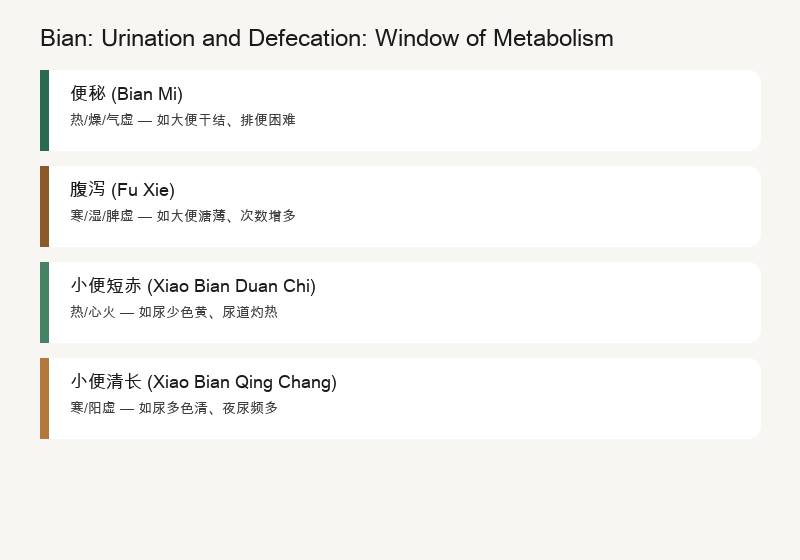
• Constipation (biàn mì): Heat constipation (Yangming fu-organ excess, dry-heat internal binding), qi constipation (qi stagnation, impaired transmission), cold constipation (cold congealing qi stagnation), deficiency constipation (qi/blood/yin deficiency, unable to propel).
• Diarrhea (xiè): Cold-dampness encumbering the spleen (watery stools), damp-heat pouring downward (sticky, foul-smelling stools with burning anus), food accumulation (sour, rotten, foul smell), spleen deficiency (undigested food, diarrhea right after eating), kidney deficiency (dawn diarrhea, diarrhea before dawn).
• Undigested food in stool (wán gǔ bù huà): Spleen-kidney yang deficiency, fire unable to warm earth, food expelled without digestion.
• Pus and blood in stool (nóng xuè biàn): Damp-heat toxic evil, accumulating in the large intestine, scorching the blood vessels — seen in dysentery and toxic heat.
Urine (xiǎo biàn): Normal — pale yellow and clear, moderate volume. Abnormal:
• Short and red (duǎn chì): Small volume, dark yellow or reddish — excessive heat / heart fire shifting to the small intestine.
• Clear and copious (qīng cháng): Large volume, clear color — cold / kidney yang deficiency, qi transformation impaired.
• Frequent (pín shù): Many times — kidney deficiency, inability to secure (nocturia) or damp-heat pouring downward (urgency and pain).
• Turbid (hún zhuó): Urine cloudy like paste — damp turbidity /膏淋 (urinary protein or chyluria).
So what the ancients called "biàn" is not just "excretion" — it is "the external expression of all metabolic states." It can be a digestive system issue (constipation, diarrhea), a urinary system issue (frequent urination, dark urine), or more commonly, both intertwined — spleen-stomach disharmony affecting stool, kidney yang deficiency affecting urine.
But TCM has a core principle: The two eliminations must flow smoothly; the spleen and stomach are the foundation, and kidney yang is the root. The spleen governs transformation and transportation of water and grains; the stomach governs receiving and ripening; the kidney governs water metabolism and the gate of life fire. Whether stool is formed depends on the spleen's transformation; the amount and clarity of urine depend on the kidney's qi transformation. It's not simply "take a laxative"; it's regulating the spleen and stomach + warming and supplementing kidney yang + unblocking qi flow.
Part 3giaogiao Modern Translation
OK, now let's translate "biàn" into modern language.
I'm not going to talk about gut microbiology and urine metabolomics. Too complicated. You only need to remember one metaphor:
Stool = gut microbiome metabolites + digestive absorption residues + shed intestinal mucosal cells
Normal stool = balanced microbiome (normal Firmicutes/Bacteroidetes ratio) + normal intestinal motility + moderate water absorption
Constipation = slowed intestinal motility + excessive water absorption + dysbiosis (reduced short-chain fatty acid-producing bacteria) + pelvic floor dysfunction
Diarrhea = accelerated intestinal motility + insufficient water absorption + dysbiosis (pathogenic overgrowth) + increased intestinal mucosal permeability (leaky gut)
Undigested food in stool = insufficient pancreatic exocrine function + small intestine malabsorption + digestive enzyme deficiency
Pus and blood in stool = intestinal mucosal inflammation (ulcerative colitis / Crohn's disease / bacterial dysentery) + neutrophil infiltration, mucosal ulceration and bleeding
Urine = kidney filtration + tubular reabsorption + urine concentration and dilution
Short and red = small volume + high concentration (dehydration / heat / infection) + elevated urobilinogen
Clear and copious = large volume + poor concentration (diabetes insipidus / diabetes / tubular damage)
Frequent = overactive bladder + urinary tract infection + prostate enlargement + neurogenic bladder
Turbid = urinary protein / white blood cells / bacteria / crystals (nephritis / infection / stones)
Regulating the two eliminations = restoring gut microbiome + improving intestinal motility + repairing intestinal mucosal barrier + protecting kidney filtration function + regulating water and salt metabolism
That's it. Simple. "Biàn" is essentially a metabolic window — the functional state of the gut and kidneys, directly reflected through the quality of excretions.
Specifically:
What does "constipation" correspond to? It corresponds to modern medicine's "slowed intestinal motility + dysbiosis + excessive water absorption + pelvic floor dysfunction." When dietary fiber is insufficient, you sit too much, and short-chain fatty acid-producing bacteria (like butyrate producers) in the gut microbiome decrease, intestinal motility slows, stool stays in the colon too long, water is excessively absorbed, and it becomes dry and hard. It's not "excessive heat" mysticism; it's measurable changes in gut dynamics and microecology. Modern research: chronic constipation patients show a 30% reduction in gut microbiome diversity, with a significant decrease in butyrate-producing bacteria (e.g., Faecalibacterium prausnitzii).
What does "diarrhea" correspond to? It corresponds to "accelerated intestinal motility + increased mucosal permeability + dysbiosis." When infection (viral/bacterial), food intolerance, or inflammation (e.g., IBS, IBD) occurs, intestinal secretion increases, motility speeds up, and water doesn't have time to be absorbed. Meanwhile, the intestinal mucosal barrier is damaged (leaky gut), and toxins and antigens enter the bloodstream. It's not "cold-dampness entering the body" mysticism; it's destruction of the intestinal mucosal barrier and microbiome homeostasis. Modern research: acute diarrhea patients show detectable pathogens (e.g., Salmonella, C. difficile) or viruses (e.g., rotavirus), and intestinal mucosal permeability (L/M ratio) can increase 2-3 fold within 24 hours.
What does "undigested food in stool" correspond to? It corresponds to insufficient pancreatic exocrine function, small intestine malabsorption, or digestive enzyme deficiency. Food expelled without full digestion suggests insufficient pancreatic secretion of amylase / lipase / protease, or small intestinal villous atrophy (e.g., celiac disease). It's not "spleen-kidney yang deficiency" mysticism; it's a physiological indicator of digestive enzyme activity and intestinal absorption area. Modern research: in chronic pancreatitis patients, 80% have steatorrhea (undigested food in stool), and fecal elastase testing is the diagnostic gold standard.
What does "short and red urine" correspond to? It corresponds to small urine volume + high concentration + possible infection or hemolysis. Dehydration, fever, urinary tract infection (E. coli), or liver-gallbladder disease (elevated urobilinogen) can all cause it. It's not "heart fire shifting to the small intestine" mysticism; it's a measurable indicator of kidney concentration function, hydration status, or infectious inflammation. Modern research: in urinary tract infections, urine leukocyte esterase and nitrite are positive, and urine specific gravity rises (>1.030).
What does "clear and copious urine" correspond to? It corresponds to large urine volume + poor concentration function. Diabetes (blood glucose exceeding renal threshold, osmotic diuresis), diabetes insipidus (ADH deficiency), or renal tubular damage (decreased concentration function) can all cause it. It's not "kidney yang deficiency" mysticism; it's a precise indicator of endocrine hormones (ADH / insulin) or renal tubular function. Modern research: diabetes patients' 24-hour urine volume can reach 3-5 liters, with urine specific gravity fixed at 1.005-1.010 (isosthenuric urine).
So "the two eliminations" is not mysticism. It is simply a metabolic window — the functional state of the gut and kidneys, directly reflected through the quality of excretions. The ancients used "constipation, diarrhea, short and red, clear and copious" to describe it; modern people use "gut microbiome, intestinal permeability, urine metabolomics, kidney concentration function" to describe it — the core logic is the same: the two eliminations are the barometer of the body's metabolism.
Part 4Life Cases
Four stories to help you instantly understand what "biàn" is.
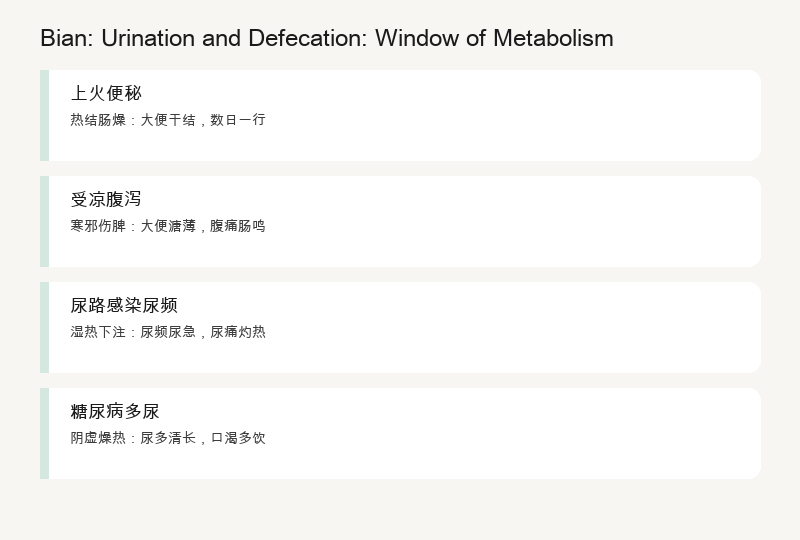
Case one: Excessive-heat constipation.
You eat hot pot, barbecue, and drink strong liquor for three days straight, then your stool becomes as hard as sheep dung pellets, passing like squeezing glass, with a burning anus and breath that reeks. You ask: "Why does spicy food always constipate me?"
The truth: This is typical "heat constipation" — a high-protein, high-fat diet alters the gut microbiome (putrefactive bacteria like Clostridium perfringens increase), insufficient dietary fiber reduces stool volume, and water is excessively absorbed. Meanwhile, spicy food irritates the intestinal mucosa, triggering local inflammation, but intestinal motility actually slows (because intestinal water is absorbed into the blood). It's not "excessive fire"; it's gut dysbiosis + insufficient dietary fiber + dehydration. Modern research: three consecutive days of high-fat diet reduces gut microbiome diversity by 20% and prolongs intestinal transit time by 40%.
Case two: Cold-induced diarrhea.
You sleep with the AC on in summer without covering yourself, then eat ice-cold watermelon the next day, and start having diarrhea with watery stools and a gurgling stomach. You ask: "Why does getting cold give me diarrhea?"
The truth: This is typical "cold-dampness diarrhea" — cold stimuli activate intestinal TRPV1 and TRPM8 channels, leading to increased intestinal secretion and accelerated motility. Meanwhile, low temperatures inhibit beneficial gut bacteria (e.g., Bifidobacterium), and pathogenic or opportunistic bacteria proliferate. It's not "cold qi entering the body"; it's dual effects of cold stimulus on intestinal nerves and microbiome. Modern research: a 1°C drop in rectal temperature increases intestinal motility speed by 30%; cold stimulus can alter gut microbiome composition within 1 hour.
Case three: Urinary tract infection with frequent urination.
You're a woman, recently busy at work, drinking little water, and holding your urine often. Suddenly you have frequent, urgent, and painful urination, with short, red urine like dripping chili oil. You ask: "Why does excessive heat cause frequent urination?"
The truth: This is typical "damp-heat pouring downward" — pathogenic bacteria like E. coli ascend from the urethra into the bladder, multiply on the bladder mucosa, and trigger an inflammatory response. Inflammation stimulates the bladder detrusor muscle, causing frequent contractions (urgency and frequency). It's not "excessive fire"; it's bacterial infection + inflammatory response + overactive bladder. Modern research: 75% of women experience at least one UTI in their lifetime, and E. coli is the main pathogen (>80%). Urinalysis shows white blood cells >5/HP, and bacterial culture is positive.
Case four: Diabetes with polyuria.
An elderly person in your family has been constantly thirsty, drinking a lot, and urinating a lot, with clear, copious urine and getting up three or four times at night. You ask: "Why does whatever they drink come right out? Is it kidney deficiency?"
The truth: This is typical "wasting-thirst" (diabetes) — blood glucose chronically exceeds the renal threshold (~10 mmol/L), causing osmotic diuresis. The renal tubules cannot reabsorb all the glucose, and water is excreted with it, increasing urine volume. Meanwhile, high blood glucose damages renal tubules and autonomic nerves, causing nocturia. It's not "kidney depletion"; it's osmotic diuresis caused by high blood glucose + renal tubular damage. Modern research: diabetes patients' 24-hour urine volume can reach 3-5 liters, with positive urine glucose and urine specific gravity fixed at 1.005-1.010. Long-term high blood glucose can lead to diabetic nephropathy (microalbuminuria is the early marker).
Four cases, one underlying logic: the eliminations are the metabolic window — the functional state of the gut and kidneys, directly reflected through the quality of excretions. It's not "mysterious excrement"; it's a measurable, intervenable metabolic indicator.
Part 5Modern Research
Does "the two eliminations" have scientific research?
Yes, and it's very robust. Scientists don't use the term "two eliminations"; they use "fecal microbiome analysis," "urine metabolomics," "intestinal permeability," and "metagenomics":
• Fecal microbiome analysis (16S rRNA sequencing / metagenomics). Modern research confirms that chronic constipation patients show significantly reduced gut microbiome diversity, decreased short-chain fatty acid (SCFA)-producing bacteria (e.g., Faecalibacterium prausnitzii, Roseburia), and increased methanogenic bacteria (e.g., Methanobrevibacter smithii). Diarrhea patients (e.g., infectious diarrhea, IBS-D) show microbiome disruption, pathogenic overgrowth, and intestinal mucosal barrier destruction. What TCM calls "loose stools" and "undigested food in stool" corresponds to gut dysbiosis and digestive absorption dysfunction — not mysticism, but pathological states with clear microbiome mechanisms. Modern research: fecal microbiota transplantation (FMT) for C. difficile infection has a cure rate exceeding 90%, with significant efficacy for IBS and inflammatory bowel disease as well.
• Urine metabolomics. Modern research uses gas chromatography-mass spectrometry (GC-MS) or liquid chromatography-mass spectrometry (LC-MS) to detect urinary metabolites. Diabetes, kidney disease, liver disease, and obesity all have characteristic metabolic profiles. For example, diabetes patients' urine shows elevated glucose, ketones, and advanced glycation end products (AGEs); kidney disease patients' urine shows abnormal albumin, creatinine, and N-acetyl-β-D-glucosaminidase (NAG). What TCM calls "clear and copious urine" and "turbid urine" corresponds to precise indicators of kidney filtration and reabsorption function — not mysticism, but measurable data from metabolomics.
• Intestinal permeability (Leaky Gut). The lactulose/mannitol ratio (L/M ratio) is the gold standard for assessing intestinal permeability. Modern research confirms that leaky gut is closely related to autoimmune diseases (e.g., rheumatoid arthritis, celiac disease), allergies, metabolic syndrome, and depression. What TCM calls "spleen deficiency diarrhea" and "undigested food in stool" corresponds to damaged intestinal mucosal barrier — not mysticism, but molecular pathology of intestinal epithelial tight junctions. Modern research: zonulin is the key molecule regulating intestinal permeability, and serum zonulin levels correlate positively with intestinal permeability.
• Fecal microbiota transplantation (FMT) and the gut-brain axis. Modern research confirms that gut microbiome influences brain function and mood through the vagus nerve, neurotransmitters (5-HT, GABA), and short-chain fatty acids (SCFA). Constipation/diarrhea co-occurs with anxiety and depression. What TCM calls "spleen-stomach disharmony leads to restless sleep" corresponds to gut-brain axis dysregulation — not mysticism, but a precise network of gut microbiome-neuro-endocrine interactions. Modern research: supplementing specific probiotics (e.g., Bifidobacterium longum) can improve both constipation and anxiety symptoms.
• Urinary exosomes and liquid biopsy. Urinary exosomes carry renal cell proteins, mRNA, and miRNA, and can serve as biomarkers for early diagnosis of kidney disease. What TCM calls "observing urine to know kidney qi" corresponds to urinary molecular diagnosis — not mysticism, but cutting-edge non-invasive liquid biopsy technology.
These studies fully demonstrate that "the two eliminations" is a concept that can be precisely described in modern scientific language. The ancients used "constipation, diarrhea, short and red, clear and copious" to describe it; modern people use "gut microbiome, metabolomics, intestinal permeability, liquid biopsy" to describe it — the core logic is the same: the two eliminations are the window into the body's metabolism.
Part 6Practical Methods
Now that you understand "biàn," how do you regulate it?
First, dispel a few myths:
• "Constipation? Take laxatives." Stimulant laxatives (e.g., senna, rhubarb, aloe) used long-term can cause melanosis coli, intestinal nerve damage, and drug-dependent constipation. It's not "just clear it out"; it's restoring the gut's autonomous motility and microbiome balance.
• "Diarrhea? Take antidiarrheals." In infectious diarrhea (bacterial/viral), using antidiarrheals too early prevents pathogens from being expelled, leading to toxin absorption. It's not "just stop it"; it's distinguishing the cause: infection needs anti-infection, inflammation needs anti-inflammation, dysbiosis needs restoration.
• "Frequent urination? It's kidney deficiency." The most common causes of frequent urination are urinary tract infection (women), prostate enlargement (men), and overactive bladder. It's not "just supplement it"; it's urinalysis + urinary system ultrasound for clear diagnosis.
Specific methods:
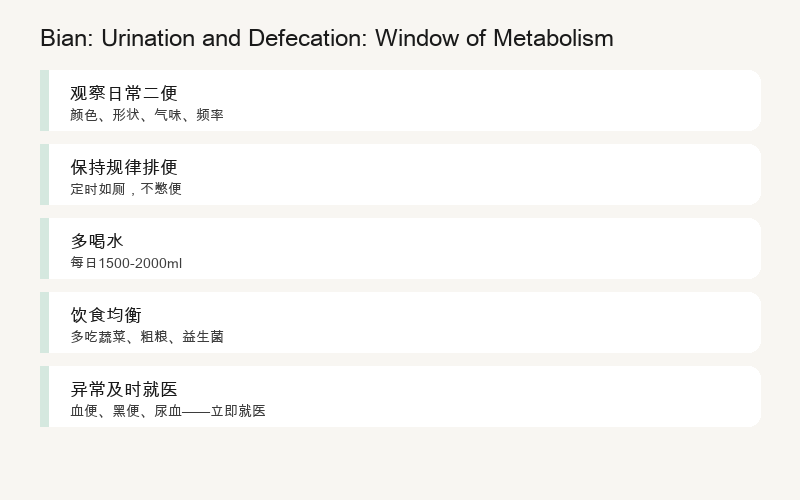
• Observe the two eliminations: keep an "elimination diary." Every day, record stool time, color (yellow/black/red/white), quality (Bristol Stool Scale types 1-7), odor, and straining effort; record urine color, volume, frequency, and whether there's excessive foam (proteinuria?). Observing the two eliminations is the best self-health management. It's not "gross"; it's a daily health report from your body.
• Maintain regular bowel movements: follow the gastrocolic reflex. Have a fixed time every day (after waking or after meals) to defecate, using the gastrocolic reflex to promote intestinal motility. Don't hold it in — the longer stool stays in the colon, the more water is absorbed, and the harder it gets. It's not "just go to the toilet on time"; it's training your gut's biological clock.
• Drink more water: 1.5-2 liters per day. Adequate water is the foundation for softening stool and diluting urine. Especially a glass of warm water on an empty stomach in the morning can stimulate gastrointestinal motility. Urine color should be pale yellow (like lemonade); dark yellow indicates dehydration. It's not "drink more water to detox"; it's maintaining normal kidney filtration and normal intestinal water content.
• Balanced diet: 25-30 grams of dietary fiber per day. Vegetables, whole grains, legumes, and nuts are the main sources of dietary fiber. Fiber increases stool volume, promotes motility, and is the "food" for probiotics (prebiotics). Probiotic foods (yogurt, kimchi, kombucha, miso) directly supplement beneficial bacteria. It's not "eat whole grains to relieve constipation"; it's feeding your gut microbiome + increasing stool volume.
• Moderate exercise: promotes intestinal motility. 150 minutes of moderate-intensity aerobic exercise per week (brisk walking, jogging, swimming) can significantly shorten intestinal transit time. Core muscle training (e.g., plank) improves pelvic floor function. It's not "exercise is good for health"; it's increasing intestinal motility + improving pelvic floor coordination.
• Seek medical attention promptly for abnormalities: watch for danger signals. Blood in stool (bright red or dark red), black tarry stool (suggesting upper GI bleeding), persistent diarrhea over 2 weeks, painless hematuria, persistently cloudy urine — all require immediate medical attention to rule out tumors, inflammatory bowel disease, nephritis, and other serious conditions. It's not "just endure it"; it's early detection, early diagnosis.
Part 6 (continued)Practical Methods: Six Moves to Regulate the Two Eliminations
Part 7One-Minute Summary
🕐 Understand "Biàn" in One Minute
Biàn = the two eliminations = metabolic window.
In TCM, "biàn" is not simply "waste excretion"; it is the direct reflection of the gut and kidney functional states.
Constipation = slowed intestinal motility + dysbiosis + excessive water absorption (insufficient fiber, sedentary lifestyle).
Diarrhea = accelerated intestinal motility + increased mucosal permeability + dysbiosis (infection / inflammation / food intolerance).
Undigested food in stool = insufficient pancreatic exocrine function + small intestine malabsorption (digestive enzyme deficiency).
Pus and blood in stool = intestinal mucosal inflammation + ulceration and bleeding (dysentery / IBD / tumor).
Short and red = small urine volume + high concentration (dehydration / heat / infection).
Clear and copious = large urine volume + poor concentration (diabetes / diabetes insipidus / tubular damage).
Frequent = overactive bladder + infection + prostate issues.
Turbid = urinary protein / white blood cells / bacteria / crystals (nephritis / infection / stones).
Myths: constipation means take laxatives, diarrhea means take antidiarrheals, frequent urination means kidney deficiency.
Methods: keep an elimination diary, regular bowel movements, 1.5-2L water daily, 25-30g dietary fiber daily, probiotic foods, moderate exercise, seek medical attention for abnormalities.
The ancients didn't have metagenomics and metabolomics, but they knew "the large intestine is the official of conveyance, from whom changes are derived" and "the bladder, with qi transformation, can discharge."
This is probably the most down-to-earth wisdom of the Chinese people: the two eliminations are the window into the body's metabolism; understand them, and you can hear the body's voice.
The ancients didn't have 16S rRNA sequencing and urine metabolomics, but they knew "observe the two eliminations to know the organs."
This is probably the most down-to-earth wisdom of the Chinese people: the two eliminations are signals sent by the body; understand them, and you can hear the body's voice. The doctor's task is not to replace the body, but to help read these signals.
Making money is the art of living; art is the life after making money
giaogiao Decodes Traditional Chinese Wisdom · Concept 97
Using modern scientific language to help the world understand traditional Chinese wisdom.
No mysticism, no superstition, no disparagement.
Understanding, not merely believing.
Coach Liu
Written in Florence