Wang Diagnosis: How Can TCM Doctors Tell What's Wrong Just by Looking at Your Face?
Part 1A Question
Have you ever had this experience?
You look in the mirror and see your face is yellow, your lips chapped. A friend asks: "Have you been working too much overtime?" You go to the hospital, and the doctor says: "Anemia, probably iron deficiency." But the TCM doctor takes one look and says: "Spleen deficiency, qi and blood insufficient." You ask: "How do you know just by looking?" Western medicine says: "Anemic people have a sallow complexion — that's low hemoglobin." TCM says: "The spleen governs transformation and transportation; spleen deficiency means qi and blood have no source to generate from, so the complexion turns sallow." Two explanations, both pointing to the same fact — your complexion is your body's display screen.
Even more surprisingly, you notice someone has a thick white tongue coating, like a layer of cream. You ask: "What does that mean?" Western medicine says: "Could be oral hygiene issues, or a fungal infection." TCM says: "White thick coating indicates cold-dampness or phlegm-dampness." The two doctors say different things, but both could be right — a thick white tongue coating, in TCM, means internal dampness; in Western medicine, it might suggest Candida infection. It's not about who's right or wrong — it's two systems using different languages to describe the same phenomenon.
Another question: You see someone with dark circles under their eyes and ask: "Didn't get enough sleep?" Western medicine says: "Poor microcirculation around the eyes, pigment deposition." TCM says: "Kidney deficiency; the kidney's color is black." Which one is right? Modern science has found that chronic kidney disease indeed causes periorbital pigmentation (the "renal facies" specific to kidney patients). It's not that TCM "guessed right" — it's that ancient doctors, through massive observation, summarized the connections between external body signals and internal states.
Even more confusing: You see someone with yellow eyes, yellow sclera. Western medicine says: "Jaundice, abnormal liver function, elevated bilirubin." TCM says: "Damp-heat accumulated in the spleen, steaming the liver and gallbladder." Two explanations, consistent again. During jaundice, liver and gallbladder function is abnormal, bilirubin rises, causing yellowing of skin and mucous membranes. TCM's "damp-heat accumulated in the spleen" describes the liver and gallbladder dysfunction caused by damp-heat. It's not "who copied whom" — it's two systems describing the same pathology from different angles.
So, what is Wang?
Part 2Traditional Chinese Explanation
The concept of "Wang" in TCM is the most intuitive diagnostic method. Ancient doctors observed: someone with a greenish complexion and irritable temper has liver qi stagnation; someone with a red face and dry mouth has heart fire flaring upward; someone with a yellow complexion and fatigue has spleen deficiency with dampness; someone with a pale face and shortness of breath has lung qi deficiency; someone with a dark complexion and weak knees has kidney essence depletion. Ancient doctors summarized facial color changes as the Five-Color Diagnosis — green, red, yellow, white, and black, corresponding to liver, heart, spleen, lung, and kidney.
—— Classic of Difficulties, Chapter 61
"The brilliance of the five colors is the splendor of qi."
—— Yellow Emperor's Inner Canon, Basic Questions
"Green should be like the luster of a dark jade, not like blue; red should be like vermilion wrapped in white, not like ochre; yellow should be like realgar wrapped in silk, not like yellow earth; white should be like goose feathers, not like salt; black should be like heavy lacquer, not like dusty earth."
—— Yellow Emperor's Inner Canon, Basic Questions
TCM summarized the objects of Wang observation into three key terms: Observing Spirit, Observing Color, and Observing Form.
Observing Spirit (Observing Vitality) — Spirit is the vitality of life. Someone with spirit has bright eyes, natural expressions, and quick responses. Someone without spirit has dull eyes, flat expressions, and slow responses. TCM says "spirit is the essence of food and water" — spirit is the external manifestation of qi and blood. Modern medicine says vitality reflects the functional state of the nervous system and endocrine system. A person with burnout has "dead" eyes — you don't need to feel their pulse to see that.
Observing Color (Observing Complexion) — Complexion is the "display screen" of qi and blood. Healthy people have a rosy, lustrous complexion ("faintly red and yellow, bright and moist"). Sick people show abnormal colors: green (liver), red (heart), yellow (spleen), white (lung), black (kidney). Ancient doctors said "five colors correspond to five organs" — not that colors "determine" organs, but that changes in organ qi and blood are reflected in color through facial vascular filling, skin pigment metabolism, and subcutaneous fat thickness. Modern research finds that complexion is closely related to objective indicators like hemoglobin, bilirubin, melanin, and blood oxygen saturation.
Observing Form (Observing Form/Shape) — Body form reflects the excess or deficiency of organs. Obese people tend to have phlegm-dampness; thin people tend to have yin deficiency or qi stagnation. A crooked gait may indicate stroke sequelae; trembling limbs may indicate internal liver wind. TCM says "form is the dwelling of spirit" — body form is the external container of spiritual state. Modern medicine says posture, gait, and muscle tension reflect the function of the neuromuscular and metabolic systems.
So, what ancient doctors called "Wang" was not just "looking" but systematic visual information reading — judging the abundance or decline of qi and blood and the excess or deficiency of organs by observing vitality, complexion, and form. Ancient doctors used "Five-Color Diagnosis," "Observing Spirit," and "Observing Form" to summarize what modern people need "clinical observation + physical examination" to explain.
Part 3giaogiao Modern Translation
OK, now let's translate "Wang" into modern language.
I'm not going to talk about microcirculation, hemoglobin, or bilirubin metabolism. Too complicated. You just need to remember one metaphor:
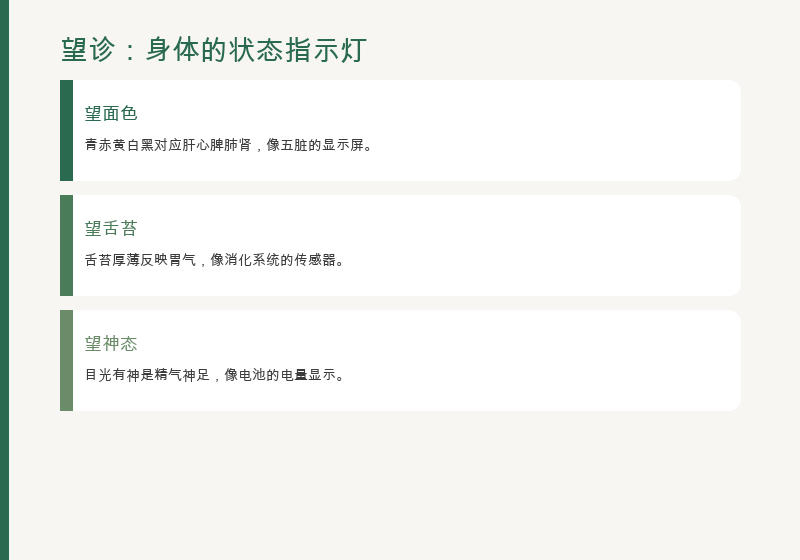
Complexion = The body's LED display, showing qi and blood circulation status
Tongue coating = The oral environment sensor, reflecting digestive and metabolic status
Eyes = The nervous system's signal light, showing energy and attention levels
Form = The body's mechanical structure, showing muscle and bone health
Five colors = Five system zones, corresponding to the functional status of different organs
That's it. Your "Wang" is essentially the body passing internal state information outward through visual signals — like a car's dashboard and indicator lights, where different colors, brightness levels, and flashing patterns represent different system states.
Specifically:
"What does 'yellow complexion' correspond to?" Corresponds to insufficient hemoglobin or abnormal bilirubin metabolism. During anemia, hemoglobin decreases, blood oxygen-carrying capacity drops, and the complexion turns sallow. With spleen deficiency, digestive and absorptive functions decline, and nutrient intake (including iron, folic acid, vitamin B12) becomes insufficient, leading to a lack of raw materials for blood production. TCM says "spleen deficiency causes sallow complexion" — modern medicine says "anemia causes yellow complexion" — they're describing the same mechanism.
"What does 'red complexion' correspond to?" Corresponds to vasodilation or inflammatory response. During emotional excitement, fever, or high blood pressure, facial blood vessels dilate, blood flow increases, and the complexion turns red. TCM says "heart fire flares upward" — the heart governs blood vessels, and fire's nature is to flame upward. Modern medicine says "sympathetic nervous system excitement + facial vasodilation" — they're describing the same pathology.
"What does 'thick white tongue coating' correspond to?" Corresponds to oral microbiome imbalance and decreased digestive function. Tongue coating is a mixture of shed epithelial cells, bacteria, and food debris. When digestive function is disordered, the tongue coating thickens and its color becomes abnormal. TCM says "thick white coating indicates cold-dampness" — modern medicine says "indigestion + oral microbiome imbalance" — they're describing the same phenomenon.
"What do 'dark circles under the eyes' correspond to?" Corresponds to poor microcirculation around the eyes and pigment deposition. With insufficient sleep, chronic fatigue, or decreased kidney function, microvessels around the eyes become congested, metabolic waste deposits, forming dark circles. TCM says "kidney deficiency causes blackness" — modern medicine says "poor microcirculation around the eyes + pigment deposition" — they're describing the same fact.
So, "Wang" is not mysticism. It's a functional metaphor — describing the process by which the body passes internal state information through visual signals. Ancient doctors used "Five-Color Diagnosis" and "Observing Spirit" to summarize; modern people use "clinical observation + physical examination" to describe — they're talking about the same thing.
Part 4Life Cases
Four stories to help you instantly understand what Wang is.
Case 1: The "Yellow-Faced Woman" After Overtime.
You work overtime for two weeks straight, sleeping six hours a day. On the weekend, you look in the mirror and see your face is yellow, your eyes dry, your lips chapped. You ask a friend: "Do I look haggard?" Western medicine says: "Chronic fatigue slows blood circulation, skin oxygen supply is insufficient, causing a sallow complexion." TCM says: "Spleen deficiency, qi and blood insufficient, unable to nourish the face."
The truth: Long-term sleep deprivation causes sustained sympathetic nervous system excitement, leading to peripheral vasoconstriction and reduced skin (especially facial) blood flow. At the same time, sleep deprivation affects liver metabolic function, slowing bilirubin metabolism, making the complexion tend toward yellow. Additionally, chronic fatigue causes digestive function to decline, nutrient absorption becomes insufficient, and hemoglobin synthesis decreases. TCM's "spleen deficiency causes sallow complexion" — precisely describes the digestive and circulatory function decline caused by chronic fatigue. It's not "just looking tired" — it's your body really sending signals. But "sallow complexion" precisely summarizes the external manifestation of chronic fatigue.
Case 2: The "Red-Faced Guan Yu" After Hot Pot.
You eat a spicy hot pot meal, and the next day you find three pimples on your face and a red complexion. You ask: "Why does spicy food make my face red?" Western medicine says: "Capsaicin in chili peppers activates TRPV1 receptors, causing facial vasodilation and increased blood flow." TCM says: "Pungent foods help fire, heart fire flares upward, steaming the face."
The truth: Capsaicin indeed activates TRPV1 receptors, causing vasodilation and neuropeptide release (substance P), leading to facial flushing and vasodilation. At the same time, spicy foods stimulate the sympathetic nervous system, increasing heart rate and blood pressure, further increasing facial blood flow. TCM's "pungent foods help fire" — "fire" is pathological hyperfunction, corresponding to inflammatory response and vasodilation. It's not "having too much internal heat" — it's the neurovascular response caused by capsaicin. But "heart fire flares upward" precisely summarizes the facial vasodilation caused by spicy food.
Case 3: The "Thick Tongue Coating" from Chronic Constipation.
You've been constipated for a long time, going to the bathroom only once every three days. One day you look in the mirror and find your tongue coating is thick and white, with tooth marks on the edges of your tongue. You ask: "What's going on?" Western medicine says: "Indigestion, intestinal microbiome imbalance, possibly with oral Candida infection." TCM says: "Spleen deficiency with dampness encumbrance, transformation and transportation failure, phlegm-dampness internally stagnated."
The truth: During chronic constipation, intestinal peristalsis slows, food residue stays too long in the intestines, producing large amounts of toxins and metabolic waste. These substances enter the bloodstream through the enterohepatic circulation, affecting the oral environment. The tongue coating thickens because the oral microbiome is unbalanced, with shed epithelial cells and bacteria piling up. Tooth-marked tongue is caused by tongue swelling pressing against the teeth — tongue swelling reflects disturbed body fluid metabolism (water and sodium retention). TCM's "spleen deficiency with dampness encumbrance" — the spleen governs transformation and transportation of water-dampness; spleen deficiency causes water-dampness to stagnate internally, leading to tongue swelling and thick greasy tongue coating. Modern medicine's "indigestion + water and sodium retention" — they're describing the same mechanism. It's not "too much dampness" — it's decreased digestive and metabolic function. But "spleen deficiency with dampness encumbrance" precisely summarizes the external manifestations of digestive and metabolic disorders.
Case 4: The "Empty Eyes" of the Retired Elderly.
After your grandfather retired, he sits on the sofa watching TV all day, rarely going out. You notice his eyes are getting more and more "empty" — a vacant gaze, slow reactions. You ask: "Is it just old age?" Western medicine says: "Reduced activity, insufficient brain stimulation, declining cognitive function." TCM says: "Spirit fatigue, qi and blood decline, spirit loses its nourishment."
The truth: The brain needs continuous stimulation to maintain function. After retirement, reduced social interaction and reduced activity cause a sharp drop in cognitive stimulation received by the brain. At the same time, reduced physical activity slows blood circulation, reducing blood and oxygen supply to the brain. The eyes are the external window of nervous system function — a vacant gaze and slow reactions reflect decreased cerebral cortex excitability. TCM's "spirit fatigue" — spirit is the mental state, and when qi and blood decline, the spirit loses its nourishment. Modern medicine's "insufficient cognitive stimulation + reduced brain blood supply" — they're describing the same mechanism. It's not "that's just how old people are" — it's neural function degeneration caused by reduced activity. But "spirit fatigue" precisely summarizes the external manifestations of cognitive decline.
Four cases, one underlying logic: Wang is "reading the body's signals" — your complexion, tongue coating, and eyes are all your body speaking.

Part 5Modern Research
Does "Wang" have scientific research?
Yes, and quite a lot. Scientists don't use the term "Wang diagnosis"; they use:
• Facial Color Analysis. Modern research finds that complexion is closely related to multiple physiological indicators. For example, sallow complexion is significantly correlated with serum bilirubin levels and hemoglobin concentration. Flushing is related to facial skin blood flow and sympathetic nervous activity. A 2015 study published in the Journal of Biomedical Optics used spectral imaging technology to analyze complexion and found that spectral characteristics of complexion could distinguish healthy people from anemic patients, with an accuracy rate above 85%. This is consistent with TCM's "Five-Color Diagnosis" approach — complexion is a window to internal state.
• Tongue Diagnosis Objectification. In recent years, computer vision and deep learning techniques have been used for tongue diagnosis research. In 2017, Tianjin University of Traditional Chinese Medicine and Tsinghua University collaborated, using convolutional neural networks (CNN) to analyze tongue coating images, automatically identifying the color, thickness, and moisture of tongue coating, with an accuracy rate above 90%. Research found that tongue coating characteristics are related to objective indicators like gastrointestinal diseases, metabolic syndrome, and immune function. This is the scientific verification of "tongue coating is the digestive system's sensor" — not mysticism, but image recognition + medical statistics.
• Micro-expression and Neural State. Psychology and neuroscience research finds that people's facial expressions (especially eyes) are closely related to nervous system states. For example, vacant gaze and reduced blinking frequency are related to decreased dopamine levels in the cerebral cortex and reduced prefrontal function. People with chronic stress, depression, or burnout have typical "dead fish eye" characteristics — you don't need to feel their pulse to identify this. This is the scientific basis of "Observing Spirit" — vitality is a direct reflection of neural state.
These studies fully demonstrate: "Wang" is a concept that can be precisely described in modern scientific language. Ancient doctors used "Five-Color Diagnosis" and "Observing Spirit" to summarize; modern people use "facial color analysis + computer vision + neuropsychology" to describe — they're talking about the same thing.
Part 6Practical Methods
Now that you understand "Wang," how do you apply it?
First, clear up some misconceptions:
• "Looking at complexion can diagnose all diseases." Complexion is just one of the body's state signals; it can't replace comprehensive examination. A yellow complexion might be anemia, or it might be liver and gallbladder disease, or it might be excessive carotene intake. Diagnosing based on complexion alone is prone to misdiagnosis. It's not "one look and you know everything" — it's Wang diagnosis is a clue, not a conclusion.
• "TCM looking at complexion is superstition." Complexion is an objectively existing physiological signal, closely related to indicators like hemoglobin, bilirubin, and blood oxygen saturation. Denying complexion diagnosis is denying basic physiology. It's not "mysterious and profound" — it's an observation method with scientific basis.
Specific methods:
• Look in the mirror every day, not just for beauty. When you wash your face each morning, observe your complexion, tongue coating, and eyes. Is your complexion more yellow or pale than usual? Is your tongue coating thicker? Do your eyes have spirit? These changes are often the first signals of changes in body state. It's not "vanity" — it's a free tool for body self-check.
• Observe your family members' complexion changes. Parents, partners, and children's complexion changes are often discovered earlier by you than by themselves. If a family member suddenly turns yellow or their eyes become dull, it might be a signal of fatigue or health problems. It's not "being nosy" — it's a window for caring about your family's health.
• Pay attention to the influence of special environments. Lighting, skin color, and cosmetics all affect complexion observation. Don't judge complexion under strong light or colored light. Observing without makeup is most accurate. It's not "a bad complexion means you're sick" — it's you need to observe under natural light, without makeup.
• Learn to distinguish the basic meanings of the "Five Colors." Green (cyan/purple): may be related to poor circulation and oxygen deficiency; Red: may be related to inflammation, vasodilation, high blood pressure; Yellow: may be related to anemia, liver and gallbladder problems, malnutrition; White (pale): may be related to anemia, low blood pressure, insufficient qi and blood; Black (dark): may be related to chronic kidney disease, pigment deposition, poor blood circulation. It's not "five colors determine fate" — it's colors are clues, needing to be combined with other information for judgment.
• Pay attention to eyes and vitality. The eyes are the hardest to fake. Eyes with spirit: bright, flexible, focused. Eyes without spirit: dim, dull, scattered. If you find yourself or a family member's eyes "empty," it might be a signal of chronic fatigue, depression, or health problems. It's not "reading minds from eyes" — it's eyes are a direct window to neural state.
These methods don't require you to believe in TCM. You just need to understand: Wang is "reading the body's signals" — complexion, tongue coating, and eyes are all your body speaking.

Part 7One-Minute Summary
🕐 Understanding "Wang" in One Minute
Wang = Body's Status Indicator Light + Dashboard.
Wang diagnosis includes Observing Spirit, Observing Color, and Observing Form, reading body signals through observing vitality, complexion, and form.
Five colors correspond to five organs: green-liver, red-heart, yellow-spleen, white-lung, black-kidney.
Overtime yellow face, hot pot red face, constipation thick tongue, retiree empty eyes — these are all signals that Wang can discover.
Wang = Facial Color Analysis + Tongue Diagnosis Objectification + Micro-expression Neuroscience.
Wang is not mysticism; it's the body passing internal state through visual signals.
Misconceptions: looking at complexion can diagnose all diseases, TCM looking at complexion is superstition.
Methods: daily mirror observation, watch family changes, observe under natural light without makeup, learn five-color identification, pay attention to eyes and vitality.
Ancient doctors called it "to know by looking is called divine"; modern people call it "clinical observation."
Different names, but the body knows: complexion is the body's display screen. Those who can read it can understand the body.
Complexion is the display of qi and blood; tongue coating is the sensor of digestion.
Ancient doctors didn't have spectral analyzers, but they knew "five colors correspond to five organs."
This is probably the most unadorned wisdom of the Chinese: what is visible is the mapping of what is invisible; to know by looking is called divine.

Making money is the art of living; art is life after making money
giaogiao Interprets Chinese Traditional Wisdom · Concept 51
Using the language of modern science to help the world understand Chinese traditional wisdom.
No mysticism, no superstition, no belittling.
Understand, don't just believe.
Coach Liu
Written in Florence