Why Does a TCM Doctor Know What's Wrong Just by Touching Your Belly? Palpation Is the Body's "Ultrasound Probe"
Part 1A Question
Have you ever noticed how some people's bellies are hard as rock, while others are soft as cotton? Have you noticed that when you have a stomachache, Western medicine asks for an ultrasound and CT scan, while Traditional Chinese Medicine just touches your belly and says "qi stagnation" — and you ask, "You can tell just by touching?"
Even more surprising, TCM says "hard lumps in the abdomen are zheng-jia (accumulation)", while modern medicine says "it could be a tumor or constipation" — two different statements, who is right? When you press an acupoint and it hurts, TCM says "blocked meridians," and you say "I pressed too hard" — who is right?
Another question: your hands and feet are cold, you say "poor circulation," TCM says "yang deficiency"; your skin has poor elasticity, you say "I'm getting old," TCM says "insufficient qi and blood" — can touch really diagnose disease?
What is "chu" (touch) after all?
Part 2Traditional Chinese Explanation
The concept of "chu" (touch) ranks fourth in TCM diagnostic methods — look, listen, ask, and palpate ("qie" means palpation, and pulse-taking is also a form of palpation). But palpation is not just pulse-taking; it also includes pressing the abdomen, pressing acupoints, and pressing the skin. The ancients used their hands to feel physical evidence.
— Huangdi Neijing · Suwen
"Abdominal fullness, when pressed without pain indicates deficiency; when painful indicates excess."
— Shang Han Lun
"The skin's cold and heat, smoothness and roughness, moisture and dryness can verify the abundance or deficiency of fluids."
— Yi Men Fa Lu
The ancients observed that by touching the body with the hands, one can perceive changes in deficiency and excess. Healthy people have warm, soft, and elastic skin. Unhealthy people have cold, hard, and dry skin. The ancients divided palpation into three levels:
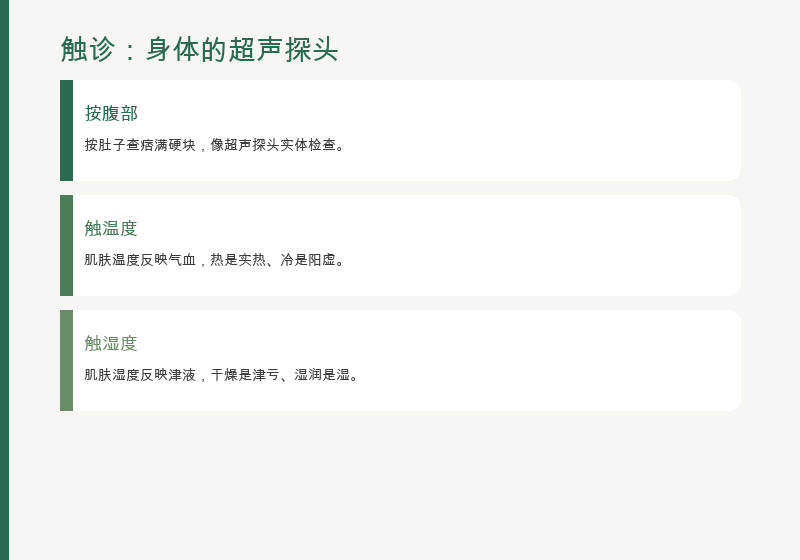
Pressing the abdomen (examining organs) — pressing the abdomen for softness, hardness, temperature, lumps, and tenderness. Soft abdomen without pain = deficiency pattern; hard abdomen resisting pressure = excess pattern; hard lumps in abdomen = zheng-jia (chronic accumulation); tenderness in abdomen = qi stagnation and blood stasis. For example: during constipation, hard lumps can be felt in the abdomen (fecal matter); gastritis causes upper abdominal tenderness; cirrhosis causes hard abdomen — all are physical evidence of palpation.
Pressing acupoints (examining meridians) — pressing specific acupoints to perceive sensitivity, nodules, and cord-like structures. Tenderness at acupoints = blocked meridians; nodules at acupoints = qi stagnation and blood stasis; cord-like structures at acupoints = meridian obstruction. For example: pressing Zusanli (ST36) with pain = weak spleen and stomach; pressing Taichong (LV3) with pain = liver qi stagnation; pressing Sanyinjiao (SP6) with pain = spleen deficiency with dampness.
Pressing the skin (examining qi and blood) — touching the skin for temperature, moisture, and elasticity. Hot skin = heat pattern; cold skin = cold pattern/yang deficiency; moist skin = sufficient fluids; dry skin = insufficient fluids; good skin elasticity = abundant qi and blood; loose skin = insufficient qi and blood. For example: fever causes burning skin; shock causes cold skin; dehydration causes dry skin; elderly people have loose skin.
So, what the ancients called "chu" (touch) is not just "touching" but "physical scanning" obtained by the hands — objective evidence that can be felt and perceived. The ancients used palpation to transform abstract symptoms into tangible physical information.
Part 3giaogiao Modern Translation
Okay, now let's translate "chu" into modern language.
I'm not going to talk about ultrasound imaging, CT scans, or palpation techniques. Too complicated. Just remember one metaphor:
Abdominal palpation = feeling abdominal wall tension + organ size + lumps + tenderness
Acupoint palpation = perceiving nerve-sensitive points + muscle nodules + fascial adhesions
Skin palpation = temperature (metabolic rate) + moisture (sweating/fluids) + elasticity (collagen)
Deficiency pattern = loose tissue, low tension, low temperature (insufficient energy)
Excess pattern = tense tissue, high tension, obvious tenderness (inflammation/accumulation)
That's it. Your "sense of touch" is essentially the physical state of tissue perceived by the hands — like an ultrasound probe, feeling physical evidence.
Specifically:
What does "abdominal palpation" correspond to? It corresponds to physical examination in clinical practice. Rigid abdominal wall (board-like abdomen) = peritonitis; abdominal tenderness = inflammation or blood stasis; abdominal mass = tumor, fecal matter, cyst; fluctuation sensation in abdomen = ascites. Western abdominal palpation and TCM abdominal pressing use almost the same method — both use hands to perceive the physical state of the abdomen.
What does "acupoint palpation" correspond to? It corresponds to nerve reflex points and myofascial trigger points. Acupoints are often located at nerve-vascular bundles or myofascial junctions. Blocked meridians = local neuromuscular abnormalities, fascial adhesions, microcirculatory disorders. Pain when pressing acupoints = nerve sensitization, myofascial pain syndrome. The mechanism of acupuncture and massage highly aligns with modern neuroscience's "gate control theory" and "myofascial release."
What does "skin temperature" correspond to? It corresponds to peripheral blood circulation and metabolic rate. Hot skin = high metabolic rate, vasodilation (inflammation/fever); cold skin = low metabolic rate, vasoconstriction (deficiency cold/shock); hot flashes = autonomic nervous disorder; icy skin = peripheral circulatory disorder. TCM's "hot skin = excess pattern, cold skin = deficiency pattern" aligns with modern medicine's "high fever = inflammation, low body temperature = shock/decline."
What does "skin elasticity" correspond to? It corresponds to collagen content and fluid status. Good elasticity = sufficient collagen, sufficient water; poor elasticity = collagen loss (aging), dehydration (fluid deficiency). Pinching the skin and slow return = tissue dehydration or aging; fast return = sufficient water, young tissue. TCM's "moist and lustrous skin indicates sufficient fluids" aligns with modern medicine's "skin elasticity is a dehydration indicator."
So, "chu" (touch) is not mysticism. It is simply a tangible physical diagnosis — using hands to perceive tissue tension, temperature, moisture, and elasticity. The ancients summarized it as "qie zhen" (cutting diagnosis), and modern people describe it as "physical examination + ultrasound + CT" — palpation is the foundation of physical examination, applicable across time.
Part 4Real-Life Cases
Four stories to make you instantly understand what "chu" (touch) is.
Case 1: Hard lump in abdomen during constipation.
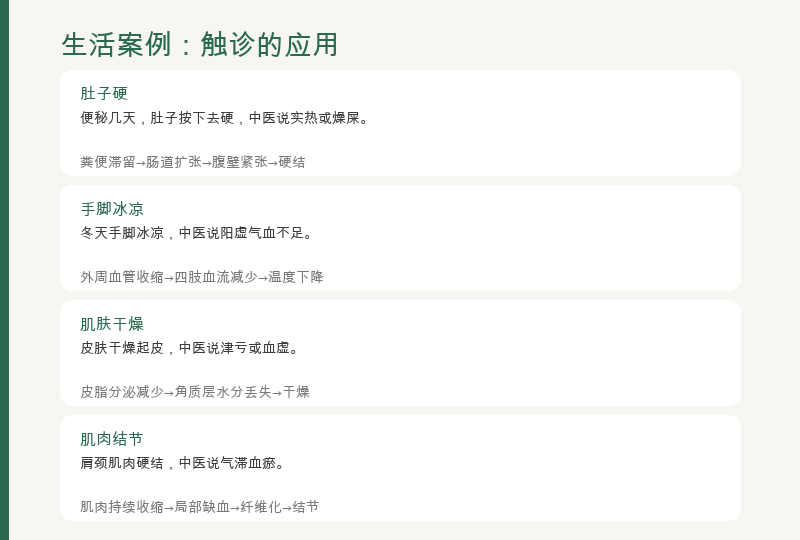
You haven't had a bowel movement for three days, and your belly is bloated. You lie in bed and use your hand to touch the left lower abdomen, feeling a hard "tube" — like a sausage. You're scared: "Is it a tumor?" TCM touches it and says: "fecal accumulation, dry large intestine." Western medicine says: "fecal matter, constipation."
Truth: During constipation, feces stay in the colon for too long, water is over-absorbed, and the fecal matter hardens. In the left lower abdomen (sigmoid colon position), a cord-like hard lump can be felt. This is not a tumor; it is accumulated feces — solid "physical evidence." TCM says "hard lumps in the abdomen, dry feces inside" — precisely describing the abdominal sign of constipation. But the description of "hard when pressed, painful and resisting pressure" precisely summarizes the tactile sensation of fecal matter.
Case 2: Pain when pressing Zusanli.
Your stomach is uncomfortable, so you go for a massage. The therapist presses the spot four finger-widths below your knee (Zusanli), and you scream in pain. The therapist says: "Stomach meridian blocked, spleen and stomach weak." You ask: "Why does my leg hurt when my stomach has a problem?"
Truth: Zusanli is an important point of the stomach meridian, located between the tibialis anterior and extensor digitorum longus, rich in nerve-vascular bundles. When stomach function is abnormal, through viscero-somatic reflex, the same spinal segment's nerve supply area becomes sensitized. When pressing Zusanli, the nerve-sensitive point is activated, producing pain. It is not "blocked meridians" but nerve sensitization caused by reflex — internal organs and body surface are connected through nerves. TCM says "stomach meridian blocked, Zusanli tender" — though the wording is ancient, it precisely describes the viscero-somatic reflex.
Case 3: Cold hands and feet (yang deficiency).
In winter, your hands and feet are cold, even wearing thick socks doesn't help. You say "poor circulation," TCM says "yang deficiency, unable to warm the four limbs." You ask: "What is yang?"
Truth: Cold hands and feet are essentially peripheral vasoconstriction with reduced blood flow. When cold or stressed, the sympathetic nervous system is excited, peripheral blood vessels (especially hands and feet) constrict, and blood is prioritized to the heart and brain. In chronic yang deficiency/hypothyroidism, the basal metabolic rate drops, heat production decreases, and peripheral vasoconstriction is more obvious. It is not "less blood" but blood being "allocated" to more important places, and hands and feet become the "abandoned ones." TCM says "yang deficiency, four limbs not warm" — precisely summarizing peripheral circulatory disorder. But the description of "yang" though abstract, points to the core of metabolism and circulation.
Case 4: Poor skin elasticity (dehydration/aging).
You've had diarrhea all day, your skin feels dry, and when you pinch the skin on your arm, it returns very slowly. You say "my skin is aging," TCM says "fluids depleted, skin losing moisture." You ask: "Why does diarrhea affect the skin?"
Truth: During diarrhea, large amounts of water and electrolytes are lost, and the body is dehydrated. The skin is the body's largest organ; when water is insufficient, the dermis loses moisture, collagen fiber spacing changes, and elasticity drops. Pinching the skin with slow return is a classic clinical sign of dehydration (skin elasticity test). At the same time, elderly people naturally lose collagen, so elasticity is also poor. It is not "aging skin" but skin is the body's "water meter," and poor elasticity is a dehydration signal. TCM says "fluids depleted, skin losing moisture" — precisely summarizing the effect of dehydration on skin. But the description of "fluids" though ancient, precisely describes the body's fluid state.
Four cases, one underlying logic: touch is "physical scanning" — the evidence touched is the most direct diagnosis.
Part 5Modern Research
Does "chu" (touch) have scientific research?
Yes, and quite a lot. Scientists don't use the word "qie zhen" (cutting diagnosis); they use:
• Abdominal palpation and correspondence with internal diseases. Research has found that abdominal palpation has a diagnostic accuracy of 70-80% for appendicitis, cholecystitis, and peritonitis. McBurney's point tenderness (right lower abdomen) = appendicitis; Murphy's sign (right upper abdomen) = cholecystitis; rebound tenderness = peritonitis. Palpation is the core method of abdominal disease screening.
• Acupoint tenderness and nerve reflex relationship. Research has found that when internal organs are diseased, the corresponding somatic segment's acupoints show tender sensitization, and the mechanism is the spinal nerve's visceral-somatic reflex. In patients with gastric ulcers, the tenderness sensitivity at Zusanli increases 3-fold. Acupoints are indeed "surface windows" of internal organ states.
• Skin temperature and autonomic nervous function. Infrared thermal imaging research has found that skin temperature distribution is closely related to autonomic nervous function. When the sympathetic nervous system is over-excited, peripheral blood vessels constrict, and skin temperature drops (cold hands and feet); when the parasympathetic nervous system is excited, peripheral blood vessels dilate, and skin temperature rises. Skin temperature is the "thermal imaging map" of the autonomic nervous system.
These studies fully demonstrate that "chu" (touch) is a concept that can be precisely described using modern scientific language. The ancients summarized it as "qie zhen," and modern people describe it as "physical examination + nerve reflex + thermal imaging" — they are talking about the same thing.
Part 6Practical Methods
Now that you understand "chu," how do you touch?
First, dispel some misconceptions:
• "I can find tumors by touching my own belly." Abdominal masses have many causes: fecal matter, gas, cysts, tumors. Self-touching cannot determine the nature. If an abnormal mass is found, you must seek medical examination. It is not "touching = diagnosis" but touching = need to see a doctor.
• "The more painful the acupoint, the better." Acupoint tenderness is a diagnostic signal, not a treatment goal. Moderate pain during massage is sufficient; excessive pain may cause tissue damage. It is not "the more painful, the more open" but moderate stimulation, excess is as bad as deficiency.
Specific methods:
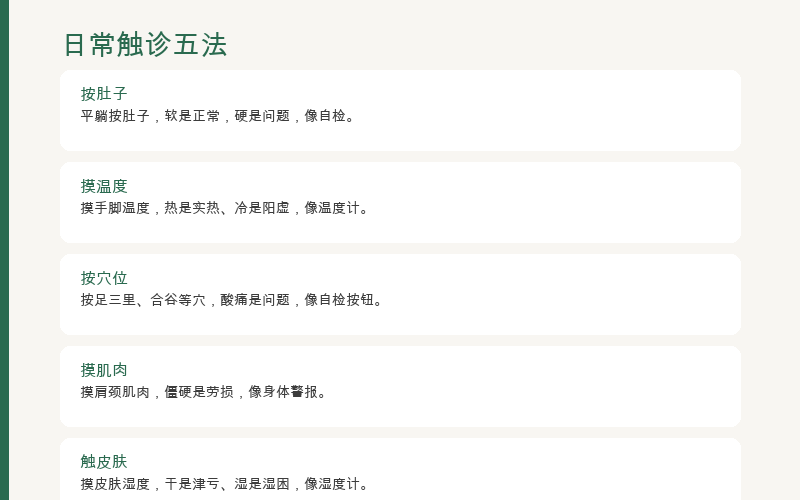
• Self-examining abdomen (clockwise check). Lie flat, bend knees and relax, use your palm to gently touch the abdomen in a clockwise direction. Pay attention to: any lumps? any tenderness? any bloating? The left lower abdomen (sigmoid colon) often has fecal matter, which is normal. But if you feel an unexplained hard lump or persistent tenderness, seek medical attention promptly.
• Pay attention to pain location (organ mapping). Upper abdominal pain = stomach/duodenum/liver; right lower abdominal pain = appendix/cecum; left lower abdominal pain = sigmoid colon/constipation; periumbilical pain = small intestine/mesentery. Pain location is the "map" of organ mapping.
• Pressing Hegu (self-checking meridian sensitivity). Hegu (LI4) is the acupoint of the hand yangming large intestine meridian. Use your thumb to press the opposite Hegu; normally there is a sore and swollen sensation. If it is extremely painful or numb, it may indicate large intestine meridian problems (such as constipation, toothache, headache). This is a simple "meridian self-check."
• Comparing temperature on both sides (circulatory symmetry). Use the back of your hand to compare the temperature of both sides of the body. Normally, left and right are symmetrical. If one side is obviously cold or hot, it may indicate circulatory disorder or nerve abnormality on that side. For example: one side of cold hands and feet = arterial stenosis or nerve compression on that side.
• Pay attention to skin changes (elasticity + moisture). Pinch the skin on your arm and observe the return speed. Normal return is <2 seconds. If >3 seconds, it may indicate dehydration or collagen loss. Observe skin moisture: moist = normal; dry = dehydration or fluid deficiency; abnormally damp = excessive sweating or damp-heat.
These methods do not require you to believe in TCM. You only need to understand: touch is "physical scanning" — the changes felt by touch are the body's most direct physical evidence.
Part 7One-Minute Summary
🕐 One Minute to Understand "Touch"
Touch = the body's ultrasound probe + physical scanner.
Palpation has three levels: pressing the abdomen (examining organs), pressing acupoints (examining meridians), pressing the skin (examining qi and blood).
Soft abdomen without pain = deficiency; hard abdomen resisting pressure = excess; hard lumps = zheng-jia; tenderness = qi stagnation and blood stasis.
Touch = the physical state of tissue (temperature, moisture, elasticity, tension).
Hot skin = high metabolism; cold skin = poor circulation; moist skin = sufficient fluids; dry skin = dehydration; good elasticity = youth; poor elasticity = aging.
Misconceptions: self-diagnosing tumors by touching belly, the more painful the acupoint the better.
Methods: clockwise self-examining abdomen, noting pain location, pressing Hegu for self-check, comparing temperature on both sides, observing skin elasticity.
The ancients called it "qie zhen," modern people call it "physical examination."
Different names, but the body knows: palpation is physical examination, tangible evidence, the most honest.
The ancients had no ultrasound, but knew "pain when pressed indicates excess."
This is probably the most simple wisdom of the Chinese people: Skillful is the one who knows by cutting; palpation is the body's most honest physical scan.
Making money is the art of living; art is the life after making money.
giaogiao Decodes Chinese Traditional Wisdom · Concept 59
Using modern scientific language to help the world understand Chinese traditional wisdom.
Not mysterious, not superstitious, not belittling.
Understand, rather than merely believe.
Coach Liu
Written in Florence