Fang (Formula) — Formula Prescriptions: The Art of Combination
Part 1A Question
Have you ever noticed why sometimes you use Ephedra Decoction for a cold, and sometimes Cinnamon Decoction? Both involve sweating, but one promotes sweating while the other stops it—completely different prescriptions?
Have you noticed that ginseng alone can't cure illness, but when combined into Four Gentlemen Decoction (ginseng + atractylodes + poria + licorice) it can regulate the spleen and stomach? What's the difference between single herbs and compound formulas?
What's even crazier is that TCM talks about the "Eighteen Incompatibilities"—some herbs can't be used together, like aconite incompatible with pinellia, which can cause poisoning if combined. But you also hear that some highly toxic herbs combined together actually reduce toxicity, like chemotherapy toxicity reduction protocols. You ask: What kind of art is formula composition?
Here's another question: Modern pharmacology research has found that the effective ingredients in compound Chinese medicine aren't simply the additive effects of each herb's ingredients, but produce new synergistic effects. You ask: This is completely different from Western medicine's logic of "single ingredient, single target"—is Chinese medicine's combination actually more advanced?
What exactly is fang? Why did the ancients say "a thousand formulas are easy to obtain, but one effective formula is hard to find"?
Part 2Traditional Chinese Explanation
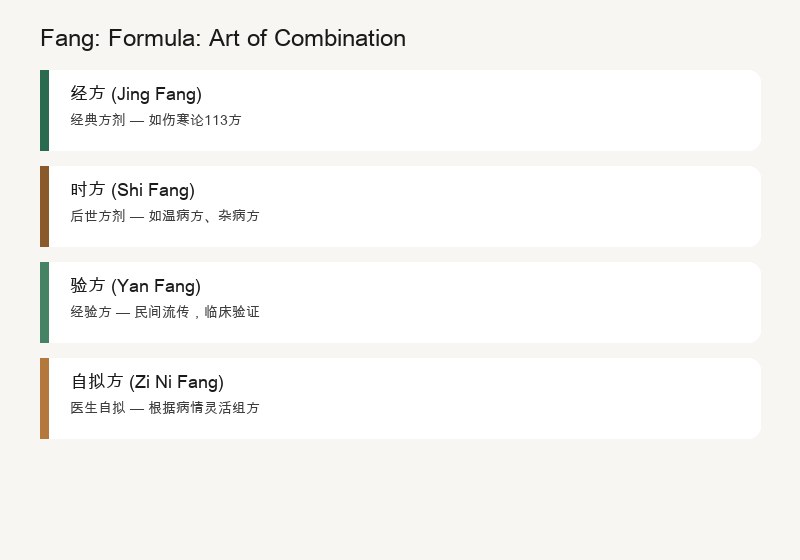
The concept of "fang" is TCM's core technical system. It's not single herbs, but combined formulas; not simple stacking, but precise collaboration. The Yellow Emperor's Inner Classic says: "Formulas have monarch, minister, assistant, and envoy, to control the chaotic qi"—formulas are like national governance, with a ruler, ministers, assistants, and envoys.
— Yellow Emperor's Inner Classic, Su Wen
"Medicinals have monarch, minister, assistant, and envoy, to harmonize and coordinate."
— Divine Farmer's Classic of Materia Medica
"Formulas arise from methods, methods follow from patterns."
— Methods of the Heart in Medicine
The ancients observed: using a single herb to treat illness is like one person fighting a gang, overwhelmed. But combining several herbs in specific proportions and specific ways is like forming a team—some lead the attack, some assist, some restrain, some provide logistics. This is "formula."
Formula = Monarch Herb + Minister Herb + Assistant Herb + Envoy Herb. Not randomly assembled, but a collaboration system where each has its own role.
• Monarch Herb: The main striker, targeting the primary disease and pattern. In Ephedra Decoction, ephedra promotes sweating and releases the exterior—like the core product manager in a team, clear goals.
• Minister Herb: The assistant striker, assisting the monarch or treating secondary symptoms. In Ephedra Decoction, cinnamon assists ephedra in promoting sweating—like an engineer cooperating with the product manager, enhancing the main attack.
• Assistant Herb: The auxiliary, one to assist the monarch and minister, two to restrain toxicity, three to counteract (preventing the medicine from being rejected by the disease). In Ephedra Decoction, apricot kernel lowers lung qi and stops cough and wheezing—like a designer, solving side effects; while also restraining ephedra's overly strong dispersing nature.
• Envoy Herb: The guide and messenger, guiding the medicinal power to the disease location, or harmonizing all medicinals. In Ephedra Decoction, licorice harmonizes all medicinals and moderates ephedra's strong nature—like a project manager, coordinating the team, ensuring smooth operation.
So, what the ancients called "fang" wasn't just a "prescription"—it was a "team collaboration art" of carefully orchestrated combination, like a meticulously arranged symphony, where every voice has a reason for being.
But formulas have one big principle: Formulas arise from methods, methods follow from patterns. First, pattern differentiation (determine the treatment method), then compose the formula according to the method. Not "one formula treats a hundred diseases," but "one pattern, one formula." Like warfare, first assess the enemy (pattern differentiation), then devise strategy (establish method), finally deploy troops (compose formula).
Part 3giaogiao's Modern Translation
Okay, now let's translate "fang" into modern language.
I'm not going to talk about medicinal chemistry or pharmacokinetics. Too complicated. You just need to remember one analogy:
Monarch Herb = Main active ingredient (targeting the primary target)
Minister Herb = Synergistic active ingredient (enhancing the main herb's action or targeting secondary targets)
Assistant Herb = Auxiliary/regulatory ingredient (enhancing efficacy, reducing toxicity, correcting deviations)
Envoy Herb = Guide/harmonizing ingredient (directing delivery, moderating stimulation)
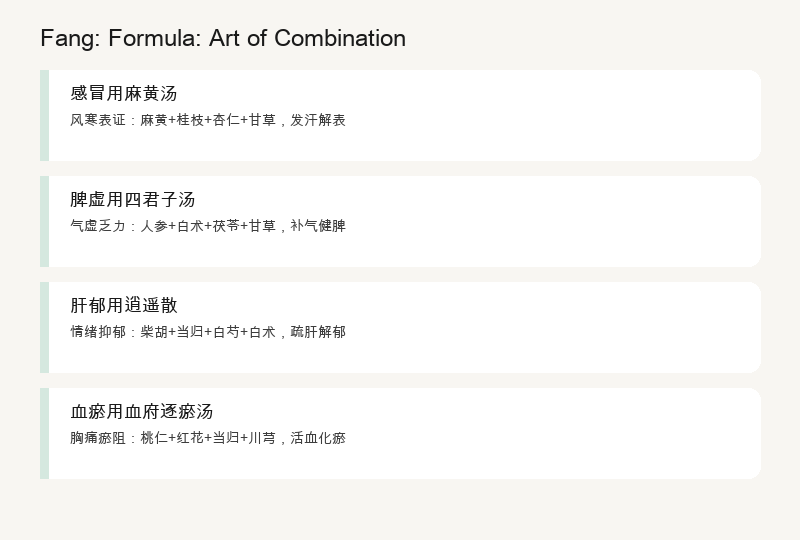
Ephedra Decoction = Ephedra (promotes sweating) + Cinnamon (synergistic sweating) + Apricot kernel (stops cough and wheezing) + Licorice (harmonizes strong nature)
Four Gentlemen Decoction = Ginseng (tonifies qi) + Atractylodes (strengthens spleen and dries dampness) + Poria (drains dampness and promotes water metabolism) + Licorice (harmonizes)
Synergistic enhancement = 1+1>2 (multi-ingredient, multi-target synergy)
Toxicity reduction enhancement = 1+1<2 (toxic ingredients are inhibited, therapeutic ingredients are enhanced)
Herb pairs = Fixed combinations (like ephedra-cinnamon, ginseng-atractylodes), like classic doubles teams
That's it. Simple. "Fang" is essentially a "team collaboration system" for medicinals—not single combat, but precisely proportioned multi-ingredient synergy.
Specifically:
What does "Ephedra Decoction" correspond to? It corresponds to a synergistic sweating antipyretic and analgesic solution. Ephedra contains ephedrine, which stimulates the sympathetic nervous system and expands sweat glands; cinnamon contains volatile oils, which expand blood vessels and promote sweating; apricot kernel contains amygdalin, which suppresses cough and wheezing; licorice contains glycyrrhizin, which harmonizes all medicinals and has anti-inflammatory and anti-allergic effects. Not "sweating and releasing the exterior" mysticism, but multi-ingredient synergy acting on the thermoregulatory center + sweat glands + respiratory tract. Modern research confirms that Ephedra Decoction's antipyretic effect is over 30% stronger than using ephedra alone—this is synergistic enhancement.
What does "Four Gentlemen Decoction" correspond to? It corresponds to an intestinal function repair "nutrition + regulation" combination. Ginseng contains ginsenosides, which enhance immune function and promote protein synthesis; atractylodes contains volatile oils, which enhance intestinal motility and protect intestinal mucosa; poria contains polysaccharides, which promote diuresis and regulate immunity; licorice contains glycyrrhizin, which is anti-inflammatory and harmonizing. Not "tonifying qi and strengthening the spleen" mysticism, but multi-ingredient synergy repairing intestinal function + enhancing immunity + regulating water metabolism. Modern research confirms that Four Gentlemen Decoction can significantly improve intestinal flora imbalance, with better effects than ginseng alone.
What does "combination toxicity reduction" correspond to? It corresponds to drug-drug interaction mechanisms for toxicity reduction. Pinellia is toxic, but when paired with ginger (in Pinellia and Magnolia Bark Decoction), the gingerols in ginger can inhibit pinellia's irritant toxicity; aconite is toxic, but when paired with dried ginger (in Frigid Extremities Decoction), dried ginger can enhance aconite's cardiotonic effect while reducing its toxicity. Not "fighting poison with poison" mysticism, but one ingredient inhibiting another ingredient's toxicity target, while enhancing its therapeutic target—modern pharmacology calls this "selective synergy."
So, "fang" is not mysticism. It's simply a multi-ingredient, multi-target, synergistic enhancement, toxicity reduction enhancement "team collaboration system"—the ancients described it as "monarch, minister, assistant, envoy," modern people describe it as "multi-ingredient synergy, network pharmacology"—the core logic is consistent: single herb is limited, team is unlimited.
Part 4Real-Life Cases
Four stories to help you instantly understand what "fang" is.
Case One: Ephedra Decoction Treats a Cold (Synergistic Sweating).
You caught a chill, aversion to cold, fever, no sweating, headache, body pain. Western medicine says "viral infection, self-limiting disease, drink more water." TCM prescribes Ephedra Decoction (ephedra + cinnamon + apricot kernel + licorice), one dose sweats out, illness mostly resolved. You ask: "Why are a few herbs faster than Western medicine for reducing fever?"
Truth: This is the synergistic sweating antipyretic mechanism. Ephedrine stimulates sympathetic nerves and expands sweat glands; cinnamon volatile oils expand blood vessels and promote heat dissipation; amygdalin suppresses cough and wheezing; licorice harmonizes and moderates. The four herbs are like a special forces team—ephedra breaks the door (opens sweat glands), cinnamon provides cover (expands blood vessels), apricot kernel cleans up (suppresses cough), licorice coordinates (prevents over-strength). Not "sweating and releasing the exterior" mysticism, but multi-ingredient synergy acting on the thermoregulatory center. Modern research: Ephedra Decoction's antipyretic effect is over 30% stronger than ephedra alone, with faster onset by 20 minutes—this is the power of teamwork. But Ephedra Decoction is only for "no sweating" exterior excess patterns; for sweating exterior deficiency patterns, Cinnamon Decoction is used—different teams fight different battles.
Case Two: Four Gentlemen Decoction Regulates Spleen and Stomach (Team Repair).
You have long-term stomach bloating, poor appetite, loose stools. Gastroscopy: chronic superficial gastritis. Take Western medicine domperidone, temporary improvement, relapse after stopping. TCM prescribes Four Gentlemen Decoction (ginseng + atractylodes + poria + licorice), after one month, stomach bloating significantly reduced, appetite improved. You ask: "Why can 'tonifying qi' cure stomach disease?"
Truth: This is an intestinal function repair "nutrition + regulation" combination. Ginseng promotes gastric mucosa repair and enhances immunity; atractylodes enhances intestinal motility and protects mucosa; poria regulates intestinal water metabolism; licorice is anti-inflammatory and harmonizing. The four herbs are like a repair crew—ginseng buys materials (promotes repair), atractylodes lays pipes (enhances motility), poria drains water (regulates water metabolism), licorice does quality control (anti-inflammatory). Not "tonifying qi and strengthening the spleen" mysticism, but multi-ingredient synergy repairing intestinal function. Modern research: Four Gentlemen Decoction can significantly improve intestinal flora diversity, with effects 40% better than ginseng alone—teamwork is more efficient.
Case Three: Aconite Paired with Dried Ginger Reduces Toxicity (The Science of Fighting Poison with Poison).
You have icy cold limbs, weak pulse, yang qi about to collapse. TCM prescribes Frigid Extremities Decoction (aconite + dried ginger + licorice), aconite is highly toxic, but after taking it you're fine, and instead come back from the brink of death. You ask: "Why can a highly toxic medicine save a life without causing poisoning?"
Truth: This is a classic case of combination toxicity reduction. Aconite contains aconitine, which has a cardiotonic effect but is highly toxic; dried ginger contains gingerols, which can inhibit aconitine's toxicity target (excessive sodium channel opening) while enhancing its cardiotonic target (beta receptor stimulation). Glycyrrhizin in licorice further detoxifies. Not "fighting poison with poison" mysticism, but one ingredient selectively inhibiting the toxicity pathway while preserving the therapeutic pathway—modern pharmacology calls this "selective synergy." Like installing a precise detonator on a bomb, only blowing up the enemy, not yourself.
Case Four: The Lesson of Random Formula Assembly (A Mess Without Monarch, Minister, Assistant, and Envoy).
You heard "ginseng greatly tonifies, astragalus tonifies qi, angelica supplements blood, goji berry nourishes yin," so you boil all four herbs together, thinking "all-tonifying." You end up with internal heat, dry mouth, insomnia. You ask: "Why do tonic herbs harm the body instead?"
Truth: This is a mess without "monarch, minister, assistant, and envoy." Both ginseng and astragalus are qi-tonifying monarch herbs; two monarch herbs stacked together is like two CEOs fighting for power, causing internal team friction. Angelica supplements blood but tends to warm, goji berry nourishes yin but tends to cool, hot and cold clash, with no "envoy" to harmonize. Not "tonic herbs are bad," but uncombined stacking is like putting several experts in one room without division of labor—they're bound to fight. TCM says "formulas arise from methods"—first determine what problem you want to solve (pattern differentiation), then choose the team (compose formula), not "throw in all the good stuff."
Four cases, one underlying logic: Fang is "team collaboration"—it's not about having more people, but about clear division of labor and synergistic enhancement; it's not about expensive herbs, but about forming the right team for the symptoms, precise strikes.
Part 5Modern Research
Is there scientific research on "fang"?
Yes, and it's very cutting-edge. Scientists don't use the term "monarch, minister, assistant, envoy"; they use "network pharmacology" and "multi-ingredient, multi-target synergy":
• Network pharmacology and compound formula combination. In the 2010s, Chinese scientists proposed the concept of "network pharmacology": compound Chinese medicine formulas are not single ingredients acting on single targets, but multiple ingredients simultaneously acting on multiple targets, forming a "drug-target-disease" network. Like playing mahjong, it's not about winning with one tile, but about the whole hand cooperating. Research shows that the active ingredients of Four Gentlemen Decoction act on over 200 targets, covering the digestive, immune, nervous, and endocrine systems—not "one formula treats a hundred diseases," but multi-system synergistic regulation network effects.
• Synergistic enhancement and toxicity reduction enhancement mechanisms. Modern pharmacology confirms that compound formula combinations can produce three effects: synergistic enhancement (additive or multiplicative), antagonistic toxicity reduction (one ingredient inhibiting another's toxicity), and bidirectional regulation (the same compound formula producing different effects in different states). For example, Coptis Toxin-Removing Decoction (coptis + scutellaria + phellodendron + gardenia), the antibacterial spectra of the four herbs overlap, with antibacterial effects 4-8 times stronger than coptis alone, while reducing coptis's gastrointestinal irritation—not "simple stacking," but precisely coordinated chemical network.
• From Chinese medicine formulas to modern new drugs. Artemisinin was extracted from the single herb "sweet wormwood" and won the Nobel Prize; Compound Danshen Dripping Pills (salvia + notoginseng + borneol) passed FDA Phase II clinical trials, confirming efficacy for coronary heart disease; Lianhua Qingwen Capsules (ephedra + forsythia + honeysuckle, etc.) were approved by multiple countries during the COVID-19 pandemic. These examples show that the combination logic of Chinese medicine formulas is being re-examined and validated by modern medicine. Not "ancient secret formulas," but multi-ingredient synergistic scientific systems.
These studies fully demonstrate that "fang" is a concept that can be precisely described in modern scientific language. The ancients described it as "monarch, minister, assistant, envoy," modern people describe it as "network pharmacology, multi-target synergy"—the core logic is consistent: single herb is limited, team is unlimited; not simple stacking, but precise collaboration.
Part 6Practical Methods
You understand "fang"—now how do you use it?
First, dispel a few misconceptions:
• "Good herbs piled together make a good formula." Ginseng, astragalus, angelica, goji berry are all good herbs, but piled together they might cause internal heat, clash, and waste. Not "more good herbs is better," but it's about team coordination, not star stacking.
• "Ancient formulas are secret formulas, just copy them." Ephedra Decoction treats no-sweat colds, Cinnamon Decoction treats sweating colds—the same disease, completely different formulas. Not "one formula treats a hundred diseases," but formulas arise from methods, methods follow from patterns.
Specific methods:
• Understand that "pattern differentiation and method establishment" is the premise of formula composition (first diagnose, then prescribe). Colds are divided into wind-cold, wind-heat, summer-dampness, and qi deficiency—different treatments, completely different formulas. Wind-cold uses Ephedra Decoction, wind-heat uses Honeysuckle and Forsythia Powder, qi deficiency uses Ginseng and Perilla Decoction. Not "take isatis root for every cold," but first differentiate the pattern, then choose the formula.
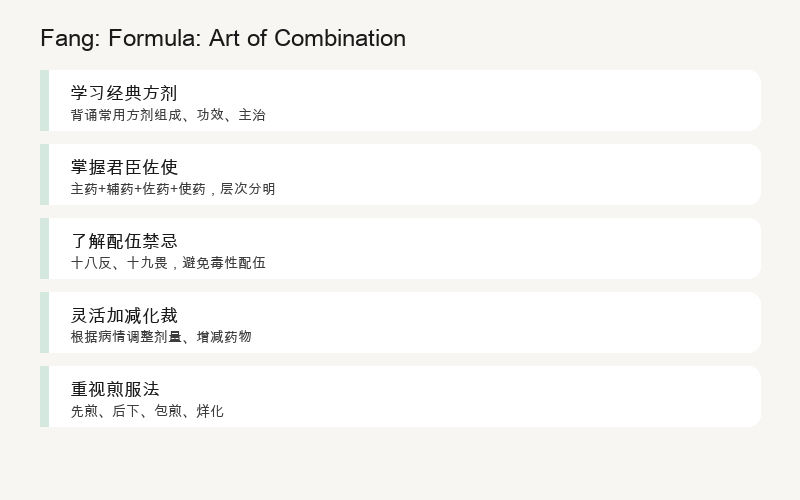
• Learn the combination logic of classic formulas (see how the team coordinates). Four Gentlemen Decoction: ginseng (tonifies qi) + atractylodes (strengthens spleen) + poria (drains dampness) + licorice (harmonizes)—tonifying without stagnation, warming without drying. Understand each role's division of labor, not rote memorization.
• Learn herb pairs (classic doubles combinations). Some herbs are naturally a pair: ephedra-cinnamon (promotes sweating and releases the exterior), ginseng-atractylodes (tonifies qi and strengthens the spleen), coptis-scutellaria (clears heat and dries dampness), angelica-ligusticum (activates blood and regulates menstruation). Learn these classic pairings, like learning basketball "pick and roll" coordination.
• Value combination contraindications (Eighteen Incompatibilities, Nineteen Fears). Aconite incompatible with pinellia, licorice incompatible with kansui, veratrum incompatible with ginseng—these combinations produce toxicity or severe side effects. Not "superstitious taboos," but modern pharmacology-confirmed adverse drug interactions.
• Understand that dosage is the soul of the formula (team member ratio). In Ephedra Decoction, ephedra is three liang, cinnamon two liang, apricot kernel seventy pieces, licorice one liang—different dosages, different effects. Not "having these herbs is enough," but dosage ratio determines the team's combat power.
These methods don't require you to become a TCM doctor. You just need to understand: Fang is "team collaboration"—not single combat, but precise proportioning; not good herb stacking, but symptom-matching team formation; not copying ancient formulas, but pattern differentiation and method establishment.
Part 6 (Continued)Practical Methods: Five Tips for Using Formulas Well
Part 7One-Minute Summary
🕐 One Minute to Understand "Fang"
Fang = The Art of Combination + Team Collaboration.
Formula prescriptions are not single herbs, but combined formulas; not simple stacking, but precise collaboration.
Monarch Herb (main attack) + Minister Herb (assistance) + Assistant Herb (auxiliary/restraint) + Envoy Herb (guidance/harmonization).
Ephedra Decoction = Ephedra (promotes sweating) + Cinnamon (synergy) + Apricot kernel (suppresses cough) + Licorice (harmonizes).
Four Gentlemen Decoction = Ginseng (tonifies qi) + Atractylodes (strengthens spleen) + Poria (drains dampness) + Licorice (harmonizes).
Synergistic enhancement = 1+1>2; Toxicity reduction enhancement = 1+1<2; Herb pairs = classic doubles combinations.
Misconceptions: Good herbs piled together make a good formula; ancient formulas can be copied as-is.
Methods: Pattern differentiation and method establishment, learn classic combinations, learn herb pairs, value contraindications, understand dosage.
The ancients called it "monarch, minister, assistant, envoy," modern people call it "network pharmacology, multi-ingredient multi-target synergy."
Different names, but medicine knows: single herb is limited, team is unlimited—formulas are TCM's core technology.
The ancients didn't have network pharmacology, but knew "monarch, minister, assistant, and envoy, each with its own role."
This is probably the most朴素的 wisdom of the Chinese people: One person walks fast, a group walks far—but only if the group has clear division of labor and默契 cooperation.
Making money is the art of living; art is the life after making money.
giaogiao Explains Traditional Chinese Wisdom · Concept 76
Using the language of modern science to help the world understand traditional Chinese wisdom.
No mysticism, no superstition, no belittlement.
Understand, rather than merely believe.
Coach Liu
Written in Florence