Yao (药) — Medicine: The Natural Pharmacy
Part 1A Question
Have you ever noticed that berberine treats diarrhea, artemisinin cures malaria, and paclitaxel fights cancer — these Nobel Prize-level drugs all come from Chinese medicine?
Have you noticed that Chinese medicine doesn't talk about "chemical composition" but about "four energies and five flavors" — cold, hot, warm, and cool; pungent, sweet, sour, bitter, and salty — like sticking a "physicochemical property card" on every herb? Even more mind-blowing, the ancients spoke of "meridian tropism" — this herb enters the Liver channel, that one enters the Kidney channel — like installing a "targeted navigation system" in the drug?
You ask: Why can Chinese medicine cure diseases? Is it the placebo effect, or are there real chemical substances? If there really are chemical substances, why didn't the ancients use chemical formulas, but instead described them with "energies, flavors, and meridian tropism"?
Here's another question: Different parts of the same plant have different medicinal effects — ginseng uses the root, mint uses the leaves, honeysuckle uses the flowers — why? The same herb from different origins or harvested in different seasons has vastly different effects — is "geo-authentic medicinal material" really scientific?
What exactly is medicine? What secrets does the "natural pharmacy" of Chinese medicine hold?
Part 2Traditional Chinese Explanation
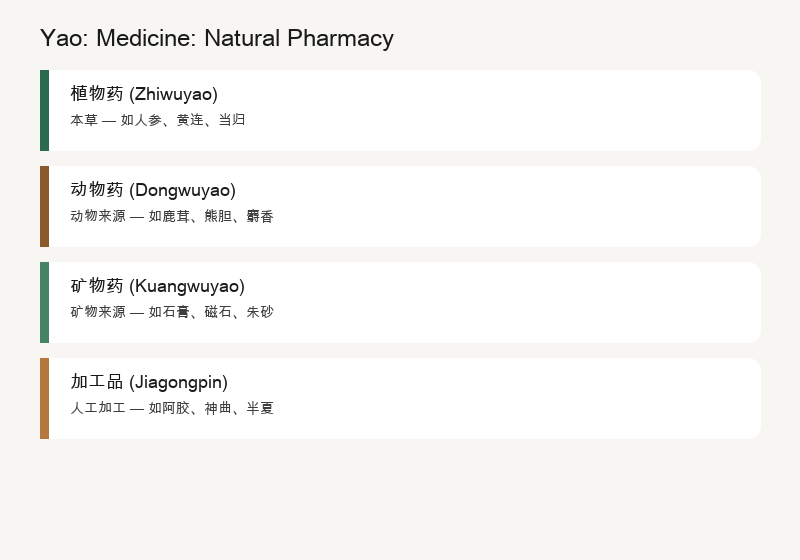
The concept of "medicine" (药) is the material foundation of Chinese medicine. Chinese medicine is not just roots and bark; it is a treasury of natural compounds. The ancients used "four energies, five flavors, ascending-descending-floating-sinking, and meridian tropism" to describe drugs — like establishing a set of "attribute files" for every herb.
——Shennong Bencao Jing
"Ascending, descending, floating, and sinking are the directional tendencies of medicinal properties."
——Compendium of Materia Medica
"Meridian tropism is the specific entry of a drug into a particular channel."
——Bencao Beiyao
The ancients observed that plants, minerals, and animals in nature could change the body's state when consumed. Some made you feel hot, some made you feel cold, some caused diarrhea, some caused constipation — this was the starting point of observing "four energies and five flavors."
Four Energies = Cold, Hot, Warm, Cool — the "temperature attribute" of a drug, corresponding to the intensity of physiological activity in modern pharmacology.
Five Flavors = Pungent, Sweet, Sour, Bitter, Salty — the "taste attribute" of a drug, corresponding to the type and direction of chemical constituents.
Ascending-Descending-Floating-Sinking = the "direction of movement" of a drug — ascending means upward (inducing sweating, lifting yang), descending means downward (subduing rebellious qi, purging), floating means outward (dispersing, releasing the exterior), sinking means inward (astringing, consolidating).
Meridian Tropism = the "targeting system" of a drug — entering the Liver channel, entering the Heart channel, entering the Spleen channel — like a drug's "GPS navigation," knowing where it should go.
So, what the ancients called "medicine" was not just "substance" — it was a set of "attribute encoding systems" — four energies and five flavors are the basic parameters, ascending-descending-floating-sinking is the direction of movement, and meridian tropism is the targeted positioning.
But medicine has a major principle: medicine and food share the same origin. Many medicines are also foods — ginger, jujube, Chinese yam, hawthorn — showing that the ancient understanding of medicine was continuous, not a binary "medicine = poison" split. This is also the theoretical basis of Chinese medicine's "food therapy."
Part 3giaogiao's Modern Translation
Okay, now let's translate "medicine" into modern language.
I'm not going to talk about phytochemistry or pharmaceutical analysis. Too complex. You just need to remember one metaphor:
Four Energies = Intensity of physiological activity of a drug (hot = excitation, cold = inhibition)
Five Flavors = Taste identifiers of chemical constituents (pungent = volatile oils, sweet = sugars/amino acids, sour = organic acids, bitter = alkaloids/glycosides, salty = minerals)
Ascending-Descending-Floating-Sinking = Direction of drug action (ascending = promoting/exciting, descending = inhibiting/sedating, floating = outward dispersing, sinking = inward consolidating)
Meridian Tropism = Target organ selectivity of a drug (Liver channel = nervous system/detoxification, Heart channel = circulatory system, Spleen channel = digestive system)
Berberine = Berberine (antibacterial, anti-inflammatory)
Artemisinin = Sesquiterpene lactone (kills malaria parasites)
Paclitaxel = Diterpenoid (inhibits microtubule depolymerization, anti-cancer)
Ginsenoside = Triterpenoid saponin (adaptogen, immune regulation)
Glycyrrhizin = Triterpenoid saponin (anti-inflammatory, harmonizing)
That's it. "Medicine" is essentially a natural source "active compound library" — every herb is a collection of chemical constituents, the ancients encoded them with four energies and five flavors, and modern people decode them with chemical structural formulas.
Specifically:
What do "Four Energies" correspond to? They correspond to the intensity of a drug's physiological activity. Cold-natured drugs (such as coptis, gypsum) = inhibitory activity — lowering metabolism, sedation, antibacterial, anti-inflammatory; Hot-natured drugs (such as aconite, dried ginger) = excitatory activity — increasing metabolism, strengthening the heart, raising temperature, promoting blood circulation. It's not "cold and hot" mysticism; it's the direction in which a drug regulates the body's metabolic rate — modern pharmacology calls this "excitation/inhibition effects."
What do "Five Flavors" correspond to? They correspond to the categories of chemical constituents. Pungent flavor (such as ephedra, mint) = contains volatile oils, with stimulating, dispersing, and blood-circulation-promoting effects; Sweet flavor (such as ginseng, licorice) = contains sugars and amino acids, with nourishing, tonifying, and moderating effects; Sour flavor (such as dark plum, hawthorn) = contains organic acids, with astringing and consolidating effects; Bitter flavor (such as coptis, scutellaria) = contains alkaloids and glycosides, with antibacterial, anti-inflammatory, and purgative effects; Salty flavor (such as mirabilite, oyster shell) = contains minerals, with softening hardness, purging, and sedating effects. It's not "taste" mysticism; it's the correspondence between the taste identifiers of chemical constituents and their pharmacological activities.
What does "Meridian Tropism" correspond to? It corresponds to the target organ selectivity of a drug. Entering the Liver channel (such as bupleurum, white peony) = acts on the nervous system, detoxification system, and emotional regulation; Entering the Heart channel (such as salvia, sour jujube seed) = acts on the circulatory system and nervous system; Entering the Spleen channel (such as atractylodes, poria) = acts on the digestive system and immune system. It's not "meridian mysticism"; it's the selective distribution and action of drug components on specific organs/systems — modern pharmacology calls this "tissue distribution specificity" and "receptor selectivity."
So, "medicine" is not mysticism. It's just a natural source "active compound library" — the ancients encoded it with four energies, five flavors, ascending-descending-floating-sinking, and meridian tropism; modern people decode it with chemical constituents, pharmacological effects, and target mechanisms — the core logic is consistent: nature provides the medicine, and humans need to learn to read it.
Part 4Real-Life Cases
Four stories to make you instantly understand what "medicine" is.
Case One: Berberine Treats Diarrhea (From Herb to Modern Drug).
You have diarrhea, you take berberine (berberine hydrochloride), and it stops quickly. Berberine is an alkaloid extracted from coptis — the ancients used coptis for "clearing heat, drying dampness, purging fire, and detoxifying" for two thousand years, and modern people extracted and purified it into tablets. You ask: "Why can coptis be antibacterial?"
The truth: Coptis contains berberine, which can inhibit the DNA gyrase of intestinal bacteria (such as E. coli and dysentery bacteria), preventing bacterial reproduction. At the same time, it inhibits the release of inflammatory factors, reducing intestinal inflammation. The ancients didn't have microscopes, but they observed that coptis was "bitter and cold" and treated "damp-heat dysentery" — bitter = contains alkaloids (antibacterial components), cold = inhibitory activity (reducing inflammatory response). It's not "clearing heat" mysticism; it's the science of natural antibiotics. Modern research: berberine has a broad antibacterial spectrum and is effective even against drug-resistant bacteria, known as a "plant antibiotic."
Case Two: Artemisinin Saves Malaria (The Nobel Prize Chinese Medicine Story).
Tu Youyou extracted artemisinin from sweet wormwood, won the 2015 Nobel Prize in Physiology or Medicine, and saved the lives of millions of malaria patients. Artemisinin comes from the Chinese medicine qinghao (sweet wormwood); the ancients used it to "clear deficient heat and eliminate bone-steaming fever." You ask: "Why can a grass cure malaria?"
The truth: Artemisinin is a sesquiterpene lactone, and its mechanism for killing malaria parasites is extremely unique — it is activated by iron ions inside the malaria parasite, generating free radicals that attack the parasite's cell membrane and proteins. This is a completely new anti-malarial mechanism, and the parasite cannot develop resistance. The ancients used qinghao to "treat malaria with alternating chills and fever" — they observed the therapeutic effect but didn't know the principle. Modern people extracted the active component and figured out the mechanism. It's not "magic grass" mysticism; it's the chemical wisdom of plant secondary metabolites. Nature took hundreds of millions of years to evolve this compound; humans only discovered it.
Case Three: Ginseng's "Adaptogen" Effect (Bidirectional Regulation).
Your blood pressure is low, you take ginseng, and your blood pressure rises; your blood pressure is high, you take ginseng, and your blood pressure drops? How is that possible? Western antihypertensives can only lower blood pressure, and pressor agents can only raise it. You ask: "Does ginseng raise or lower blood pressure?"
The truth: This is ginseng's "adaptogen" effect. Ginsenosides have more than 40 subtypes, some of which excite the central nervous system (raising blood pressure), and some inhibit the central nervous system (lowering blood pressure); some enhance immunity, and some inhibit excessive immunity. Depending on the body's state, different subtypes play a role — the body needs to rise, so it rises; the body needs to fall, so it falls. The ancients used ginseng to "greatly replenish primordial qi" — it's not "primordial qi" mysticism; it's the network effect of multi-component bidirectional regulation. Modern research: ginsenosides are "intelligent regulators," like the body's thermostat, automatically calibrating.
Case Four: Danggui's Blood-Nourishing "Iron + Volatile Oil" Mechanism.
You are anemic, pale, and Chinese medicine prescribes danggui (angelica sinensis). Danggui is the "sacred medicine for blood nourishment," but you ask: "It's not an iron supplement, so how does it nourish blood?"
The truth: Danggui contains two key components — one is iron (rich in the head of danggui), which directly participates in hemoglobin synthesis; the other is volatile oil (rich in the tail of danggui), which promotes blood circulation and improves the hematopoietic microenvironment. The ancients used danggui "head to stop bleeding, tail to activate blood, body to nourish blood" — different parts have different constituents and different effects. It's not "blood nourishment" mysticism; it's the synergistic effect of iron + blood circulation promotion. Modern research: danggui polysaccharides can also stimulate the proliferation of bone marrow hematopoietic stem cells — multi-component synergy, the ancients observed it, and modern people explained it.
Four cases, one underlying logic: medicine is a "natural compound library" — active molecules evolved by nature, the ancients encoded them with four energies and five flavors, and modern people decode them with chemical constituents. Nature is the best pharmaceutical company.
Part 5Modern Research
Is there scientific research on "medicine"?
Yes, and it's very substantial. Scientists don't use the term "four energies and five flavors"; they use "phytochemistry" and "natural medicinal chemistry":
• From Chinese Medicine to the Nobel Prize: The Discovery of Artemisinin. In the 1960s, Tu Youyou's team was inspired by Ge Hong's "Zhouhou Beiji Fang" from the Eastern Jin Dynasty, used low-temperature ether extraction on sweet wormwood, and obtained the highly effective anti-malarial component artemisinin. Won the Nobel Prize in 2015. This is the most successful case of modernizing Chinese medicine — it's not "ancient prescription mystery," it's discovering new chemical structures from traditional experience and then verifying them with modern science. The discovery of artemisinin proves that Chinese medicine, this "natural compound library," hides treasures that modern medicine has yet to discover.
• Multi-Target Pharmacological Effects of Berberine. Berberine (berberine) is not only a natural antibiotic; modern research has also found that it can regulate blood sugar (improving insulin resistance), lower blood lipids, protect the cardiovascular system, and regulate the gut microbiome. One molecule, multiple targets — this is precisely the manifestation of Chinese medicine's "multi-component, multi-target" characteristics in a single component. It's not "coptis is omnipotent"; it's the multi-target network effect of natural compounds.
• Scientific Validation of Geo-Authentic Medicinal Materials. The ancients emphasized "geo-authentic medicinal materials" — such as Ningxia goji berries, Sichuan coptis, Northeast ginseng, and Yunnan pseudo-ginseng. Modern research confirms that the same species of medicinal material from different origins has significantly different chemical constituents. For example, the ginsenoside content of ginseng from Fusong in Northeast China is 2-3 times higher than that of southern cultivated ginseng; the goji polysaccharide content of Ningxia goji berries is significantly higher than that of other production areas. It's not "origin superstition"; it's soil, climate, and altitude affecting the secondary metabolism of plants — just like the terroir of wine, scientifically verifiable.
These studies fully demonstrate that "medicine" is a concept that can be precisely described in modern scientific language. The ancients described it with "four energies and five flavors, ascending-descending-floating-sinking, and meridian tropism"; modern people describe it with "chemical constituents, pharmacological effects, and target mechanisms" — the core logic is consistent: nature is the best pharmaceutical company, and humans need to learn to read it.
Part 6Practical Methods
Now that you understand "medicine," how do you use it?
First, let's dispel a few misconceptions:
• "Chinese medicine has no side effects because it's natural". Natural ≠ safe. Aconite, wolfsbane, and cinnabar are all toxic; aristolochic acid (contained in guanmutong, etc.) is nephrotoxic. It's not "natural is non-toxic"; it's natural medicines also have toxicity, and you need to understand dosage and contraindications.
• "Chinese medicine works slowly, while Western medicine works fast". Some Chinese medicines work very quickly (ephedra decoction induces sweating in 30 minutes), and some Western medicines work very slowly (antihypertensives need to be taken long-term). It's not "Chinese medicine is slow, Western medicine is fast"; it's it depends on the specific drug and the condition.
Specific methods:
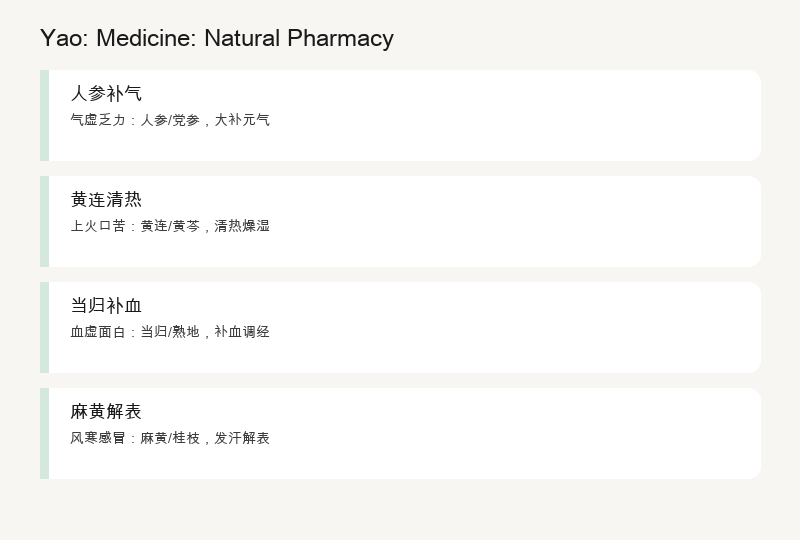
• Understand the four energies of a drug (determine cold and heat). If you have excessive internal heat (dry mouth, bitter taste, acne), use cold-natured drugs (coptis, chrysanthemum); if you are cold (cold hands and feet, diarrhea), use hot-natured drugs (dried ginger, aconite). It's not "use it randomly"; it's select medicine based on the body's condition.
• Understand the correspondence between the five flavors and effects (pungent disperses, sweet tonifies, sour astringes, bitter purges, salty softens). In the early stage of a cold, use pungent drugs (ginger, mint) to disperse; when weak, use sweet drugs (jujube, licorice) to tonify; when sweating excessively, use sour drugs (dark plum, schisandra) to astringe; when constipated, use bitter drugs (rhubarb, coptis) to purge; when there is a mass, use salty drugs (mirabilite, oyster shell) to soften. It's not "it tastes good"; it's flavor corresponds to chemical constituents and effects.
• Pay attention to the meridian tropism of a drug (targeted selection). For insomnia, choose drugs that enter the Heart channel (sour jujube seed, salvia); for indigestion, choose drugs that enter the Spleen channel (atractylodes, poria); for emotional depression, choose drugs that enter the Liver channel (bupleurum, white peony). It's not "meridian mysticism"; it's the target organ selectivity of drugs.
• Choose geo-authentic medicinal materials (origin matters). For ginseng, choose Fusong in Northeast China; for pseudo-ginseng, choose Wenshan in Yunnan; for goji berries, choose Zhongning in Ningxia; for coptis, choose Hongya in Sichuan. It's not "origin superstition"; it's origin affects the content of chemical constituents.
• Understand the harvesting season (time matters). Mulberry leaves are harvested after frost (higher effective constituents), mint is harvested in summer (rich in volatile oils), and ginseng is harvested in autumn (saponin accumulation is highest). It's not "time superstition"; it's plant secondary metabolism changes with the seasons.
These methods don't require you to become a Chinese medicine pharmacist. You only need to understand: medicine is a "natural compound library" — four energies and five flavors are the encoding, chemical constituents are the decoding; meridian tropism is the targeting, origin is the quality; nature is the best pharmaceutical company, but you need to read it with science.
Part 6 (Continued)Practical Methods: Five Ways to Use Medicinal Substances Well
Part 7One-Minute Summary
🕐 One Minute to Understand "Medicine"
Medicine = Natural Pharmacy + Natural Chemical Library.
Chinese medicine is not just roots and bark; it is a treasury of natural compounds.
Four Energies (cold, hot, warm, cool) = Intensity of physiological activity; Five Flavors (pungent, sweet, sour, bitter, salty) = Type of chemical constituents.
Ascending-Descending-Floating-Sinking = Direction of action; Meridian Tropism = Target organ selectivity.
Berberine = Natural antibiotic; Artemisinin = New anti-malarial drug; Paclitaxel = Anti-cancer star.
Ginsenoside = Adaptogen (bidirectional regulation); Danggui = Iron + volatile oil synergistic blood nourishment.
Misconceptions: Chinese medicine has no side effects because it's natural; Chinese medicine works slowly, Western medicine works fast.
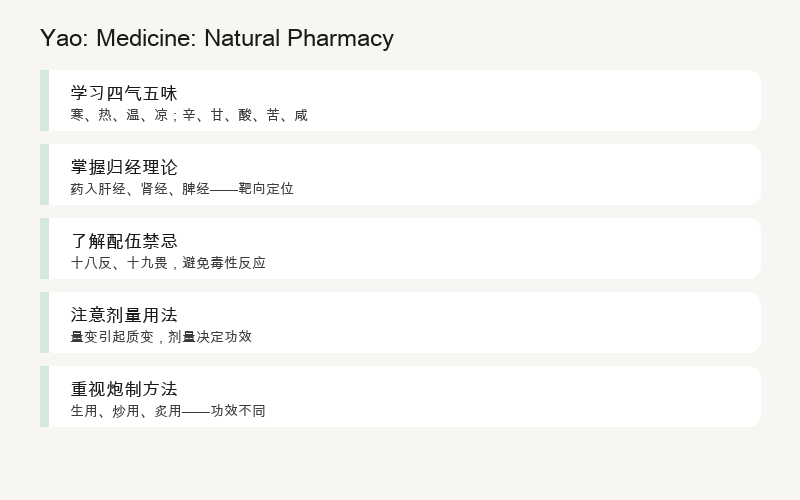
Methods: Understand the four energies to choose cold or heat, understand the five flavors to match effects, pay attention to meridian tropism for targeting, choose geo-authentic medicinal materials, and understand the harvesting season.
The ancients called it "four energies, five flavors, and meridian tropism"; modern people call it "chemical constituents, pharmacological effects, and target mechanisms."
Different names, but medicine knows: nature is the best pharmaceutical company, and humans are only apprentices.
The ancients didn't have chromatographs, but they read nature's user manual using four energies and five flavors.
This is probably the most simple wisdom of the Chinese people: nature is the best pharmaceutical company, but you need to learn to read its language.
Making money is the art of living; art is the life after making money
giaogiao Decodes Traditional Chinese Wisdom · Concept 77
Using the language of modern science to help the world understand traditional Chinese wisdom.
No mysticism, no superstition, no belittlement.
Understand, rather than merely believe.
Coach Liu
Written in Florence