Cao (草) — Herbal: Plant Wisdom
Part 1A Question
Have you ever noticed why ginseng grows in the Northeast, pseudo-ginseng in Yunnan, and danggui in Gansu — as if every herb has its own "hometown"?
Have you noticed that the "Compendium of Materia Medica" records 1,892 kinds of medicinal substances, each with properties, meridian tropism, effects, and contraindications — like a "user manual" for plants? Even more mind-blowing, the ancients had no laboratories; they used their tongues to taste and their bodies to test, tasting out the "properties" of each herb — like conducting a thousand-year human experiment?
You ask: How did the ancients know that coptis clears heat, ginseng tonifies qi, and danggui nourishes blood? Was it guesswork, or does it really work? If it really works, why has modern science only proven a small fraction of it?
Here's another question: Why is it called "materia medica" (本草)? What's the difference between "materia medica" and "Chinese medicine"? Why does Japan call it "kampo" and Korea "han-yak" — all the same set of plants, but different names?
What exactly is herbal? Why has materia medica been passed down for two thousand years?
Part 2Traditional Chinese Explanation
The concept of "materia medica" (本草) is the general term for traditional Chinese pharmacology. "Ben" (本) means root and origin, "cao" (草) means plant — materia medica is the pharmacology that takes plants as the root. The "Compendium of Materia Medica" is the pinnacle of materia medica; Li Shizhen spent 27 years recording 1,892 kinds of medicinal substances and 11,096 formulas — like an ancient pharmaceutical encyclopedia.
——Compendium of Materia Medica
"Shennong tasted a hundred herbs, encountering seventy poisons a day, and was saved by tea."
——Huainanzi
"The physician is one who uses intention. Using medicine is like using troops; the opportunity must not be missed."
——Bencao Beiyao
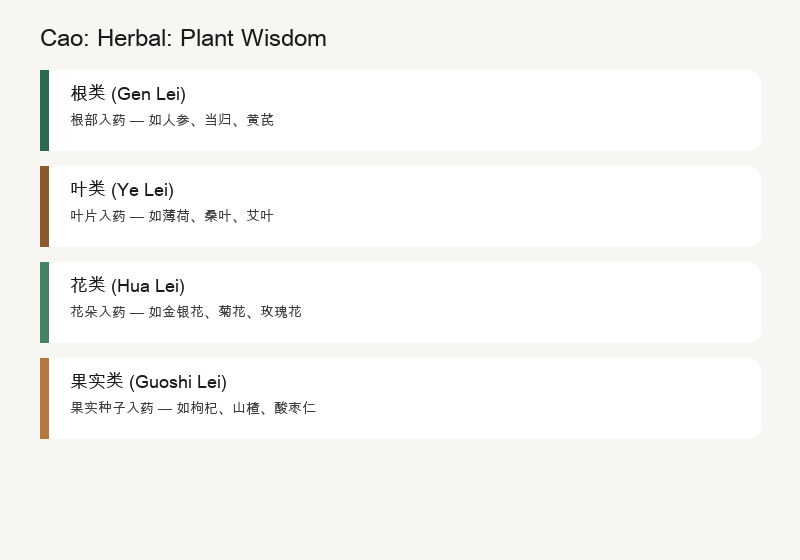
The ancients observed that plants have "properties" — cold, hot, warm, and cool; have "flavors" — pungent, sweet, sour, bitter, and salty; have "forms" — root, stem, leaf, flower, and fruit; have "colors" — green, red, yellow, white, and black. These properties correspond to different effects.
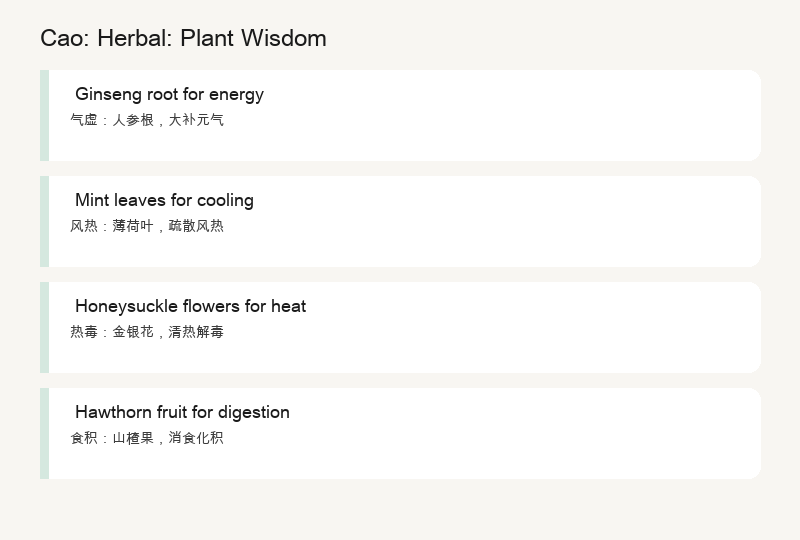
Ginseng: Sweet and slightly bitter in flavor, slightly warm in nature, entering the Spleen, Lung, and Heart channels — greatly tonifies primordial qi, restores the pulse and prevents collapse, tonifies the Spleen and benefits the Lungs, generates fluids and nourishes blood.
Coptis: Bitter in flavor, cold in nature, entering the Heart, Spleen, Stomach, Liver, Gallbladder, and Large Intestine channels — clears heat and dries dampness, purges fire and detoxifies.
Danggui: Sweet and pungent in flavor, warm in nature, entering the Liver, Heart, and Spleen channels — nourishes and activates blood, regulates menstruation and relieves pain, moistens the intestines and promotes bowel movement.
Pseudo-ginseng: Sweet and slightly bitter in flavor, warm in nature, entering the Liver and Stomach channels — disperses blood stasis and stops bleeding, reduces swelling and relieves pain.
Every herb's description is like a "product manual" — properties and flavors are the basic parameters, meridian tropism is the scope of application, effects are the core functions, and contraindications are the precautions. The ancients managed 1,892 kinds of medicinal substances with this system.
But materia medica has a major characteristic: medicine and food share the same origin. Many herbs are both medicine and food — Chinese yam, goji berries, jujube, hawthorn, ginger, and mint. This shows that the ancient understanding of "herbal" was continuous, not a fear of "medicine = poison."
Part 3giaogiao's Modern Translation
Okay, now let's translate "herbal" (materia medica) into modern language.
I'm not going to talk about plant taxonomy or pharmacognosy. Too complex. You just need to remember one metaphor:
Materia medica = Ancient pharmaceutical information system (1,892 medicinal substances, each with an attribute file)
Properties and flavors = Physiological activity + chemical constituent identifiers (cold = inhibitory, hot = excitatory; bitter = alkaloids, sweet = sugars)
Meridian tropism = Target organ/system selectivity of a drug (Liver = nerve/detoxification, Heart = circulation, Spleen = digestion)
Effects = Clinically observed pharmacological actions (tonifying qi = enhancing immunity/metabolism, clearing heat = anti-inflammatory/antibacterial)
Contraindications = Adverse reactions and contraindications (pregnant women avoid, deficient cold avoid, overdose is toxic)
Ginseng = Ginsenosides (adaptogen, bidirectional regulation) + polysaccharides (immune enhancement)
Coptis = Berberine (antibacterial, anti-inflammatory) + coptisine (lowers blood sugar)
Danggui = Volatile oil (activates blood) + iron (nourishes blood) + polysaccharides (promotes hematopoiesis)
Pseudo-ginseng = Pseudo-ginseng saponins (bidirectional regulation of hemostasis + blood activation) + flavonoids (antioxidant)
Geo-authentic medicinal materials = High-quality varieties under specific ecological conditions (soil, climate, altitude affect secondary metabolism)
Harvesting season = Time window for accumulation of plant chemical constituents (different seasons have different effective constituent contents)
That's it. "Materia medica" is essentially an "herbal pharmaceutical information system" built by the ancients through a thousand-year human experiment — every herb has an attribute file, a record of effects, and a label of contraindications.
Specifically:
What does "Shennong tasting a hundred herbs" correspond to? It corresponds to ancient drug screening clinical trials. The ancients had no animal experiments, only human experiments — tasting a plant, observing the body's reaction: fever, chill, sweating, diarrhea, pain relief, calming... recording and accumulating, passing down to future generations. Over two thousand years, 1,892 effective medicinal substances and more than 11,000 proven formulas were screened. It's not a "mythical legend"; it's large-scale, long-term, human-participated drug screening — the cost was high ("encountering seventy poisons a day"), but the results were real.
What do "properties and flavors and meridian tropism" correspond to? They correspond to the drug's "attribute file system." Properties (cold, hot, warm, cool) = direction of physiological activity (excitation/inhibition); Flavors (pungent, sweet, sour, bitter, salty) = type of chemical constituents (volatile oils/sugars/organic acids/alkaloids/minerals); Meridian tropism = target organ selectivity (Liver/Heart/Spleen/Lung/Kidney). It's not "mystical encoding"; it's an "attribute database of drugs" built by the ancients through sensory and clinical observation — in modern terms, it's the five-dimensional file of a drug's "physiological activity spectrum + chemical fingerprint + target distribution + clinical indication + contraindications."
What does "geo-authentic medicinal materials" correspond to? It corresponds to the concepts of ecotype and chemotype. The same species, under different ecological environments, has vastly different secondary metabolites (effective constituents). For example, Northeast ginseng (Changbai Mountains, cold, humus soil) has high ginsenoside Rg1 and Rb1 content; Korean ginseng (similar ecology) has similar quality; while southern cultivated ginseng has low saponin content and poor quality. It's not "origin superstition"; it's ecological conditions affecting the yield and quality of plant chemical constituents — exactly the same as wine's terroir, scientifically provable.
So, "materia medica" is not mysticism. It's just an "herbal pharmaceutical information system" built by the ancients through a thousand-year human experiment — nature provided the database, and the ancients wrote the user manual — modern people verify and expand it with chemical analysis and pharmacological experiments.
Part 4Real-Life Cases
Four stories to make you instantly understand what "materia medica" is.
Case One: The "Geo-authentic" Mystery of Ginseng (Ecology Determines Quality).
You buy ginseng; Northeast-produced ginseng costs 5,000 yuan per jin, while southern greenhouse-produced ginseng costs 500 yuan per jin. You ask: "It's all ginseng, why is there a 10-fold difference?"
The truth: This is an ecotype difference. The Northeast Changbai Mountains — cold (average annual temperature 3-7°C), long daylight (16 hours in summer), humus soil (deep and fertile) — these conditions stimulate ginseng to produce large amounts of secondary metabolites (ginsenosides) to resist cold and pests. Southern greenhouses — warm, short daylight, artificial soil — the ginseng is "coddled" and doesn't need to produce so many defensive compounds, so saponin content is low. It's not "superstition about the Northeast"; it's adversity breeds quality — plants are like people, too comfortable and they don't develop skills. Modern testing: Northeast ginseng total saponin content is 3-6%, while southern greenhouse ginseng is only 1-2%.
Case Two: Pseudo-ginseng's "Hemostasis + Blood Activation" Bidirectional Regulation (Same Herb, Two Opposite Functions).
You have a bruise, swelling, and pain from a fall, and you use pseudo-ginseng to activate blood and resolve stasis; you have stomach bleeding or a nosebleed, and you also use pseudo-ginseng to stop bleeding. You ask: "The same herb can both activate blood and stop bleeding — isn't that contradictory?"
The truth: This is the bidirectional regulation effect of pseudo-ginseng saponins. Pseudo-ginseng contains pseudo-ginseng total saponins (PNS), among which different subtypes produce different effects at different doses: at low doses, they promote platelet aggregation (hemostasis), and at high doses, they inhibit platelet aggregation (blood activation). The ancients observed that pseudo-ginseng "stops bleeding without leaving stasis, and resolves stasis without harming the healthy qi" — it's not "contradiction"; it's dose-dependent bidirectional regulation — the body's intelligent switch. Modern research: pseudo-ginseng saponins are like a thermostat, automatically regulating direction according to the body's state.
Case Three: Danggui's "Head, Body, and Tail" Different Parts (The Plant's "Functional Zones").
You buy danggui; the pharmacy divides danggui into "head," "body," and "tail" — danggui head stops bleeding, danggui body nourishes blood, and danggui tail activates blood. You ask: "The same plant, why do different parts have different effects?"
The truth: This is the "functional zoning" of plant chemical constituents. The danggui head (top of the root) is rich in iron, and iron is the raw material for hemoglobin, so it "nourishes blood"; the danggui body (main root) has balanced polysaccharides and volatile oil, so it "harmonizes blood"; the danggui tail (lateral roots and rootlets) is rich in volatile oil, and volatile oil promotes blood circulation, so it "activates blood." It's not "part superstition"; it's different parts have different chemical constituent contents, so the functions naturally differ — just like tangerine peel (chenpi) and tangerine flesh have different effects because the constituents are different. Modern analysis: danggui tail volatile oil content is 3 times that of the head.
Case Four: Mint's "Harvest Time Window" (Time Matters).
You make mint tea and find that some mint is richly aromatic and coolingly long-lasting, while others are bland and tasteless. You ask: "Why does the same mint have such different effects?"
The truth: This is the effect of the harvesting season. Mint's cool constituent is mainly menthol, which belongs to volatile oils. Volatile oils accumulate most during the plant's vigorous growth period (summer flowering period); harvesting at this time yields high menthol content; if harvested too early (spring), volatile oils have not yet been fully synthesized; if harvested too late (autumn), volatile oils have partially decomposed. The ancients required "mint to be harvested in summer" — it's not "time superstition"; it's plant chemical constituents have an accumulation time window. Modern analysis: summer-harvested mint has menthol content 2-3 times higher than spring-harvested mint.
Four cases, one underlying logic: Materia medica is "plant wisdom" — every herb is a product of natural evolution, with specific ecology, specific parts, and specific times "optimal solution." The ancients recorded these patterns through a thousand-year observation, and modern people verify and explain them with science.
Part 5Modern Research
Is there scientific research on "materia medica"?
Yes, and it's very substantial. Scientists don't use the term "materia medica"; they use "pharmacognosy" and "phytochemistry":
• The "Human Experiment" of Materia Medica Has Been Verified by Modern Science. The ancients used ginseng to "greatly tonify primordial qi" — modern research confirms that ginsenosides have adaptogen effects, bidirectionally regulating immunity, nerves, and endocrine; the ancients used coptis to "clear heat and dry dampness" — modern research confirms that berberine has broad-spectrum antibacterial, anti-inflammatory, and blood sugar-lowering effects; the ancients used danggui to "nourish and activate blood" — modern research confirms that danggui polysaccharides promote hematopoiesis and volatile oil improves microcirculation. These examples show that the ancients' observations were not "guesswork"; they were real records of large-scale human experiments, only they didn't know the chemical principles at the time.
• Modern Development of Materia Medica Active Constituents. Active constituents extracted from materia medica have become important sources of modern drugs: paclitaxel (yew tree, anti-cancer), camptothecin (camptotheca, anti-cancer), vincristine (Madagascar periwinkle, anti-cancer), quinine (cinchona tree, anti-malarial), ephedrine (ephedra, anti-asthma), tanshinone (salvia, cardiovascular). World Health Organization statistics: about 40% of modern drugs globally are directly or indirectly derived from natural products. Materia medica, this "natural database," is a treasure trove for modern new drug research and development.
• Molecular Mechanisms of Geo-Authentic Medicinal Materials. Modern research uses genomics and metabolomics to reveal the quality mechanisms of geo-authentic medicinal materials. For example, the "ginsenoside synthesis genes" of Northeast ginseng are upregulated under low-temperature stress, producing more saponins; the "goji polysaccharide synthesis" of Ningxia goji berries is enhanced under drought and strong light, accumulating more polysaccharides. It's not "origin superstition"; it's ecological stress → gene expression → chemical constituents → medicinal quality a complete scientific chain.
These studies fully demonstrate that "materia medica" is a concept that can be precisely described in modern scientific language. The ancients described it with "properties, flavors, meridian tropism, geo-authentic origin, and harvesting"; modern people describe it with "chemical constituents, pharmacological mechanisms, and gene expression" — the core logic is consistent: nature is the best pharmaceutical company, and materia medica is the "user manual" written by the ancients.
Part 6Practical Methods
Now that you understand "materia medica," how do you use it?
First, let's dispel a few misconceptions:
• "Wild is always better than cultivated". Not necessarily. Wild ginseng is rare, but quality varies widely; standardized cultivation (GAP) ginseng has controllable quality and high safety. It's not "wild is good"; it's quality depends on standards, not source.
• "Ancient formulas are the best solution and cannot be changed". Ancient formulas were the optimal solution at the time, but modern people have new needs (such as a faster pace of life, new environmental toxins). It's not "ancient formulas cannot be touched"; it's understand the logic of ancient formulas and apply them flexibly.
Specific methods:
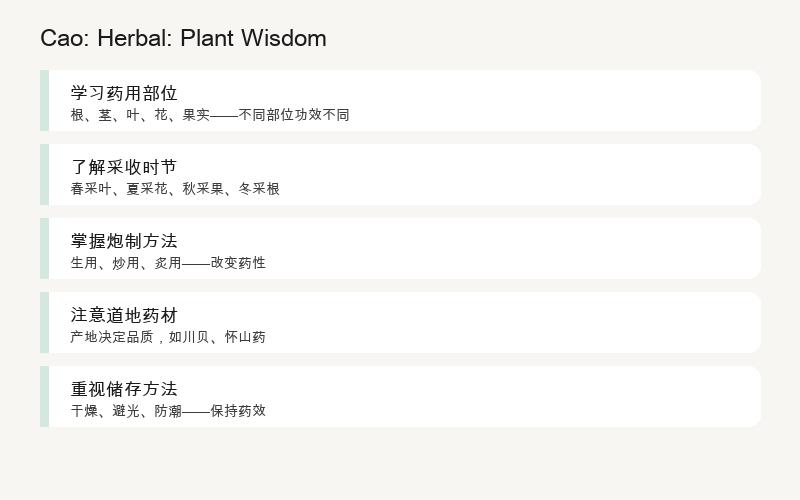
• Understand the drug's "four properties" (determine cold and heat direction). If you have excessive internal heat (dry mouth, bitter taste, acne), choose cold-natured herbs (chrysanthemum, honeysuckle, mint); if you are cold (cold hands and feet, diarrhea), choose hot-natured herbs (ginger, cinnamon, jujube). It's not "randomly brewing"; it's choose herbs based on the body's condition.
• Learn the daily application of "medicine and food sharing the same origin" (introduction to food therapy). Ginger dispels cold (drink ginger soup when chilled), hawthorn aids digestion (drink hawthorn water when overeaten), chrysanthemum benefits the eyes (drink chrysanthemum tea when eyes are overused), goji berries nourish (eat goji berries after staying up late). These are both food and medicine, safe and effective. It's not "taking medicine"; it's daily food therapy, prevention first.
• Choose geo-authentic medicinal materials (origin matters). For ginseng, choose the Northeast; for pseudo-ginseng, choose Wenshan in Yunnan; for goji berries, choose Ningxia; for danggui, choose Minxian in Gansu. It's not "origin superstition"; it's origin affects the content of chemical constituents.
• Understand the harvesting season (time matters). Mulberry leaves are harvested after frost, mint is harvested in summer, chrysanthemum is harvested in autumn, and root and rhizome medicinal materials are harvested in winter. It's not "time superstition"; it's plant chemical constituents change with the seasons.
• Understand the necessity of "formula compatibility" (don't use single herbs randomly). Herbs are rarely used alone; they are mostly combined into formulas. Ginger paired with jujube (harmonizes ying and wei), ginseng paired with atractylodes (tonifies qi and strengthens the Spleen), coptis paired with scutellaria (clears heat and dries dampness). It's not "one herb can do it all"; it's teamwork produces better results.
These methods don't require you to become a materia medica scholar. You only need to understand: materia medica is "plant wisdom" — nature evolved active compounds over hundreds of millions of years, the ancients wrote the user manual through a thousand-year human experiment, and modern people verify and expand it with science. Reading materia medica is reading the gift that nature has given to humanity.
Part 6 (Continued)Practical Methods: Five Ways to Use Materia Medica Well
Part 7One-Minute Summary
🕐 One Minute to Understand "Herbal"
Herbal = Plant Wisdom + Natural Database.
Materia medica is the "herbal pharmaceutical information system" built by the ancients through a thousand-year human experiment.
The "Compendium of Materia Medica" records 1,892 medicinal substances, each with properties, meridian tropism, effects, and contraindications — like a plant's "user manual."
Properties and flavors = Physiological activity + chemical constituent identifiers; Meridian tropism = Target organ selectivity;
Effects = Clinical pharmacological actions; Contraindications = Adverse reactions.
Ginseng (Northeast, adaptogen), pseudo-ginseng (Yunnan, bidirectional hemostasis and blood activation), danggui (Gansu, different effects for head, body, and tail), mint (summer harvest, highest volatile oil).
Misconceptions: wild is better than cultivated, ancient formulas cannot be changed.
Methods: understand the four properties to choose cold or heat, medicine and food sharing the same origin for daily food therapy, choose geo-authentic medicinal materials, look at the harvesting season, and understand compatibility.
The ancients called it "Shennong tasting a hundred herbs"; modern people call it "natural pharmaceutical chemistry, pharmacognosy."
Different names, but medicine knows: nature is the best pharmaceutical company, and materia medica is the ancients' "user manual."
The ancients had no laboratories; they used their tongues and bodies to write "user manuals" for 1,892 medicinal substances.
This is probably the most simple wisdom of the Chinese people: nature is the best pharmaceutical company; you only need to learn to read its user manual.
Making money is the art of living; art is the life after making money
giaogiao Decodes Traditional Chinese Wisdom · Concept 78
Using the language of modern science to help the world understand traditional Chinese wisdom.
No mysticism, no superstition, no belittlement.
Understand, rather than merely believe.
Coach Liu
Written in Florence