San (Powder) — Powder Preparation: Instant Powder
Part 1A Question
Have you ever noticed that Yunnan Baiyao is in powder form, and when you bleed from a wound, you just sprinkle it on and the bleeding stops? Have you ever noticed that ancient people had no tablets or capsules, so they took medicine by grinding herbs into powder and "swallowing powder" or "dissolving powder in water"?
Even more outrageous is that the era of "Shennong tasting a hundred herbs" — the earliest period of Chinese medicine — used powder preparations. Back then, there were no pots to boil medicine, so people just chewed herbs or ground them into powder and swallowed them directly. Powder is the oldest dosage form of Chinese medicine, even older than decoctions. You ask: "Why is the oldest thing still in use today?"
Another question: when you travel, decoctions are inconvenient to carry, pills are okay, but powder is the most convenient — a small packet of powder, add hot water and you have a bowl of medicine. You ask: "What is the difference between powder and granules?"
So, what exactly is San? Why is powder like "instant coffee" — powdered, easy to carry, quickly absorbed? Why must a "first aid kit" like Yunnan Baiyao be in powder form?
Part 2Traditional Chinese Explanation
The "San" dosage form is the oldest method of administering medicine in Chinese medicine. The ancients observed that grinding herbs into fine powder increases the surface area, enlarges contact area, and accelerates absorption — like instant coffee, the powder dissolves as soon as it touches water. Moreover, powder does not need to be decocted; it can be taken directly or dissolved in water, making it easy to carry — it was the "first aid kit" for ancients traveling far or going to war.
— Collected Annotations on the Materia Medica
"Decoction sweeps; pill delays; powder disperses."
— Shennong's Classic of Materia Medica
"Powder is fine and碎, easy to absorb, easy to carry."
— Compendium of Materia Medica
The ancients categorized dosage forms into levels: decoctions are fastest (need boiling), powder is also fast (no boiling, direct absorption), pills are slowest (need disintegration). Powder "disperses" — like wind scattering, quickly taking effect. Suitable for acute diseases, trauma, and situations requiring rapid intervention.
Powder = fine herb powder + direct administration / dissolving in water / external application. It is not simply "grinding up"; it is crushing herbs to a specific fineness, increasing surface area, and improving absorption speed.
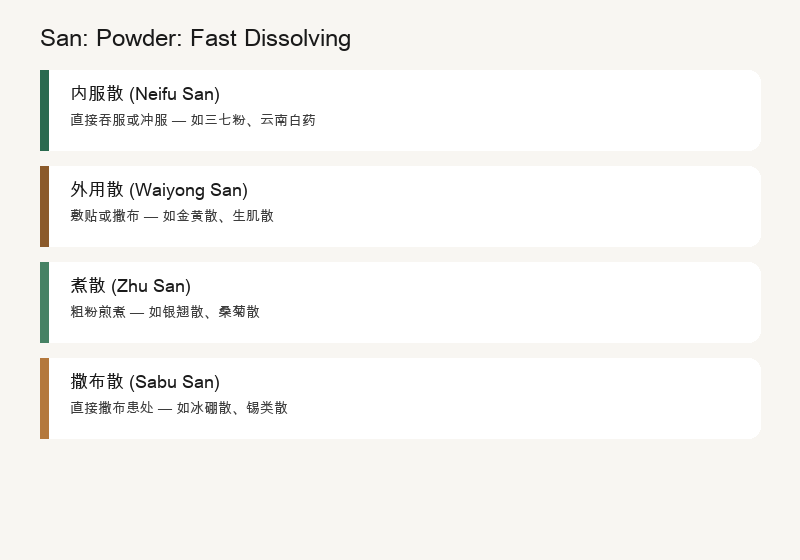
• Internal powder: taken directly (e.g., Qili Powder), or dissolved in hot water (e.g., Zixue Dan). The powder enters the gastrointestinal tract without needing disintegration, dissolving and absorbing directly — absorption speed is much faster than pills, approaching that of decoctions.
• External powder: sprinkled directly on wounds or affected areas (e.g., Yunnan Baiyao, Shengji Powder). The powder directly contacts the wound surface, with high local concentration, quickly stopping bleeding, reducing inflammation, and promoting tissue regeneration.
• Decoction powder: coarse powder boiled with water, similar to decoctions but with crushed herbs, enabling more complete extraction. It is an "upgraded version" of ancient decoctions.
So, what the ancients called "San" is not just "ground medicine" — it is a "soluble system" with large surface area, fast absorption, and the widest range of uses. Internal, external, dissolved, and decoction powder — four uses covering the most scenarios.
Powder has a unique advantage: easy to carry. When ancients went to war or traveled far, they could not bring pots to boil soup, so they ground herbs into powder and put them in small bags to take at any time. Powder was the ancients' "portable medicine bag" — like a modern soldier's field first aid kit.
Part 3giaogiao Modern Translation
Okay, now let's translate "San" into modern language.
I'm not going to talk about specific surface area, dissolution rate, or powder technology. Too complicated. You just need to remember one analogy:
Powder = crushed herbs + increased surface area + rapid dissolution and absorption
Pill = herb powder + excipient coating + slow disintegration and release
Decoction = herbs boiled + active components dissolved in water + direct absorption
Powder is like instant coffee = powder dissolves directly, quickly absorbed, convenient and fast
Pill is like sustained-release capsule = drug slowly releases, lasting effect
Decoction is like IV infusion = drug directly enters, rapid onset
Powder is like a first aid kit = small, easy to carry, ready to use at any time
That's it. "San" is essentially grinding herbs into fine powder, increasing surface area, allowing active components to dissolve and absorb quickly — like instant coffee, dissolving at a touch — while being easy to carry, like a "first aid kit."
Specifically:
What does "Powder disperses, easy to absorb" correspond to? It corresponds to the relationship between surface area and dissolution rate. Modern powder technology confirms that when herbs are ground into powder, surface area is inversely proportional to particle size — the smaller the particle, the larger the surface area, the faster the dissolution. Powder skips the disintegration step that pills need. It is not "powder disperses" mysticism; it is the basic principle of powder technology: the larger the surface area, the faster the dissolution.
What does "powder is easy to carry" correspond to? It corresponds to portability and stability. Powder is dry powder, containing no water, so microorganisms can hardly reproduce, with a long shelf life. Small in size, it can be packed in small bags or bottles to carry anywhere. Decoctions contain water and easily spoil; pills are bulky and inconvenient to carry. It is not that "ancients were smart"; it is the natural advantage of dry powder: stable, portable, dissolve and take immediately.
What does "powder externally stops bleeding" correspond to? It corresponds to local high-concentration drug delivery. Powder sprinkled directly on wounds has extremely high local drug concentration, quickly exerting hemostatic, anti-inflammatory, and tissue-regenerating effects. The panax notoginseng saponins and paris polyphylla saponins in Yunnan Baiyao directly contact the wound surface, promoting platelet aggregation and blood vessel contraction. It is not "external powder is mysterious"; it is the concentration advantage of local drug delivery + the physical hemostatic effect of powder (filling the wound, adsorbing exudate).
So, "San" is not mysticism. It is a "soluble system" with large surface area + rapid dissolution + easy to carry — the ancients described it with "powder disperses," and modern people describe it with "surface area, dissolution rate, powder technology" — the core logic is consistent: make the medicine absorb quickly, carry conveniently, and have wide uses.
Part 4Life Cases
Four stories to help you instantly understand what "San" is.
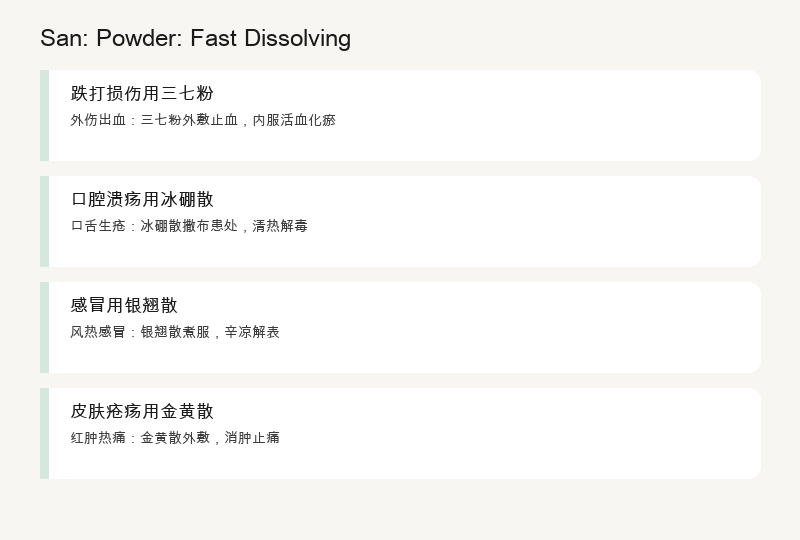
Case One: Traumatic bleeding (Yunnan Baiyao) — Wound hemostasis.
You cut your finger while cooking, blood flowing non-stop. You sprinkle Yunnan Baiyao powder, and the bleeding stops quickly. You ask: "Why can powder stop bleeding?"
The truth: Yunnan Baiyao is a powder, sprinkled directly on the wound with extremely high local concentration. Panax notoginseng saponins promote platelet aggregation, paris polyphylla saponins constrict blood vessels, and the powder itself fills the wound and adsorbs blood — a triple hemostatic mechanism. It is not "Yunnan Baiyao is mysterious"; it is local high-concentration drug delivery + physical hemostasis of powder + chemical components promoting coagulation science. If it were a decoction, it could not be sprinkled directly on the wound; if it were a pill, it would need to disintegrate first. Powder is the "natural dosage form" for trauma. Chinese medicine says "powder externally applied, stops bleeding and promotes tissue regeneration" — accurately describing the external advantage of powder.
Case Two: High fever and convulsions (Zixue Dan) — Acute fever.
Your child has a high fever of 39°C, with convulsions and seizures. You are in a panic; Western medicine fever reducers have not taken effect yet. Chinese medicine gives you Zixue Dan — a powder, dissolved in hot water. Half an hour later, the fever is gone, the convulsions stopped. You ask: "Why is powder effective for acute conditions?"
The truth: The mineral medicines in Zixue Dan, such as gypsum, glauberite, and magnetite, are finely ground with large surface area, quickly dissolving and absorbing after being dissolved. The calcium ions in gypsum have sedative and cooling effects, quickly regulating the temperature center. It is not "Zixue Dan is mysterious"; it is mineral medicine finely ground for rapid dissolution + calcium ion sedation and cooling science. Powder does not need to be decocted or disintegrated; it dissolves directly — every minute saved in emergency is precious. Chinese medicine says "powder disperses, used for acute diseases" — accurately describing the logic of powder being suitable for acute conditions.
Case Three: Food stagnation and indigestion (Baohe Powder) — Functional dyspepsia.
You overate, feeling bloated, burping, and not wanting to eat. Western medicine says "indigestion" and gives you digestive enzymes. Chinese medicine gives you Baohe Powder — hawthorn, medicated leaven, radish seed, dried tangerine peel, ground powder and dissolved. Half an hour later, your stomach feels better. You ask: "Why is powder effective for food stagnation?"
The truth: The organic acids in hawthorn, digestive enzymes in medicated leaven, and volatile oils in radish seed directly act on the gastrointestinal tract after being dissolved, promoting digestive juice secretion and enhancing gastrointestinal motility. It is not "digestion mysticism"; it is powder directly acting on gastrointestinal mucosa + promoting digestive juice secretion science. Powder directly "flushes" the gastrointestinal tract, like pouring a bottle of "digestive enzyme powder" into the body. Chinese medicine says "powder dissolved, directly reaches the affected area" — accurately describing the direct-acting advantage of powder.
Case Four: Powder vs. Decoction (taking medicine on a business trip).
You are going on a week-long business trip and need to bring Chinese medicine. Decoctions need refrigeration and cannot be brought; pills are bulky and you can't bring many bottles; powder is a small packet, just add hot water. You ask: "Why is powder the most portable?"
The truth: Powder is dry powder, containing no water, so microorganisms can hardly reproduce, and it can be stored at room temperature. Small in size, it can be divided into small bags, one per day. Dissolve in hot water, like making instant coffee. It is not "powder is convenient" experience; it is the physical characteristics of dry powder: water-free, stable, small, dissolve and take immediately. Modern granules are the "upgraded version" of powder — making powder into granules to avoid powder flying and making dissolution more convenient. Chinese medicine says "powder is easy to carry" — accurately describing the practical advantage of powder.
Four cases, one underlying logic: San is "instant powder" — large surface area, fast absorption, easy to carry, widest range of uses. Internal, external, dissolved, emergency — powder can handle them all.
Part 5Modern Research
Does "San" have scientific research?
Yes, and it is very comprehensive. Scientists do not use the term "powder disperses"; they use:
• Surface area and dissolution rate of powder. Modern powder technology confirms that after herbs are crushed, surface area is inversely proportional to particle size — the smaller the particle, the larger the surface area, the faster the dissolution. When particle size reaches the micron level, dissolution rate can increase 5-10 times. Powder absorption speed is between decoctions and pills, approaching that of decoctions. It is not "powder disperses" mysticism; it is the basic law of powder technology: surface area determines dissolution rate.
• Hemostatic mechanism of Yunnan Baiyao. Modern research confirms that panax notoginseng saponins in Yunnan Baiyao significantly promote platelet aggregation and shorten coagulation time; paris polyphylla saponins constrict blood vessels and reduce bleeding; and the physical filling effect of the powder itself quickly seals the wound surface. Triple mechanisms work together to stop bleeding. It is not "Yunnan Baiyao is mysterious"; it is plant chemical components + physical hemostasis scientific synergy.
• Stability and portability of powder. Powder has low water content (usually <10%), so microorganisms can hardly reproduce, with a shelf life of 2-3 years. In comparison, decoctions need refrigeration and have a shelf life of only 1-2 days. Powder is small and easy to pack and carry. Modern granules (such as cold and fever granules) are improved versions of powder, avoiding powder flying and improving dissolution convenience. It is not "powder is convenient" experience; it is the scientific advantage of dry powder's physical stability and portability.
These studies fully demonstrate that "San" is a concept that can be precisely described in modern scientific language. The ancients described it with "powder disperses," and modern people describe it with "surface area, dissolution rate, powder technology" — the core logic is consistent: make the medicine absorb quickly, carry conveniently, and have wide uses.
Part 6Practical Methods
Understood "San" — how to use it?
First, dispel a few misconceptions:
• "Powder is less effective than decoction". Powder absorption speed approaches that of decoctions and is faster than pills. For acute diseases and trauma, powder may be more convenient and direct than decoctions. It is not "powder is inferior"; it is powder has its own advantage scenarios — acute diseases, trauma, portability.
• "Powder is just casually grinding up". Powder has strict requirements for grinding fineness — too coarse affects absorption, too fine may cause flying loss. Modern powder has quality standards (particle size, moisture, content). It is not "casually grinding"; it is grinding to a specific fineness to ensure dissolution and absorption.
Specific methods:
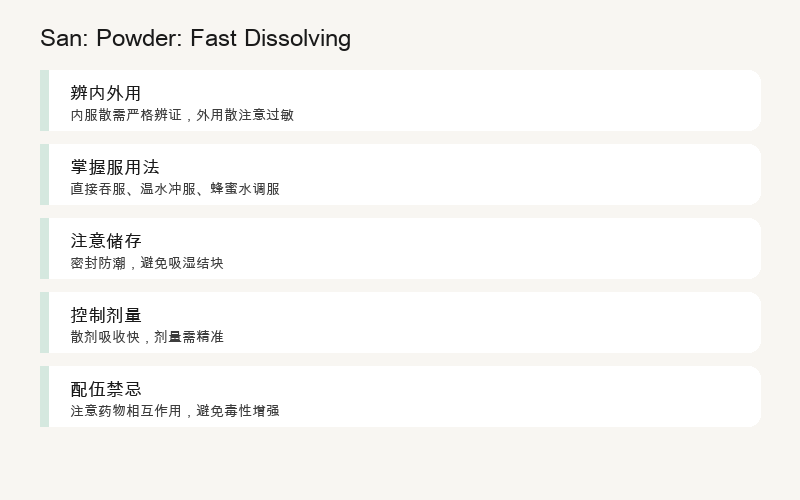
• Identify the use (internal, external, dissolved, decoction powder). For acute internal conditions — choose dissolved powder (e.g., Zixue Dan). For trauma hemostasis — choose external powder (e.g., Yunnan Baiyao). For daily conditioning — choose decoction powder (e.g., coarse powder of Yinqiao Powder boiled). It is not "all powders are the same"; it is different uses, different scenarios.
• Dissolution method (dissolve in warm water, avoid overly hot water). Dissolve powder in warm water, not boiling water — some active components (such as volatile oils) may be destroyed by high temperatures. Stir evenly when dissolving to avoid powder settling at the bottom. It is not "just add hot water"; it is dissolve in warm water to protect active components.
• External method (clean the wound, sprinkle directly). Before using external powder for trauma, clean the wound first. Sprinkle evenly, covering the entire wound surface. The powder should directly contact the wound surface; do not bandage too tightly — it affects breathability. It is not "just sprinkle it on"; it is clean the wound, sprinkle evenly, maintain breathability.
• Storage method (sealed, moisture-proof, light-avoiding). Although powder is dry powder, it easily clumps and deteriorates after absorbing moisture. Store sealed in a cool, dry place. Powders containing volatile components (such as mint, agastache) should be stored away from light. It is not "put it anywhere"; it is sealed and moisture-proof to ensure stability.
• Modern improvements (granules, capsules). Granules are the "upgraded version" of powder — avoiding powder flying and making dissolution more convenient. Capsules are the "packaged version" of powder — avoiding bitterness and ensuring accurate dosage. It is not "traditional powder is backward"; it is modern technology optimizing traditional dosage forms.
These methods do not require you to become a pharmacist. You only need to understand: San is "instant powder" — large surface area, fast absorption, easy to carry, widest range of uses. Internal, external, dissolved, emergency — choose the right scenario, use the right method.
Part 7One-Minute Summary
🕐 One Minute to Understand "San"
San = Instant Powder + First Aid Kit.
Powder disperses — large surface area, easy to absorb, easy to carry. Like instant coffee, dissolves at a touch.
Powder = fine herb powder + direct administration / dissolving in water / external application.
Internal powder = taken directly or dissolved, quickly absorbed (e.g., Zixue Dan).
External powder = sprinkled directly on the wound surface, high local concentration (e.g., Yunnan Baiyao).
Decoction powder = coarse powder boiled, more complete extraction (e.g., Yinqiao Powder).
Three mainstays: Yunnan Baiyao (hemostasis), Zixue Dan (emergency), Baohe Powder (digestion).
Misconceptions: powder is less effective than decoction, powder is just casually grinding up.
Methods: identify the use, dissolve in warm water, clean the wound for external use, store sealed and moisture-proof, modern improvements (granules, capsules).
The ancients called it "powder disperses," and modern people call it "surface area + dissolution rate + powder technology."
Different names, but medicine knows: powder is the oldest dosage form — as convenient as instant coffee, as portable as a first aid kit.
The ancients had no concept of powder technology, but they knew "powder disperses, used for acute diseases."
This is probably the most朴素 wisdom of the Chinese: grinding medicine into powder absorbs the fastest, carries the most conveniently, and has the widest uses — acute diseases dissolved in water, trauma sprinkled on the wound, travel carried along, a packet of powder travels the world.
Making money is the art of living; art is life after making money
giaogiao Concept 73
Using modern scientific language to help the world understand traditional Chinese wisdom.
No mysticism, no superstition, no belittlement.
Understand, not merely believe.
Coach Liu
Written in Florence