Tang (Decoction) — Liquid Gold
Part 1A Question
Have you ever noticed that when you catch a cold, the elders in your family always tell you to "brew a bowl of ginger soup"? Have you ever noticed that when you visit a traditional Chinese medicine clinic, the prescription the doctor gives you always ends with "decoct in water"—meaning you have to go home and cook it yourself?
Even more striking: in the Eastern Han Dynasty, Zhang Zhongjing wrote the Treatise on Cold Damage, containing 113 formulas in total, and over 90% of them are decoctions. The Sage of Medicine from two thousand years ago trusted a bowl of hot soup more than any other dosage form. You ask: "Why not pills? Why not powders? Why insist on boiling soup?"
Another question: you need to travel for work and want to take Chinese medicine with you, but decoctions require refrigeration and reheating—too much trouble. Nowadays we have "Chinese medicine granules"—just add boiling water and you've got a bowl of soup. You ask: "Are granules and decoctions the same thing?"
What exactly is Tang? Why does Traditional Chinese Medicine say "Tang means rushing like a flood"—like a powerful current sweeping through? And why is a bowl of soup called "liquid gold"?
Part 2Traditional Chinese Explanation
The dosage form called "Tang" is the most commonly used method of administering medicine in Traditional Chinese Medicine. The ancients observed that when you put medicinal herbs in water and boil them, the high temperatures "force" the effective components out of the herbs, dissolving them in the water. When you drink it, it's absorbed directly—like giving your body a dose of "liquid nutrition."
— The Collection of Commentaries on the Classic of Materia Medica
"Pills are slow, they cannot remove illness quickly; powders are dispersing, they are used for urgent diseases."
— The Collection of Commentaries on the Classic of Materia Medica
"Cinnamon Twig Decoction, Ephedra Decoction, Minor Bupleurum Decoction... all are decocted in water."
— The Treatise on Cold Damage
The ancients divided dosage forms into levels: decoctions are fastest, pills are slowest, and powders are in between. Decoctions "rush like a flood"—like a powerful current sweeping through, taking effect quickly. They are suitable for acute diseases, severe conditions, and situations requiring rapid intervention.
Decoction = Water boiling + High-temperature extraction + Direct absorption. It's not simply "soaking" the herbs—it's the "harmony of water and fire"—water acts as the solvent, fire provides the energy, extracting the effective components (alkaloids, glycosides, volatile oils, tannins) from the herbs and triggering a series of physical and chemical changes.
• High-temperature extraction: Water at 100°C can break down the cell walls of medicinal herbs, allowing the effective components to dissolve. Some components (like aconitine in aconite) require prolonged boiling to break down into less toxic but still effective compounds.
• Synergistic reactions: When multiple herbs are boiled together, the components interact through complexation, hydrolysis, and redox reactions, producing new active substances. For example, in Cinnamon Twig Decoction, the combination of cinnamon twig and peony produces synergistic effects after boiling.
• Altering medicinal properties: Raw aconite is toxic, but prolonged boiling reduces its toxicity; rhubarb added at the end (brief boiling) preserves its purgative effect, while prolonged boiling weakens it. The boiling time is essentially a "chemical regulator."
So, what the ancients called "Tang" is not just "medicine soaked in water"—it is a precise process of high-temperature extraction, chemical reaction, and synergistic enhancement. Decoctions are the oldest, most commonly used, and most trusted dosage form in Traditional Chinese Medicine.
But decoctions have one major drawback: they are inconvenient to carry. They require cooking, heating, and drinking the same day—they cannot be stored for long. When ancient people went to war or traveled far, they couldn't carry decoctions, so they used pills and powders instead. It's like fresh fruit juice—best nutrition, but short shelf life.
Part 3giaogiao's Modern Translation
Okay, now let's translate "Tang" into modern language.
I'm not going to talk about solubility, osmotic pressure, or bioavailability. Too complicated. You only need to remember one analogy:
Decoction = High-temperature extraction of effective components + Water-soluble carrier + Direct gastrointestinal absorption
Pill = Slow release + Long-lasting effect
Powder = Instant powder + Rapid absorption
Decoction is like an IV drip = medicine dissolved directly in water, quickly entering the bloodstream
Pill is like a sustained-release capsule = medicine slowly released, long-lasting effect
Powder is like instant coffee = powder directly absorbed, convenient and quick
Boiling process = Chemical reactor: High-temperature extraction + Component transformation + Synergistic enhancement
That's it. "Tang" is essentially using high temperatures to "force" the effective components out of medicinal herbs, dissolving them in water, and drinking it directly for rapid absorption—like giving your body an IV drip of "liquid gold."
Specifically:
What does "decoctions take effect quickly" correspond to? It corresponds to high bioavailability. In decoctions, the effective components are already dissolved in water, so once they enter the gastrointestinal tract, they don't need to disintegrate or dissolve—they are absorbed directly into the blood. Pills need to disintegrate first, then dissolve, then be absorbed—more steps, slower effect. Decoctions are like IV drips (directly entering the bloodstream), while pills are like oral tablets (must go through disintegration and dissolution). It's not "mystical rushing like a flood"—it's the medicine is already dissolved, so the absorption pathway is the shortest.
What does "the boiling process changes medicinal properties" correspond to? It corresponds to chemical reactions. High-temperature boiling is not just physical extraction; it also triggers chemical changes: some components hydrolyze (large molecules break into smaller ones, making them easier to absorb), some oxidize (toxicity decreases), and some form complexes with each other (synergistic enhancement). After prolonged boiling, aconitine in aconite hydrolyzes into aconine, reducing toxicity while retaining the cardiotonic effect. It's not "mystical fire control"—it's precise regulation of high-temperature chemical reactions.
What does "decoctions are inconvenient to carry" correspond to? It corresponds to shelf life issues. Decoctions contain water, so microbes can easily multiply, requiring refrigeration and same-day consumption. Modern adaptations include granules (concentrating, drying, and pelletizing the decoction)—retaining the rapid absorption advantage of decoctions while solving the portability problem. It's not "the ancients were backward"—it's limitations and breakthroughs of technological conditions.
So, "Tang" is not mysticism. It is simply high-temperature extraction + rapid absorption of "liquid gold"—the ancients described it as "rushing like a flood," while modern people describe it as "solubility, bioavailability, chemical reaction"—the core logic is the same: getting medicine into the body as quickly and effectively as possible.
Part 4Real-Life Examples
Four stories to make you instantly understand what "Tang" is.
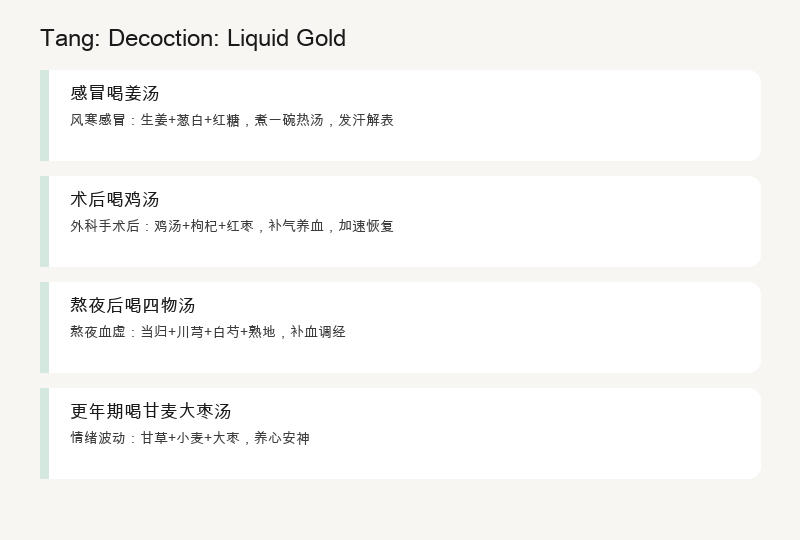
Example 1: Cold Wind (Ephedra Decoction) — Acute Upper Respiratory Infection.
You got caught in the rain, feeling aversion to cold, fever, headache, body pain, no sweating. Western medicine says "it's a cold, drink more water, rest for seven days." Traditional Chinese Medicine prescribes Ephedra Decoction—ephedra, cinnamon twig, apricot kernel, and licorice, boiled in water. Half an hour after drinking, you break out in a slight sweat, and the fever subsides. You ask: "Why does the decoction work so quickly?"
The truth: This is an acute upper respiratory infection, a virus invasion, and the body needs to mobilize its immune response quickly. Ephedrine in ephedra and volatile oils in cinnamon twig are already dissolved in the soup; once you drink it, they are directly absorbed, rapidly dilating blood vessels, promoting sweating, and regulating body temperature. It's not "mystical rushing like a flood"—it's the effective components are already dissolved, the absorption pathway is the shortest, and the effect is the fastest. If it were a pill, it would need to disintegrate and dissolve first, and by the time it took effect, the virus would have replicated several more rounds. Traditional Chinese Medicine says "Tang means rushing like a flood, used for severe diseases"—precisely describing the logic of decoctions being suitable for acute diseases.
Example 2: Stomach Disharmony (Pinellia Heart-Draining Decoction) — Gastrointestinal Dysfunction.
You have stomach pain, bloating, nausea, and loose stools, but the gastroscopy finds nothing major. Traditional Chinese Medicine prescribes Pinellia Heart-Draining Decoction—pinellia, scutellaria, coptis, dried ginger, ginseng, licorice, and jujube, boiled in water. After a week, your stomach feels better. You ask: "Why are decoctions effective for gastrointestinal diseases?"
The truth: This is gastrointestinal dysfunction, and the decoction acts directly on the digestive tract. The medicinal liquid enters the stomach and directly contacts the gastric mucosa; the effective components (berberine in coptis, gingerol in ginger) act locally at high concentrations, regulating gastrointestinal motility, repairing mucosa, and balancing flora. It's not "decoctions are universally effective"—it's decoctions directly "irrigate" the affected area, with high local concentration. Pills disintegrate slowly in the stomach, and the drug concentration doesn't reach high enough levels. Traditional Chinese Medicine says "decoctions reach the disease directly"—precisely describing the local advantage of decoctions.
Example 3: Palpitations and Insomnia (Zizyphus Seed Decoction) — Neurasthenia.
You have insomnia, palpitations, many dreams, and easy waking. Western medicine prescribes sleeping pills, which help you sleep but leave you groggy the next day. Traditional Chinese Medicine prescribes Zizyphus Seed Decoction—zizyphus seed, anemarrhena, poria, and chuanxiong, boiled in water. After a week, sleep improves, and you feel energetic the next day. You ask: "Why is the decoction gentler than Western medicine?"
The truth: The saponins and flavonoids in zizyphus seed are already dissolved in the soup, directly absorbed and regulating the nervous system—enhancing GABA (inhibitory neurotransmitter) activity and reducing brain excitability. It's not "calming the spirit mysticism"—it's the science of plant chemical components regulating the nerves. Decoctions are absorbed quickly, blood drug levels rapidly reach effective concentrations, and then are quickly metabolized—like a natural "wave," not a "straight line" like Western medicine. Traditional Chinese Medicine says "decoctions harmonize yin and yang"—precisely describing the holistic regulatory effect of decoctions.
Example 4: Decoction vs. Granules (Modern Adaptation).
You need to travel for work and want to take Chinese medicine, but decoctions can't be carried. The hospital gives you "Chinese medicine granules"—concentrating, drying, and pelletizing the decoction, so just add boiling water and you've got a bowl of soup. You ask: "Are granules and decoctions the same?"
The truth: Granules are the "modern incarnation" of decoctions—retaining the rapid absorption advantage of decoctions while solving the portability problem. But during the preparation process, high-temperature concentration may lose some volatile oils (like those in mint and cinnamon). It's not "granules are inferior to decoctions"—it's compromises—a balance between convenience and effectiveness. Granules suit modern fast-paced life, while decoctions suit home-based conditioning. Traditional Chinese Medicine says "adapt to the times"—precisely describing how dosage form selection should be based on the scenario.
Four examples, one underlying logic: Tang is "liquid gold"—rapid absorption, direct action, and efficient utilization. But decoctions are inconvenient to carry, requiring modern adaptation.
Part 5Modern Research
Is there scientific research on "Tang"?
Yes, and it's very substantial. Scientists don't use the term "rushing like a flood"—they use:
• High bioavailability of decoctions. Modern pharmacological studies confirm that the effective components in decoctions are already dissolved in water, so after entering the gastrointestinal tract, they don't need disintegration and dissolution processes, and are absorbed directly. Bioavailability (the proportion of the drug that enters the systemic circulation) is significantly higher than pills and powders. For example, berberine in Coptis Decoction has over 30% higher absorption in decoction form than in pill form. It's not "mystical rushing like a flood"—it's the scientific advantage of drugs in dissolved form.
• Chemical transformations during boiling. Modern research has found that during the boiling process, multiple chemical reactions occur: hydrolysis reactions (large molecules break into smaller ones, making them easier to absorb), complexation reactions (metal ions bind with organic molecules, forming new active substances), and redox reactions (toxic components are broken down). For example, after prolonged boiling of aconite, the highly toxic aconitine hydrolyzes into the less toxic aconine, retaining the cardiotonic effect but greatly reducing toxicity. It's not "mystical fire control"—it's precise regulation of high-temperature chemical reactions.
• Quality control of Chinese medicine granules. Modern granules use "standardized extraction"—measuring the content of effective components to ensure consistency across batches. While some volatile oils are lost, the main effective components (alkaloids, glycosides, polysaccharides) are retained. It's not "granules are inferior to decoctions"—it's modern technology's improvement and optimization of traditional dosage forms.
These studies fully demonstrate that "Tang" is a concept that can be precisely described in modern scientific language. The ancients described it as "rushing like a flood," while modern people describe it as "bioavailability, chemical reaction, dissolution state"—the core logic is the same: getting medicine into the body as quickly and effectively as possible.
Part 6Practical Methods
Now that you understand "Tang," how do you use it?
First, let's clear up some misconceptions:
• "The stronger the decoction, the better". Decoction concentration should be moderate—too concentrated irritates the gastrointestinal tract, too dilute and the effective components are insufficient. Generally, each dose of medicine is boiled twice, 200-300 ml each time, combined and taken in two portions. It's not "stronger is better"—it's moderate concentration, sufficient total volume.
• "Chinese medicine granules and decoctions are exactly the same". Granules are convenient, but lose some volatile oils; decoctions are fresh but inconvenient to carry. It's not "granules replace decoctions"—it's choose based on the scenario—boil at home, carry granules when traveling.
Specific methods:
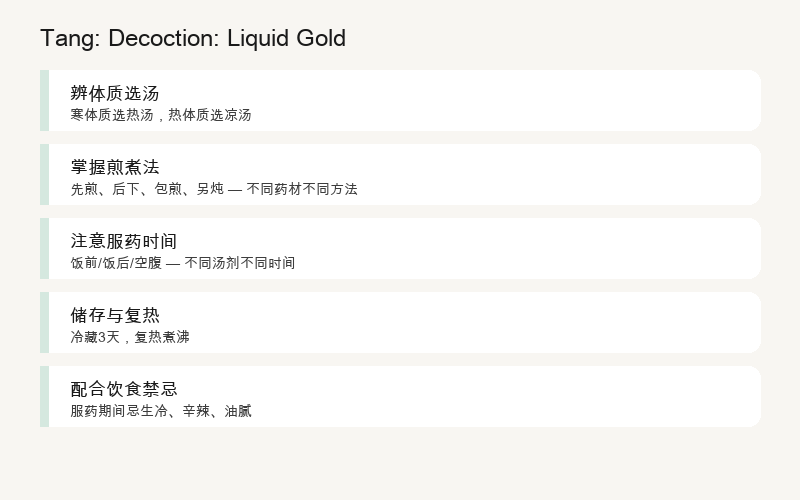
• Distinguish acute vs. chronic (decide whether to use decoction or pill). Acute diseases (cold, fever, acute stomach pain)—use decoctions for rapid effect. Chronic diseases (kidney deficiency, spleen deficiency, long-term conditioning)—use pills or medicinal paste for lasting effects. It's not "decoctions are universal"—it's acute diseases use decoctions, chronic diseases use pills.
• Master boiling methods (pre-boiling, post-addition, wrapped boiling). Pre-boiling (aconite, mineral-class herbs)—boil first for 30-60 minutes to reduce toxicity or ensure full extraction. Post-addition (mint, patchouli)—add in the last 5 minutes to preserve volatile oils. Wrapped boiling (talc powder, plantain seed)—wrap in gauze to prevent sticking to the pot. It's not "mystical medicine boiling"—it's precise control of boiling time and method based on the characteristics of different components.
• Timing of administration (before meals, after meals, on empty stomach). Tonifying medicines (ginseng, astragalus)—take on empty stomach before meals for better absorption. Irritating medicines (coptis, rhubarb)—take after meals to reduce gastrointestinal irritation. Sedative medicines (zizyphus seed, poria)—take before bed for better effect. It's not "drink it whenever"—it's choose the best time based on drug characteristics and therapeutic purpose.
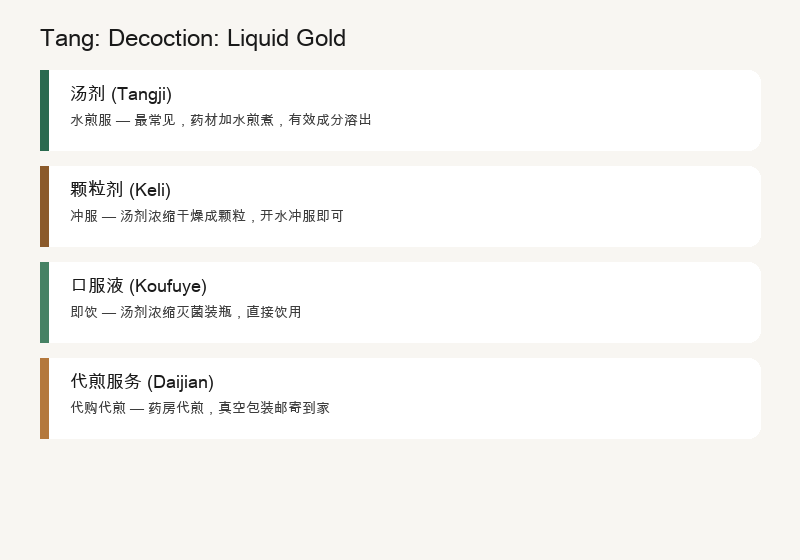
• Modern adaptations (granules, oral liquids). When traveling, carry granules—just add boiling water, convenient to carry. Oral liquids (like Compound Salvia Oral Liquid)—already boiled "decoctions," ready to drink. Pre-decocted soups (hospital-boiled, vacuum-packed)—fresh decoctions, refrigerated storage. It's not "tradition above all"—it's using modern technology to make decoctions more convenient.
• Decoction storage (drink the same day, don't store long). Decoctions contain water, so microbes can easily multiply. Boil and drink the same day. If storage is needed, refrigerate for no more than 2 days. Pre-decocted soups in vacuum packaging can be refrigerated for 7-14 days. It's not "boil and keep for a week"—it's fresh decoctions have the best effect, long storage leads to spoilage.
These methods don't require you to become a pharmacist. You only need to understand: Tang is "liquid gold"—use decoctions for acute diseases, there are tricks to boiling, and there are modern adaptations.
Part 7One-Minute Summary
🕐 One Minute to Understand "Tang"
Tang = Liquid Gold + Rapid Absorption Channel.
Tang means rushing like a flood—like a powerful current, taking effect quickly. Suitable for acute diseases, severe conditions, and situations requiring rapid intervention.
Decoction = High-temperature extraction of effective components + Water-soluble carrier + Direct gastrointestinal absorption.
Boiling process = Chemical reactor: High-temperature extraction + Component transformation + Synergistic enhancement.
Pre-boiling (reduces toxicity), post-addition (preserves volatile oils), wrapped boiling (prevents sticking to pot)—not mysticism, it's precise chemical regulation.
Three main formulas: Ephedra Decoction (promotes sweating and releases the exterior), Cinnamon Twig Decoction (harmonizes nutritive and defensive qi), Minor Bupleurum Decoction (harmonizes Shaoyang).
Misconceptions: The stronger the decoction, the better; granules completely replace decoctions.
Methods: Acute diseases use decoctions, chronic diseases use pills; master boiling methods; choose timing of administration; modern adaptations (granules, oral liquids); drink the same day, don't store long.
The ancients called it "rushing like a flood," modern people call it "high bioavailability + chemical reaction + rapid absorption."
Different names, but medicine knows: Decoctions are the most commonly used dosage form in Traditional Chinese Medicine—direct like an IV drip, precious like gold.
The ancients had no concept of bioavailability, but they knew "Tang means rushing like a flood, used for severe diseases."
This is probably the most simple wisdom of the Chinese people: getting medicine into the body as quickly and effectively as possible—acute diseases use decoctions, chronic diseases use pills, adapt to the times, this is the smart way.
Making money is the art of life; art is the life after making money
giaogiao Decodes Traditional Chinese Wisdom · Concept 71
Helping the world understand traditional Chinese wisdom through the language of modern science.
No mysticism, no superstition, no dismissal.
Understand, don't just believe.
Coach Liu
Written in Florence