Wan (Pills) — Sustained-Release Capsule
Part 1A Question
Have you ever noticed that your medicine cabinet always has a bottle of Liuwei Dihuang Pills? Have you ever noticed that when you go to a TCM practitioner for chronic conditions—kidney deficiency, spleen deficiency, qi and blood deficiency—the doctor always prescribes "pills" instead of "decoctions"?
Even more striking: Wan means "slow"—the medicinal effect is mild and long-lasting, like a "long-lasting battery," slowly releasing. You catch a cold, the doctor prescribes a decoction; you've had back pain for three months, the doctor prescribes pills. You ask: "Why do acute diseases use decoctions and chronic diseases use pills?"
Another question: You bought Liuwei Dihuang Pills and found there are large honey pills, small water pills, and concentrated pills—three different types. You ask: "They're all pills, what's the difference? Why are honey pills the biggest and concentrated pills the smallest?"
What exactly is Wan? Why are pills like "sustained-release capsules"—medicine slowly released, long-lasting effect?
Part 2Traditional Chinese Explanation
The dosage form called "Wan" is the most classic sustained-release preparation in Traditional Chinese Medicine. The ancients observed that when you grind medicinal herbs into fine powder, add honey or water to make small balls, and swallow them, they slowly disintegrate, dissolve, and absorb in the stomach—like a "long-lasting battery," continuously releasing medicinal effect.
— The Collection of Commentaries on the Classic of Materia Medica
"Diseases may be suitable for pills, suitable for powders, suitable for decoctions; each has its appropriate use."
— The Treatise on Cold Damage
"Honey pills are used for their softness and moisture, to counter dryness and urgency."
— The Compendium of Materia Medica
The ancients divided dosage forms into levels: decoctions are fastest (acute diseases), powders are in between (urgent diseases, portable), pills are slowest (chronic diseases). Wan means "slow"—like gentle rain moistening the earth, slowly penetrating. Suitable for conditions requiring long-term conditioning and gradual improvement.
Pills = Medicinal powder + Excipient (honey/water/rice paste) + Molding. It's not simply "rolling into a ball"—it's a precisely controlled drug delivery system that controls release speed.
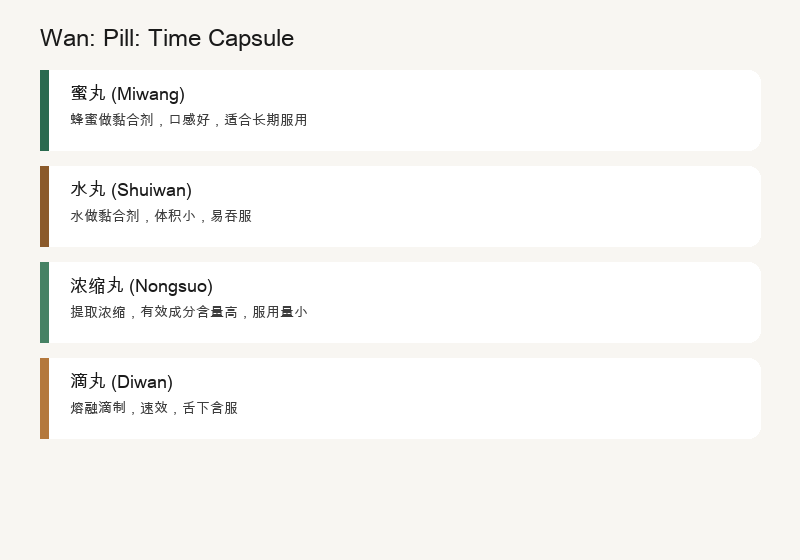
• Honey pills: Made from fine medicinal powder mixed with refined honey. Honey has viscosity; the pill surface is smooth, disintegrating slowest in the stomach, releasing most slowly. Like a "long-lasting battery," suitable for long-term conditioning. Liuwei Dihuang Pills and Jinkui Shenqi Pills are both honey pills.
• Water pills: Made from fine medicinal powder mixed with water or rice paste. Disintegrate faster than honey pills, release faster. Like a "medium-lasting battery," suitable for conditions with slightly more urgency.
• Concentrated pills: Made from concentrated medicinal extracts with a small amount of excipients. Small volume, high concentration of effective components, controllable disintegration speed. Like a "high-efficiency battery," a modern improved version.
So, what the ancients called "Wan" is not just "rolling medicine into a ball"—it's a "sustained-release system" that precisely controls release speed based on different excipients. Honey pills are slowest, water pills are medium, and concentrated pills are adjustable.
But pills have one major principle: pills take effect slowly, so they cannot be used for acute diseases. You catch a cold with a high fever and take pills—by the time the pills disintegrate, dissolve, and absorb in the stomach, the fever might have risen even higher. Acute diseases require decoctions, like a "fire brigade" quickly extinguishing the fire; chronic diseases use pills, like a "gardener" slowly trimming. Just like modern medicine: emergency uses IV injection, chronic conditions use oral sustained-release tablets.
Part 3giaogiao's Modern Translation
Okay, now let's translate "Wan" into modern language.
I'm not going to talk about disintegration time, dissolution rate, or release kinetics. Too complicated. You only need to remember one analogy:
Honey pill = Honey coating + Slow disintegration in stomach + Sustained release (like a long-lasting battery)
Water pill = Water/rice paste coating + Medium disintegration speed + Medium release (like a medium-lasting battery)
Concentrated pill = Extracted concentrate + Small amount of excipients + Efficient release (like a high-efficiency battery)
Pills are like sustained-release capsules = medicine slowly released, stable blood drug concentration, long-lasting effect
Decoctions are like IV drips = medicine quickly absorbed, high blood drug concentration peak, rapid effect
Acute diseases use decoctions = quickly extinguishing the fire (like a fire brigade)
Chronic diseases use pills = slowly trimming (like a gardener)
That's it. "Wan" is essentially a "sustained-release system" that slowly releases medicinal effect—medicinal powder is wrapped by excipients, slowly disintegrating, dissolving, and absorbing in the gastrointestinal tract—like installing a "long-lasting battery" in the body.
Specifically:
What does "Wan means slow" correspond to? It corresponds to the principle of sustained-release preparations. Pills require three steps in the stomach: disintegration (pill breaks into powder), dissolution (effective components dissolve from the powder), and absorption (dissolved components enter the blood). Decoctions only require absorption. So pills take effect slowly, but the effect is long-lasting—like modern sustained-release capsules, medicine slowly releases, blood drug concentration stays stable, not fluctuating up and down. It's not "mystical slowness"—it's the physical process of disintegration-dissolution-absorption determines the release speed.
What does "honey pills are slowest, water pills are medium" correspond to? It corresponds to the influence of excipients on disintegration speed. Honey is a highly viscous substance; honey pills have a smooth, dense surface, gastric fluid penetrates slowly, and disintegration time is long. Water pills use water or rice paste as binders, with lower viscosity, disintegrating faster. Concentrated pills are concentrated extracts with a small amount of excipients, and disintegration speed can be controlled through manufacturing processes. It's not "mystical softness of honey pills"—it's the viscosity and density of excipients determine the disintegration speed.
What does "chronic diseases use pills" correspond to? It corresponds to the pharmacokinetics of long-term administration. Chronic diseases require long-term medication, and blood drug concentration needs to be maintained at a certain level. Pills slowly release, keeping blood drug concentration stable, suitable for long-term administration. Decoctions are absorbed quickly and metabolized quickly too, with large fluctuations in blood drug concentration, requiring drinking twice or three times a day. It's not "empirical chronic disease use of pills"—it's the scientific principle that sustained-release preparations are more suitable for long-term treatment.
So, "Wan" is not mysticism. It is simply a "drug delivery system" of sustained-release + long-lasting effect—the ancients described it as "Wan means slow," while modern people describe it as "disintegration time, dissolution rate, release kinetics"—the core logic is the same: letting medicine slowly, continuously, and steadily enter the body.
Part 4Real-Life Examples
Four stories to make you instantly understand what "Wan" is.
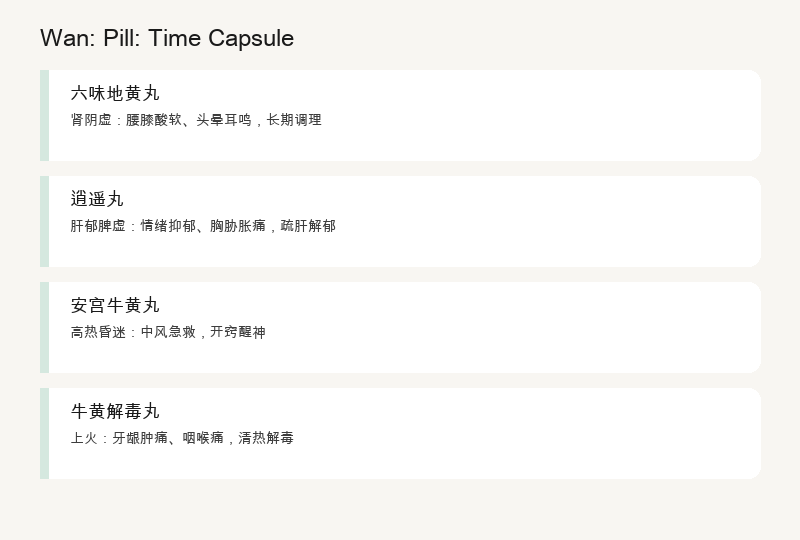
Example 1: Kidney Deficiency Back Pain (Liuwei Dihuang Pills) — Chronic Kidney Function Decline.
You have back pain, soreness, fatigue, and frequent nighttime urination. Western medicine checks kidney function and finds it normal, saying "there's no disease." Traditional Chinese Medicine prescribes Liuwei Dihuang Pills—rehmannia, cornelian cherry, Chinese yam, alisma, poria, and tree peony bark, in honey pills. After three months, the back pain lessens. You ask: "Why are pills suitable for kidney deficiency?"
The truth: This is chronic functional decline, not an organic lesion. It requires long-term conditioning and gradual improvement. Liuwei Dihuang Pills slowly release, continuously regulating kidney function—polysaccharides in rehmannia and organic acids in cornelian cherry are slowly absorbed, continuously acting on kidney metabolism. It's not "kidney-tonifying mysticism"—it's the science of sustained-release administration + long-term regulation. If it were a decoction, drinking twice a day, absorption is quick and metabolism is also quick, with large fluctuations in blood drug concentration. Pills are like a "long-lasting battery," continuously supplying power. Traditional Chinese Medicine says "Wan means slow, soothes and treats gradually"—precisely describing the logic of pills being suitable for chronic diseases.
Example 2: Spleen Deficiency Loose Stools (Shenling Baizhu Pills) — Chronic Gastrointestinal Dysfunction.
You have long-term loose stools, poor appetite, fatigue, and sallow complexion. Western medicine says "irritable bowel syndrome," medicine works while you take it, but relapses after stopping. Traditional Chinese Medicine prescribes Shenling Baizhu Pills—ginseng, poria, atractylodes, Chinese yam, lotus seed, and hyacinth bean, in water pills. After two months, stools become formed. You ask: "Why are water pills more suitable for spleen deficiency than honey pills?"
The truth: Spleen deficiency requires strengthening the spleen and boosting qi, but spleen-stomach function is weak, with poor absorption capacity. Water pills disintegrate slightly faster than honey pills, with moderate release, not adding burden to the spleen-stomach. Saponins in ginseng and volatile oils in atractylodes are slowly released, continuously regulating gastrointestinal motility and digestive juice secretion. It's not "spleen-strengthening mysticism"—it's the science of sustained-release regulation + not adding burden to the spleen-stomach. Water pills are like a "medium-lasting battery"—both long-lasting and not too slow. Traditional Chinese Medicine says "diseases have appropriate uses for pills, powders, and decoctions"—precisely describing how dosage form selection should be based on the condition.
Example 3: Qi and Blood Deficiency (Bazhen Pills) — Chronic Anemia.
You have anemia, dizziness, fatigue, and pale complexion, with low hemoglobin. Western medicine prescribes iron supplements, which cause constipation and stomach discomfort. Traditional Chinese Medicine prescribes Bazhen Pills—ginseng, atractylodes, poria, licorice, angelica, chuanxiong, white peony, and rehmannia, in concentrated pills. After three months, hemoglobin rises, and no constipation. You ask: "Why are concentrated pills suitable for anemia?"
The truth: Concentrated pills have small volume, high concentration of effective components, and controllable disintegration speed. Angelica and rehmannia in Bazhen Pills are rich in iron and hematopoietic-promoting effective components, slowly released, continuously stimulating blood production. It's not "blood-tonifying mysticism"—it's the science of concentrated extraction + sustained-release administration. Concentrated pills are a modern improvement, retaining traditional formulas while improving convenience and effectiveness. Traditional Chinese Medicine says "pills are mild and slow, suitable for deficiency conditions"—precisely describing the logic that chronic deficiency conditions require gradual treatment.
Example 4: Misuse of Pills (taking pills for acute diseases, delaying the condition).
You catch a cold, with a high fever of 39°C, and you only have Liuwei Dihuang Pills at home, so you take two pills. The fever doesn't subside, but gets even higher. You ask: "Why are pills ineffective for a cold?"
The truth: A cold is an acute upper respiratory infection, with rapid viral replication, requiring quick intervention. Pills disintegrate slowly; by the time effective components are released, the virus has already replicated several more rounds. It's like a house on fire, and you're using a "garden sprinkler" to slowly water it—the water pressure is insufficient, and the fire burns bigger. Acute diseases require decoctions or powders—quick absorption, quick effect. It's not "pills are ineffective"—it's wrong dosage form selection—using pills for acute diseases is like using a sprinkler to put out a fire. Traditional Chinese Medicine says "Wan means slow, it cannot remove illness quickly"—precisely reminding that pills are not suitable for acute diseases.
Four examples, one underlying logic: Wan is a "sustained-release capsule"—chronic diseases use pills, acute diseases use decoctions; honey pills are slowest, water pills are medium, concentrated pills are high-efficiency. Choose the right dosage form, and the medicinal effect can be fully realized.
Part 5Modern Research
Is there scientific research on "Wan"?
Yes, and it's very substantial. Scientists don't use the term "Wan means slow"—they use:
• Disintegration and dissolution research on pills. Modern pharmacological studies confirm that honey pills can take 2-4 hours to disintegrate in simulated gastric fluid, water pills about 1-2 hours, and concentrated pills can be controlled between 30 minutes and 2 hours. Disintegration speed directly determines release speed. The fructose and glucose in honey form a highly viscous matrix, delaying gastric fluid penetration. It's not "mystical softness of honey pills"—it's the scientific influence of viscous matrix on disintegration kinetics.
• Pharmacological research on Liuwei Dihuang Pills. Modern research has found that Liuwei Dihuang Pills can regulate hypothalamic-pituitary-adrenal axis function, improve kidney metabolism, and enhance immunity. Polysaccharides in rehmannia and iridoid glycosides in cornelian cherry are the main active components. Long-term use (3-6 months) significantly improves chronic kidney function indicators. It's not "kidney-tonifying mysticism"—it's the science of plant chemical components regulating the endocrine and metabolic systems.
• Modern technology of concentrated pills. Concentrated pills use an "extract-concentrate-pill" process, with effective component content 5-10 times that of raw medicinal herbs. By controlling excipient ratios and pill manufacturing processes, disintegration speed can be precisely regulated. Modern quality control standards (dissolution rate, content uniformity) ensure consistency across batches. It's not "tradition is backward"—it's modern technology's optimization and upgrade of traditional dosage forms.
These studies fully demonstrate that "Wan" is a concept that can be precisely described in modern scientific language. The ancients described it as "Wan means slow," while modern people describe it as "disintegration time, dissolution rate, sustained-release kinetics"—the core logic is the same: letting medicine slowly, continuously, and steadily enter the body.
Part 6Practical Methods
Now that you understand "Wan," how do you use it?
First, let's clear up some misconceptions:
• "Pills taking effect slowly means they are ineffective". Pills taking effect slowly is a characteristic of the dosage form, not ineffectiveness. Chronic diseases require long-term conditioning, and pills are perfectly suited. It's not "slow means bad"—it's slow and steady wins the race—chronic diseases require gradual treatment.
• "All diseases can be treated with pills". Acute diseases (cold, fever, acute diarrhea) cannot use pills; by the time the pills disintegrate, the condition has already worsened. It's not "pills are universal"—it's acute diseases use decoctions, chronic diseases use pills.
Specific methods:
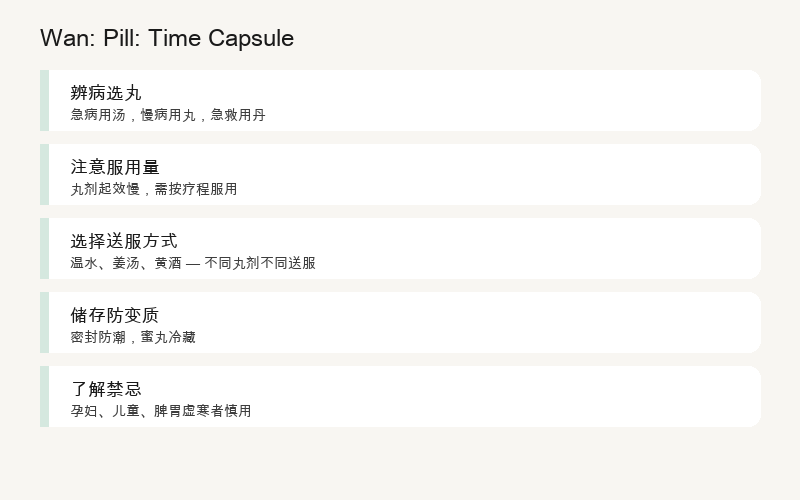
• Distinguish acute vs. chronic (decide whether to use decoction or pill). Acute diseases (cold, fever, acute pain)—use decoctions or powders for quick effect. Chronic diseases (kidney deficiency, spleen deficiency, qi and blood deficiency, long-term conditioning)—use pills for slow and lasting effects. It's not "pills are universal"—it's dosage form selection should match the disease course.
• Choose pill type (honey pills, water pills, concentrated pills). For long-term conditioning and weak spleen-stomach—choose honey pills (disintegrate slowly, don't irritate the stomach). For slightly more urgent conditions requiring medium speed—choose water pills (moderate disintegration). For high efficiency and easy portability—choose concentrated pills (small volume, high concentration). It's not "buy randomly"—it's choose pill type based on condition and constitution.
• Administration method (swallow with warm water, before or after meals). Generally, swallow pills with warm water, don't chew them (affects release speed). Tonifying pills (Liuwei Dihuang Pills, Bazhen Pills)—take on empty stomach before meals for better absorption. Irritating pills—take after meals to reduce gastrointestinal irritation. It's not "take it whenever"—it's choose administration time based on pill properties.
• Long-term persistence (pills require a treatment course). Pills take effect slowly, requiring 1-3 months of persistence to see obvious effects. Don't stop taking them after three days because you don't feel anything. Chronic conditions are "three feet of ice," and melting also takes time. It's not "pills are ineffective"—it's the treatment course is insufficient—chronic diseases require long-term conditioning.
• Storage method (sealed, moisture-proof, light-protected). Pills, especially honey pills, contain honey and easily absorb moisture and spoil. Store sealed in a cool, dry place. Concentrated pills are relatively stable, but also need moisture protection. It's not "put it anywhere"—it's pill storage needs moisture protection, otherwise they easily mold and spoil.
These methods don't require you to become a pharmacist. You only need to understand: Wan is a "sustained-release capsule"—chronic diseases use pills, acute diseases use decoctions; honey pills are slowest, water pills are medium, concentrated pills are high-efficiency; requires long-term persistence, storage needs moisture protection.
Part 7One-Minute Summary
🕐 One Minute to Understand "Wan"
Wan = Sustained-Release Capsule + Long-Lasting Battery.
Wan means slow—the medicinal effect is mild and long-lasting, like a long-lasting battery, continuously releasing.
Pills = Medicinal powder + Excipient (honey/water/rice paste) + Molding + Slow disintegration and dissolution.
Honey pills = Honey coating, slowest disintegration, like a long-lasting battery (Liuwei Dihuang Pills, Jinkui Shenqi Pills).
Water pills = Water/rice paste coating, medium disintegration, like a medium-lasting battery (Shenling Baizhu Pills).
Concentrated pills = Extracted concentrate, controllable disintegration, like a high-efficiency battery (Bazhen Pills).
Three main formulas: Liuwei Dihuang Pills (tonify kidney), Jinkui Shenqi Pills (warm yang), Shenling Baizhu Pills (strengthen spleen).
Misconceptions: Pills taking effect slowly means they are ineffective; all diseases can be treated with pills.
Methods: Distinguish acute vs. chronic, choose pill type, master administration method, long-term persistence, moisture-proof storage.
The ancients called it "Wan means slow," modern people call it "sustained-release preparations + disintegration kinetics + long-lasting release."
Different names, but medicine knows: Pills are the "long-lasting battery" for chronic diseases—acute diseases use decoctions to extinguish the fire, chronic diseases use pills to trim.
The ancients had no concept of disintegration kinetics, but they knew "Wan means slow, it cannot remove illness quickly."
This is probably the most simple wisdom of the Chinese people: acute diseases are like a fire, requiring quick extinguishing with decoctions; chronic diseases are like a garden, requiring slow trimming with pills—adapt to the times, this is the smart way.
Making money is the art of life; art is the life after making money
giaogiao Decodes Traditional Chinese Wisdom · Concept 72
Helping the world understand traditional Chinese wisdom through the language of modern science.
No mysticism, no superstition, no dismissal.
Understand, don't just believe.
Coach Liu
Written in Florence