Gao (Paste) — Paste Preparation: Nourishing Patch
Part 1A Question
Have you ever noticed that in winter, some people specifically go to the hospital for "paste tonic" — a large jar of dark brown thick paste, dig out a spoonful every day, dissolve in hot water and drink, like patching up their body? Have you ever noticed that when your back aches and you apply a medicated plaster, it feels warm and the pain gradually eases?
Even more outrageous is that Chinese medicine says "one spoonful of paste tonic equals a bowl of decoction" — paste tonic is the essence of decoction concentrated ten times. You boil a bowl of decoction for half an hour, but making a jar of paste tonic takes three days. You ask: "Why is paste tonic so concentrated?"
Another question: you have a cough, so you buy a bottle of Chuanbei loquat paste, sweet and soothing, and your throat feels better. You ask: "Is loquat paste also a paste tonic? Is Guiling paste also a paste preparation?"
So, what exactly is Gao? Why is paste tonic a "liquid patch," and medicated plaster a "transdermal patch"? Why is paste tonic suitable for winter nourishment?
Part 2Traditional Chinese Explanation
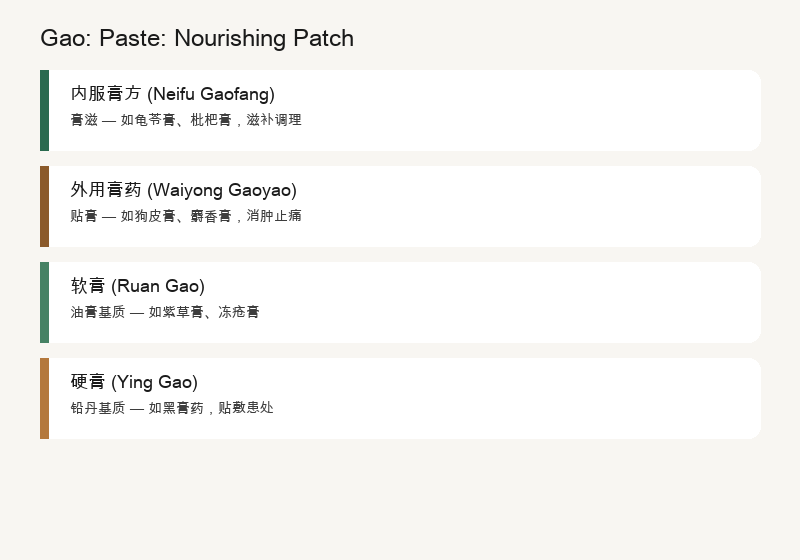
The "Gao" dosage form is divided into two major categories: internal paste tonic (gao zi) and external medicated plaster. The ancients observed that repeatedly decocting herbs and concentrating them into a thick paste, then adding honey or rock sugar to solidify — the active components are highly concentrated, and eating just one small spoonful a day achieves the effect of a bowl of decoction. Like applying a "liquid patch" to the body, slowly nourishing and repairing.
— Compendium of Materia Medica
"Paste tonic is the best product for winter nourishment, concentrated essence, one spoonful equals a bowl."
— Zhang's Medical Treatise
"Medicated plaster is an external application, penetrating through the skin, directly reaching the affected area."
— Orthodox Surgery
The ancients divided paste preparations into "internal paste tonic" and "external medicated plaster." The two have different logic, but the core is consistent: concentrated, sustained-release, long-lasting.
Internal paste tonic = herbs repeatedly decocted + concentrated + honey / rock sugar solidified. It is not simply "boiling thick"; it is a precise craft of repeated extraction, concentration, and solidification.
• Paste tonic (internal): Herbs are decocted 3-4 times, the liquid is combined, filtered and concentrated, then honey or rock sugar is added to solidify. The finished product is like thick syrup, 1-2 spoonfuls a day, dissolved in hot water. Active components are highly concentrated; one spoonful equals a bowl of decoction. Like a "liquid patch," slowly nourishing the body.
• Medicated plaster (external application): Herbs are fried and decocted with vegetable oil, the residue is removed, yellow lead (minium) is added to solidify, and spread on cloth or paper. Applied to the affected area, the medicine slowly penetrates through the skin, with high local concentration and long-lasting effect. Like a "transdermal patch," directly acting on the lesion.
• Popular versions of paste tonic: Guiling paste (nourishing yin and reducing fire), loquat paste (moistening the lungs and stopping cough), autumn pear paste (moistening dryness and producing fluid) — making the concept of paste tonic into food products, accepted by more people.
So, what the ancients called "Gao" is not just "thick medicine" — it is a highly concentrated, slowly releasing, long-lasting nourishing "patch system." Internal paste tonic is a "liquid patch," and external medicated plaster is a "transdermal patch."
Paste tonic has a unique characteristic: paste tonic is "off-season" nourishment. Paste tonic is prescribed in winter because winter is the season of storage, the body absorbs well, and the nourishing effect is best. Like farmers repairing farm tools and dikes in winter — repairing in the off-season, using in the busy season. Prescribing paste tonic in spring or summer greatly reduces its effectiveness.
Part 3giaogiao Modern Translation
Okay, now let's translate "Gao" into modern language.
I'm not going to talk about osmotic pressure, transdermal absorption, or rheology. Too complicated. You just need to remember one analogy:
Internal paste tonic = herbs repeatedly extracted + highly concentrated + honey solidified = liquid patch
External medicated plaster = herbs fried and extracted + yellow lead formed + skin penetration = transdermal patch
Paste tonic is like a liquid patch = highly concentrated, one spoonful a day, slowly nourishing and repairing
Medicated plaster is like a transdermal patch = medicine slowly penetrates, high local concentration, long-lasting effect
One spoonful of paste tonic = a bowl of decoction × 10-fold concentration
One medicated plaster = local drug delivery system, avoiding systemic side effects
That's it. "Gao" is essentially a highly concentrated, slowly releasing "patch system" — internal paste tonic concentrates essence, one spoonful equals a bowl; external medicated plaster penetrates transdermally, with long-lasting local effect.
Specifically:
What does "one spoonful of paste tonic equals a bowl of decoction" correspond to? It corresponds to the high concentration of concentrated extraction. During paste tonic preparation, herbs are decocted 3-4 times, fully extracted, then concentrated to 1/10 of the original volume. After honey solidification, the active component concentration is more than 10 times that of decoctions. So 1-2 spoonfuls of paste tonic a day equals drinking 1-2 bowls of decoction a day. It is not "paste tonic is mysterious"; it is the science of concentrated extraction: repeated extraction + concentration = high concentration.
What does "medicated plaster feels warm when applied" correspond to? It corresponds to transdermal absorption and local action. The medicinal components in medicated plaster (such as aconite, kinesio, frankincense, myrrh) penetrate through the skin, reaching subcutaneous tissue and muscle. Yellow lead (Pb3O4) reacting with vegetable oil to form lead fatty acid salts has a mild irritant effect, promoting local blood circulation and producing a "warm sensation." It is not "medicated plaster heating mysticism"; it is transdermal absorption + local irritation promoting blood circulation science.
What does "paste tonic is best eaten in winter" correspond to? It corresponds to seasonal metabolism and absorption. In winter, human metabolism slows down, gastrointestinal motility slows down, food stays in the digestive tract longer, and absorption is more complete. Paste tonic is a high-concentration nourishing agent that needs complete absorption. The physiological characteristic of winter "storage" is suitable for nourishment. In summer, metabolism is fast, and paste tonic easily causes "internal heat." It is not "only winter can you eat" superstition; it is seasonal metabolic characteristics determining the best nourishment timing.
So, "Gao" is not mysticism. It is a highly concentrated + slowly releasing + long-lasting nourishing "patch system" — the ancients described it with "paste is glue-like," and modern people describe it with "concentrated extraction, transdermal absorption, sustained-release drug delivery" — the core logic is consistent: use the smallest amount to achieve the most lasting effect.
Part 4Life Cases
Four stories to help you instantly understand what "Gao" is.
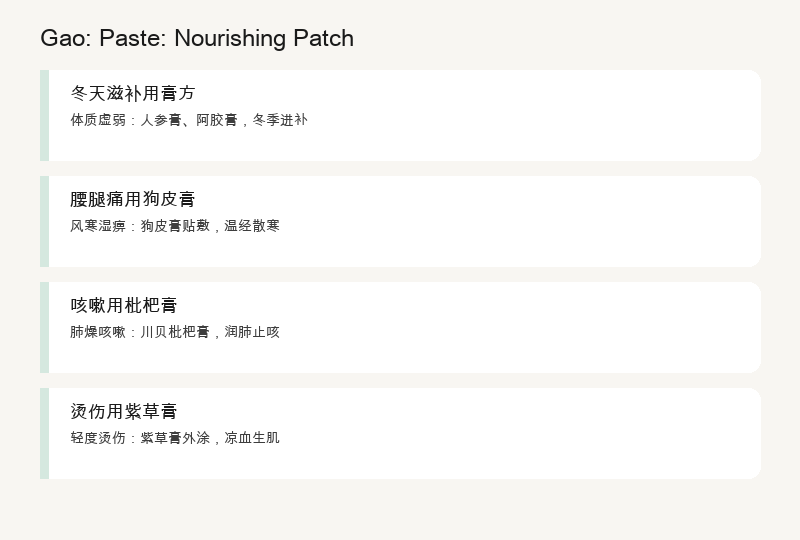
Case One: Winter nourishment (paste tonic) — Sub-health condition.
You are 40 years old, under high work pressure, fatigued, insomniac, with poor immunity. Every winter, you go to a Chinese medicine clinic for paste tonic — ginseng, astragalus, angelica, rehmannia, goji berries, etc., decocted into a large jar of dark brown paste. One spoonful a day, dissolved in hot water, eaten for a whole winter. By the next spring, you feel better and catch fewer colds. You ask: "Why is paste tonic suitable for winter?"
The truth: This is a sub-health condition requiring long-term conditioning. Paste tonic is highly concentrated; one spoonful a day equals a bowl of decoction. In winter, human metabolism slows down, absorption is complete, and the nourishing effect is best. Ginsenosides in ginseng, astragalus polysaccharides, and rehmannia iridoid glycosides slowly release, continuously regulating immunity and improving metabolism. It is not "paste tonic nourishment mysticism"; it is concentrated extraction + winter complete absorption + long-term sustained-release science. Paste tonic is like a "liquid patch," patching a little every day, slowly repairing. Chinese medicine says "winter nourishment, paste tonic is best" — accurately describing the best use scenario for paste tonic.
Case Two: Joint pain (medicated plaster) — Arthritis.
Your knees hurt, especially on cloudy days and in winter, making it hard to walk. Western medicine gives you anti-inflammatory painkillers, but your stomach feels uncomfortable. You apply a medicated plaster — warm and soothing, and the pain eases. You ask: "Why can medicated plaster relieve pain?"
The truth: The medicinal components in medicated plaster (such as alkaloids in aconite and kinesio) penetrate through the skin, reaching the joint synovium and surrounding tissue. High local drug concentration directly inhibits the inflammatory response; the plaster matrix promotes local blood circulation, accelerating the removal of metabolic waste. It is not "medicated plaster heating mysticism"; it is transdermal absorption + local high-concentration drug delivery + promoting blood circulation science. Oral medicine must pass through systemic circulation, with large doses and many side effects; medicated plaster is a "local drug delivery system," avoiding systemic side effects. Chinese medicine says "medicated plaster externally applied, directly reaches the affected area" — accurately describing the local advantage of medicated plaster.
Case Three: Cough and sore throat (loquat paste) — Acute upper respiratory infection.
You have a cough and sore throat, so you buy a bottle of Chuanbei loquat paste, sweet and soothing, and your throat feels better. You ask: "Is loquat paste also a paste tonic?"
The truth: Loquat paste is the "popular version" of paste tonic — Chuanbei, loquat leaf, honey, decocted into thick paste. The alkaloids in Chuanbei have cough-suppressing and phlegm-removing effects, the saponins in loquat leaf have anti-inflammatory effects, and honey has throat-moistening and antibacterial effects. It is not "loquat paste is just a dessert"; it is concentrated extraction + throat-moistening cough suppression + convenient consumption science. Loquat paste makes the concept of "paste tonic" into a food product, accepted by more people. Chinese medicine says "paste tonic can be both medicine and food" — accurately describing the popularization direction of paste tonic.
Case Four: Paste tonic misuse (taking paste tonic in summer, getting internal heat and acne).
You were prescribed paste tonic in summer, and after two weeks, you got mouth sores, facial acne, and dry stools. You ask: "Why does paste tonic cause internal heat?"
The truth: Paste tonic is a high-concentration nourishing agent. In summer, human metabolism is fast, yang energy floats externally, and digestive and absorptive capacity is not as good as in winter. Taking paste tonic in summer is like adding concentrated fuel to a high-speed running machine — it "burns" too fiercely, easily causing internal heat. It is not "paste tonic is bad"; it is eating it in the wrong season — winter is "storage," summer is "growth," the nourishment timing is wrong. Chinese medicine says "winter nourishment, summer light diet" — accurately reminding us of the seasonality of paste tonic.
Four cases, one underlying logic: Gao is a "nourishing patch" — internal paste tonic concentrates essence, one spoonful equals a bowl; external medicated plaster penetrates transdermally, with long-lasting local effect; but you must consider the season and constitution, and not eat it indiscriminately.
Part 5Modern Research
Does "Gao" have scientific research?
Yes, and it is very comprehensive. Scientists do not use the term "paste is glue-like"; they use:
• Concentrated extraction process of paste tonic. Modern research confirms that during paste tonic preparation, herbs are decocted 3-4 times, with an extraction rate of over 80%; after concentration, the volume is reduced to 1/10 of the original, and active component concentration increases 10-fold. After honey solidification, the paste is viscous, the medicine slowly releases, and the effect is long-lasting. It is not "paste tonic is mysterious"; it is repeated extraction + concentration + sustained-release scientific process.
• Transdermal absorption mechanism of medicated plaster. Modern pharmacological research confirms that the medicinal components in medicated plaster can penetrate through the skin stratum corneum, reaching subcutaneous tissue and muscle. Skin penetration rate is related to drug molecular weight, lipophilicity, and plaster matrix properties. Volatile components in medicated plaster (such as menthol, camphor) can promote stratum corneum permeability, accelerating drug penetration. It is not "medicated plaster is magical"; it is transdermal absorption pharmacology + matrix penetration promotion science.
• Seasonal metabolism and nourishment effect. Modern physiological research finds that in winter, human basal metabolic rate decreases, gastrointestinal motility slows down, food stays in the digestive tract longer, and nutrient absorption is more complete. Winter cortisol levels are relatively low, and immune function is relatively stable, suitable for nourishment. In summer, metabolism is fast, body temperature regulation burden is high, and high-concentration nourishing agents easily increase metabolic burden. It is not "only winter can you eat paste tonic" superstition; it is seasonal physiological changes determining the nourishment timing.
These studies fully demonstrate that "Gao" is a concept that can be precisely described in modern scientific language. The ancients described it with "paste is glue-like," and modern people describe it with "concentrated extraction, transdermal absorption, sustained-release drug delivery" — the core logic is consistent: use the smallest amount to achieve the most lasting effect.
Part 6Practical Methods
Understood "Gao" — how to use it?
First, dispel a few misconceptions:
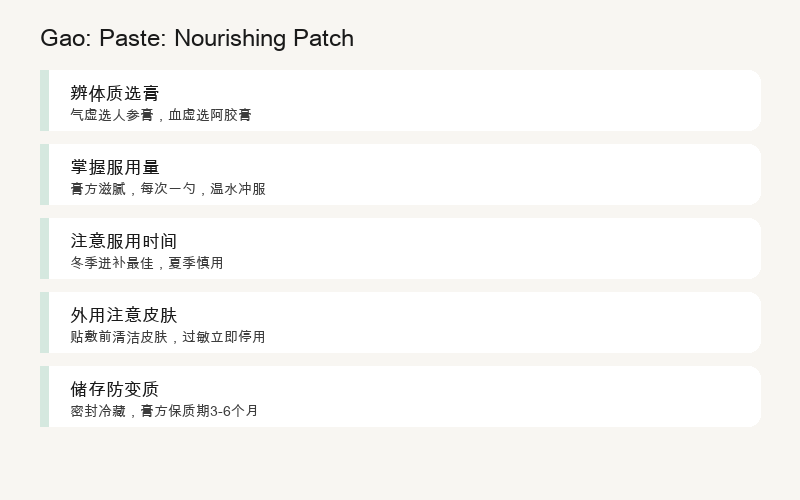
• "The more expensive the paste tonic, the better". Paste tonic price is related to herb types, but more expensive is not necessarily better. The paste tonic that suits your constitution is the good one. Some people use ginseng and cordyceps, and end up with internal heat; others use mild codonopsis and atractylodes, and feel comfortable. It is not "expensive is good"; it is suited to your constitution is most important.
• "Medicated plaster can be applied long-term, the longer the better". Medicated plaster is generally applied for 8-12 hours; exceeding 24 hours may cause skin allergy or contact dermatitis. It is not "the longer the better"; it is apply according to the instructions to avoid skin damage.
Specific methods:
• Distinguish internal and external use (paste tonic internal, medicated plaster external). Paste tonic (gao zi) is for internal use, 1-2 spoonfuls a day, dissolved in hot water. Medicated plaster is for external use, applied to the affected area. Do not confuse them — paste tonic cannot be applied externally, and medicated plaster cannot be taken internally. It is not "all paste is the same"; it is internal and external use, vastly different.
• Paste tonic consumption (best in winter, one spoonful a day). The best time to take paste tonic is winter (from the beginning of winter to the beginning of spring), 1-2 spoonfuls a day, taken on an empty stomach in the morning or before bed. Dissolve in hot water and stir evenly. Do not swallow directly — too thick, irritates the throat. It is not "eat it casually"; it is winter consumption, one spoonful a day, dissolved in hot water.
• Medicated plaster use (clean skin, application time, avoid allergy). Before applying medicated plaster, clean the skin and dry it. Apply for 8-12 hours, not exceeding 24 hours. After removal, let the skin rest for 4-6 hours before applying a new one. If skin redness, swelling, or itching occurs, stop immediately. It is not "apply and forget"; it is clean skin, control time, observe for allergy.
• Paste tonic selection (look at constitution, not price). Qi-deficiency constitution (fatigue, shortness of breath) — choose qi-tonifying paste tonic (codonopsis, astragalus). Blood-deficiency constitution (dizziness, pale complexion) — choose blood-tonifying paste tonic (angelica, rehmannia). Yin-deficiency constitution (dry mouth, insomnia) — choose yin-nourishing paste tonic (ophiopogon, goji berry). It is not "the more ginseng the better"; it is choose according to constitution, avoid wrong nourishment.
• Modern popularization (loquat paste, Guiling paste, etc.). Loquat paste (moistening lungs and stopping cough), Guiling paste (nourishing yin and reducing fire), autumn pear paste (moistening dryness and producing fluid) — making paste tonic into food products, convenient for daily consumption. It is not "authentic paste tonic"; it is popularization of the paste tonic concept, benefiting more people.
These methods do not require you to become a pharmacist. You only need to understand: Gao is a "nourishing patch" — internal paste tonic concentrates essence, external medicated plaster penetrates transdermally; eat paste tonic in winter, control application time for plasters; suited to constitution is most important, not more expensive is better.
Part 7One-Minute Summary
🕐 One Minute to Understand "Gao"
Gao = Nourishing Patch + Sustained-Release Patch.
Paste tonic (internal) = herbs repeatedly decocted + highly concentrated + honey solidified = liquid patch.
Medicated plaster (external) = herbs fried and extracted + yellow lead formed + skin penetration = transdermal patch.
One spoonful of paste tonic = a bowl of decoction × 10-fold concentration. One spoonful a day, slowly nourishing.
One medicated plaster = local drug delivery system, avoiding systemic side effects, long-lasting effect.
Three mainstays: internal paste tonic (winter nourishment), external medicated plaster (joint pain), popular paste tonic (loquat paste, Guiling paste).
Misconceptions: the more expensive the paste tonic the better, the longer medicated plaster is applied the better.
Methods: distinguish internal and external use, eat paste tonic in winter, control medicated plaster application time, choose according to constitution, modern popularized versions.
The ancients called it "paste is glue-like," and modern people call it "concentrated extraction + transdermal absorption + sustained-release drug delivery."
Different names, but medicine knows: paste preparation is a "patch system" — internal concentrated nourishment, external transdermal repair, best for winter nourishment.
The ancients had no concept of concentrated extraction, but they knew "paste is glue-like, congeals but does not flow, nourishes but is not greasy."
This is probably the most朴素 wisdom of the Chinese: repair dikes in winter so they don't burst in spring — use paste tonic to patch up the body in winter, so you have the capital to work next year.
Making money is the art of living; art is life after making money
giaogiao Concept 74
Using modern scientific language to help the world understand traditional Chinese wisdom.
No mysticism, no superstition, no belittlement.
Understand, not merely believe.
Coach Liu
Written in Florence