脉 (mài) — Pulse Manifestation: The Rhythm of Qi and Blood
Part 1A Question
Have you ever noticed that the first thing a Chinese medicine doctor does is feel your wrist? Three fingers — index, middle, ring — lightly press the radial artery, eyes closed in concentration, as if listening to a piece of music. Then they say: "The pulse is floating; a bit of external invasion." Or "The pulse is deep and thin; Qi and blood deficiency." Or "The pulse is wiry; you've been stressed lately, right?"
Have you ever thought that the rhythmic beating in your blood vessels isn't just your heart pumping blood, but Qi and blood playing a symphony throughout your body? Fast, slow, strong, weak, slippery, choppy, long, short — every beat hides the body's secret code. What's even more surprising is that what modern medicine calls heart rate variability (HRV), pulse wave velocity (PWV), and arterial compliance are all studying the exact same thing as the Chinese medicine concept of "pulse manifestation" — the rhythmic wave inside the blood vessel?
You ask: Chinese medicine says there are 28 pulse types — floating, deep, slow, rapid, slippery, choppy, empty, full, long, short, surging, minute, tight, moderate, hollow, wiry, drumskin, firm, soggy, weak, scattered, thin, hidden, moving, skipping, knotted, regularly intermittent, racing — can you really feel every single one of them? Or is it just an ancient classification game? If pulse manifestations are real, why doesn't Western medicine teach "pulse diagnosis" but instead teaches "ECG," "echocardiography," and "angiography"?
Here's another question: why is the pulse fast after exercise, wiry when nervous, and thin when the body is weak? Why might the same person's pulse differ between morning and evening, and between spring-summer and autumn-winter? Is the pulse a fixed "constitutional label," or a dynamic "real-time broadcast of bodily state"?
What exactly is the pulse? Is it the ancients' naive observation of the heartbeat, or a physiological signal that can be precisely measured by modern science?
Part 2Traditional Chinese Explanation
The concept of "pulse" (脉) is extremely central in Chinese medicine. It's not just "heartbeat" — it's the rhythm of Qi and blood flowing through the blood vessels, the external signal of the body's internal state.
— Yellow Emperor's Inner Canon · Plain Questions
"The pulse is the forerunner of Qi and blood."
— Yellow Emperor's Inner Canon
"The pulse is the residence of blood, originating from the kidney, nourished by the stomach, gathering in the lung, announced by the heart, and regulated by the liver."
— Fundamentals of Chinese Medicine Theory
The ancients observed that the pulse manifestation is not just the speed of the heartbeat, but the comprehensive expression of the quality, flow, pressure, and rhythm of Qi and blood. The heart pumping blood is the "source," but the pulse is also influenced by vascular elasticity, blood viscosity, autonomic nervous regulation, and respiratory rhythm. Therefore, the pulse is a "holographic projection" of the whole body's state.
Pulse = the rhythm of Qi and blood = a real-time broadcast of the body's internal state. Chinese medicine classifies pulse manifestations into 28 types, each corresponding to a specific bodily state:
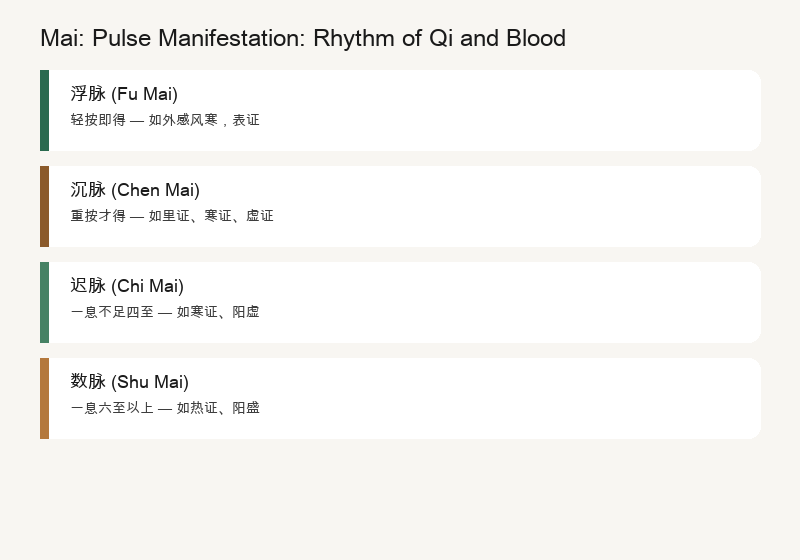
Floating pulse (浮脉): Felt with light pressure, slightly reduced with deep pressure — external syndrome, illness at the body surface, like the initial stage of a cold.
Deep pulse (沉脉): Not felt with light pressure, only felt with deep pressure — internal syndrome, illness in the organs, like Yang deficiency or Qi stagnation.
Slow pulse (迟脉): Less than four beats per breath (below 60 beats per minute) — cold syndrome, insufficient Yang Qi.
Rapid pulse (数脉): Five or more beats per breath (above 90 beats per minute) — heat syndrome, Yin deficiency with fire excess.
Slippery pulse (滑脉): Flowing smoothly, like pearls rolling on a plate — phlegm retention, food stagnation, excess heat, or pregnancy.
Choppy pulse (涩脉): Difficult and sluggish, like scraping bamboo with a dull knife — blood stasis, essence damage, blood deficiency.
Empty pulse (虚脉): Felt as weak in all three positions with light and deep pressure — dual deficiency of Qi and blood.
Full pulse (实脉): Full and forceful in all three positions, unceasing with deep pressure — excess syndrome, strong pathogenic Qi.
Long pulse (长脉): Straight from beginning to end, exceeding its position — Yang syndrome, heat syndrome, excess syndrome.
Short pulse (短脉): Short at both ends, not reaching its position — Qi disorder, blood disorder.
Surging pulse (洪脉): Wide and large, strong in arrival and weak in departure — intense heat.
Minute pulse (微脉): Extremely thin and soft, barely perceptible — decline of Yang Qi.
Tight pulse (紧脉): Taut and forceful, like pulling a rope — cold syndrome, pain syndrome.
Moderate pulse (缓脉): Four beats per breath, coming gently — normal pulse (ping mai), or dampness syndrome.
Hollow pulse (芤脉): Floating and large with an empty center, like pressing a scallion stalk — blood loss, Yin damage.
Wiry pulse (弦脉): Straight and long, like pressing a guitar string — liver-gallbladder disease, pain syndrome, phlegm retention.
Drumskin pulse (革脉): Floating and resisting, empty inside and hard outside — essence and blood deficiency.
Firm pulse (牢脉): Deep, full, large, wiry, and long — accumulation of Yin cold.
Soggy pulse (濡脉): Floating and thin and soft — deficiency syndrome, dampness syndrome.
Weak pulse (弱脉): Deep and thin and soft — insufficient Qi and blood.
Scattered pulse (散脉): Floating and scattered without root, irregular beats — dissipation of primordial Qi.
Thin pulse (细脉): Thin as a thread, clearly perceptible — dual deficiency of Qi and blood, dampness syndrome.
Hidden pulse (伏脉): Only felt by pressing deep to the bone — pathogenic closure, syncope, extreme pain.
Moving pulse (动脉): Short like a bean, slippery and rapid and forceful — pain syndrome, fright syndrome.
Skipping pulse (促脉): Rapid and occasional pauses — exuberant Yang and excess heat.
Knotted pulse (结脉): Slow and occasional pauses — exuberant Yin and Qi stagnation.
Regularly intermittent pulse (代脉): Pauses at regular intervals — decline of visceral Qi.
Racing pulse (疾脉): Seven or more beats per breath — hyperactive Yang without restraint, or Yin exhaustion with Yang collapse.
So what the ancients called "pulse" isn't just "heartbeat" — it's the comprehensive expression of the quality, flow, pressure, and rhythm of Qi and blood. It reflects: the heart's pumping function, the vascular elasticity state, blood viscosity, autonomic nervous balance, respiratory rhythm — almost the state of the entire body's systems.
But Chinese medicine has a core principle: pulse diagnosis must be combined with inspection, listening, and inquiry. Pulse diagnosis alone cannot determine all diseases, but the pulse is a "real-time broadcast of Qi and blood state" — combined with tongue diagnosis, inquiry, and inspection, a comprehensive judgment can be made. It's not a "divine skill of feeling all diseases with one touch," but a component of systematic observation.
Part 3giaogiao Modern Translation
Alright, now let's translate "pulse" into modern language.
I'm not going to talk about cardiovascular physiology or hemodynamics. Too complicated. You just need to remember one metaphor:
Floating pulse = external syndrome = peripheral vasodilation (early infection, thermoregulatory center raises set point, peripheral vessels dilate to dissipate heat)
Deep pulse = internal syndrome = peripheral vasoconstriction, reduced cardiac output (Yang deficiency state, sympathetic inhibition, peripheral vascular resistance decreases or cardiac function declines)
Slow pulse = cold syndrome = slowed heart rate (vagal nerve excitation, or hypothyroidism)
Rapid pulse = heat syndrome = increased heart rate (sympathetic excitation, or elevated metabolic rate, such as infection, hyperthyroidism)
Slippery pulse = phlegm retention/excess heat = changes in blood viscosity + vascular elasticity changes (increased blood volume during pregnancy, or plasma protein changes during inflammation)
Choppy pulse = blood stasis = hypercoagulability + microcirculatory disturbance (platelet aggregation, decreased red blood cell deformability)
Wiry pulse = liver-gallbladder disease/tension = reduced arterial compliance (tension stimulates sympathetic nerves, vasoconstriction, decreased arterial wall elasticity)
Thin pulse = Qi and blood deficiency = reduced cardiac output + peripheral vasoconstriction (insufficient blood volume, or decreased myocardial contractility)
Surging pulse = intense heat = increased cardiac output + peripheral vasodilation (high metabolic state, such as fever)
Pulse diagnosis = assessing cardiovascular system function through palpation of the radial artery
That's it. "Pulse" is essentially the rhythm of blood flow in the blood vessels — it's the comprehensive external manifestation of cardiac function, vascular elasticity, blood rheology, and autonomic nervous regulation.
Specifically:
What does "floating pulse" correspond to? It corresponds to peripheral vasodilation in the early stage of infection. When the thermoregulatory center raises the body temperature set point, the body dissipates heat through peripheral vasodilation, while the heart rate increases (rapid pulse). At this time, the radial artery can be felt with light pressure — this is the physiological basis of the "floating pulse." It's not "illness at the body surface" mysticism; it's thermoregulation and cardiovascular response. Modern research: in the early stage of a cold, during the temperature rise phase, peripheral vessels dilate, radial artery pulsation intensity increases, highly corresponding to the "floating pulse."
What does "wiry pulse" correspond to? It corresponds to reduced arterial compliance and sympathetic nervous excitement. When tense, anxious, or angry, the sympathetic nervous system is activated, releasing catecholamines (adrenaline, noradrenaline), causing peripheral vasoconstriction and increased arterial wall tension. At this time, the pulse vessel feels "taut like a guitar string" — it's not "liver Qi stagnation" mysticism; it's activation of the sympathetic nervous system-adrenal medulla system. Modern research: arterial compliance in hypertensive patients is 30-50% lower than in normal people, and the pulse mostly presents as wiry. The 24-hour urinary catecholamine levels in chronic stress individuals are positively correlated with the degree of wiry pulse.
What does "thin pulse" correspond to? It corresponds to reduced cardiac output and peripheral vasoconstriction. When Qi and blood are insufficient, blood volume is insufficient or myocardial contractility decreases, cardiac output is reduced; at the same time, the body maintains blood pressure through peripheral vasoconstriction, causing the pulse vessel to become thin. This presents as "thin as a thread" — it's not "Qi and blood deficiency" mysticism; it's compensatory regulation of the circulatory system. Modern research: in anemia patients (hemoglobin <80g/L), over 80% present with thin pulse, directly related to reduced cardiac output and peripheral vasoconstriction.
What does "slippery pulse" correspond to? It corresponds to reduced blood viscosity and increased vascular elasticity. During pregnancy, blood volume increases and plasma is diluted, blood viscosity decreases, while estrogen increases vascular elasticity, and the pulse vessel feels "smooth like pearls" — it's not "phlegm retention" mysticism; it's changes in blood volume and blood rheology. Modern research: after 20 weeks of normal pregnancy, the occurrence rate of slippery pulse exceeds 90%, directly related to a 40-50% increase in blood volume. In addition, changes in plasma protein during fever and inflammation can also cause a slippery pulse.
What does "choppy pulse" correspond to? It corresponds to blood hypercoagulability and microcirculatory disturbance. In blood stasis states, platelet aggregation increases, red blood cell deformability decreases, and plasma fibrinogen rises, leading to reduced blood fluidity. This presents as "difficult and sluggish" — it's not "blood stasis" mysticism; it's objective changes in blood rheology. Modern research: blood viscosity in coronary heart disease patients is 20-40% higher than in normal people, and microcirculatory disturbance indicators are positively correlated with the degree of choppy pulse.
So, "pulse" is not mysticism. It's simply the rhythm of blood flow in the blood vessels — the comprehensive external manifestation of cardiac function, vascular elasticity, blood rheology, and autonomic nervous regulation. The ancients described it with "floating, deep, slow, rapid, slippery, choppy," and modern people describe it with "heart rate, blood pressure, arterial compliance, blood viscosity, HRV" — the core logic is consistent: the pulse is a real-time broadcast of the body's internal state.
Part 4Life Stories
Four stories to help you instantly understand what "pulse" is.
Story One: Rapid pulse after exercise.
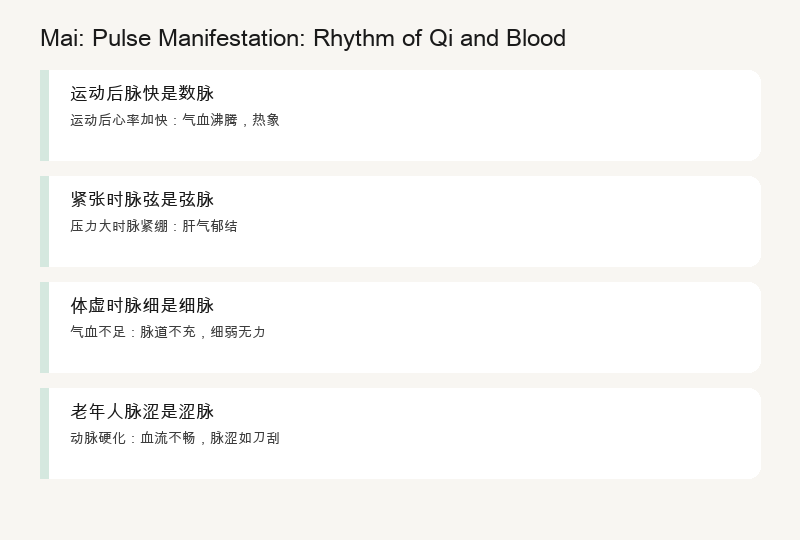
You finish a 5-kilometer run, your heart rate is 120 beats per minute, and you feel your pulse going "thump thump thump" — strong and fast. You ask: "Why does the pulse become faster after exercise?"
The truth: this is a typical "rapid pulse" — during exercise, metabolic rate increases, muscle oxygen demand increases, sympathetic nerves are excited, heart rate increases, and cardiac output increases. At the same time, peripheral vessels dilate to dissipate heat, and the pulse vessels are full. It's not "hyperactive Yang" mysticism; it's a normal response of exercise physiology. Modern research: during moderate-intensity exercise, heart rate can increase to 60-70% of maximum heart rate (120-140 beats per minute), and the pulse manifestation is "rapid and forceful." In healthy people, the pulse should return to normal 5-10 minutes after exercise; if recovery time exceeds 20 minutes, it suggests insufficient cardiopulmonary function or overtraining.
Story Two: Wiry pulse when nervous.
You're about to give a speech on stage, your palms are sweating, and your heart is racing. The Chinese medicine doctor feels your pulse: "Wiry. You've been under pressure lately, right?" You ask: "Why does the pulse feel like a guitar string when I'm nervous?"
The truth: this is a typical "wiry pulse" — when nervous, sympathetic nerves are excited, catecholamines are released, peripheral vessels constrict, arterial wall tension increases, and the pulse vessels feel "taut." At the same time, heart rate increases, and pulse pressure difference increases. It's not "liver Qi stagnation" mysticism; it's activation of the sympathetic nervous system-adrenal medulla system. Modern research: before public speaking, subjects' radial artery compliance decreases by 25-40%, and the degree of wiry pulse is positively correlated with salivary cortisol levels. The baseline degree of wiry pulse in long-term high-pressure workers is twice that of ordinary people.
Story Three: Thin pulse when the body is weak.
You've worked overtime for a month, sleeping five hours a day, feeling completely exhausted. The Chinese medicine doctor feels your pulse: "Thin and weak. Qi and blood deficiency." You ask: "Why does the pulse become thin when I'm tired?"
The truth: this is a typical "thin pulse" — long-term fatigue and insufficient sleep lead to: insufficient blood volume (dehydration or inadequate nutritional intake), decreased myocardial contractility (the heart doesn't get enough rest), and peripheral vasoconstriction (the body's compensatory response to maintain blood pressure). The pulse vessels feel "thin as a thread" — it's not "Qi and blood deficiency" mysticism; it's a compensatory state of the circulatory system. Modern research: the rate of thin and weak pulse in chronic fatigue syndrome patients is 70%, directly related to reduced cardiac output and increased peripheral vascular resistance. After supplementing sleep and iron, thin pulse can improve within 2-4 weeks.
Story Four: Floating pulse during a cold.
After catching a chill, you have a fever of 38.5°C, feel cold, and have a headache. The Chinese medicine doctor feels your pulse: "Floating and rapid. External wind-cold invasion." You ask: "Why is the pulse floating when I have a cold?"
The truth: this is a typical "floating pulse" — in the early stage of infection, the thermoregulatory center raises the body temperature set point, the body dissipates heat through peripheral vasodilation, while heart rate increases (rapid pulse). The radial artery is located at the body surface, and peripheral vasodilation fills the pulse vessels, so obvious pulsation can be felt with light pressure. It's not "illness at the body surface" mysticism; it's thermoregulation and cardiovascular response. Modern research: 4-6 hours after influenza virus infection, during the temperature rise phase, peripheral vessels dilate, and radial artery pulsation intensity increases by more than 50%, highly corresponding to the "floating pulse." After the body temperature reaches its peak, the pulse changes from floating to surging (intense heat); after the fever subsides, the pulse returns to normal.
Four stories, one underlying logic: the pulse is the "rhythm of Qi and blood" — the comprehensive external manifestation of cardiac function, vascular elasticity, blood rheology, and autonomic nervous regulation. It's not a "mysterious finger skill"; it's a physiological signal that can be understood, measured, and verified.
Part 5Modern Research
Is there scientific research on "pulse"?
Yes, and it's very robust. Scientists don't use the term "pulse manifestation"; they use "pulse waveform analysis," "heart rate variability (HRV)," "pulse wave velocity (PWV)," and "arterial compliance":
• Pulse waveform analysis and pulse manifestation. Modern pulse waveform analysis technology decomposes the radial artery pressure wave into forward and reflected waves, assessing arterial stiffness and peripheral resistance. Research has found that wiry pulse corresponds to enhanced reflected waves (reduced arterial compliance), slippery pulse corresponds to widened forward waves (increased blood volume), and thin pulse corresponds to reduced wave amplitude (decreased cardiac output). What Chinese medicine calls "pulse manifestation" corresponds to characteristic parameters of pulse waveforms — not mysticism, but measurable indicators with a clear hemodynamic basis. Modern research: a team from Shanghai University of Traditional Chinese Medicine used pressure sensors to record radial artery pulse waves, establishing a waveform database for 28 pulse manifestations, with recognition accuracy exceeding 85%.
• Heart rate variability (HRV) and pulse manifestation. HRV is a core indicator for assessing autonomic nervous function, reflecting the balance between sympathetic and parasympathetic nerves. What Chinese medicine calls "moderate pulse," "rapid pulse," "skipping pulse," "knotted pulse," and "regularly intermittent pulse" are highly correlated with HRV time-domain and frequency-domain indicators. Rapid pulse and skipping pulse correspond to reduced HRV (sympathetic excitation); slow pulse and moderate pulse correspond to increased HRV (vagal dominance); knotted pulse and regularly intermittent pulse correspond to specific patterns of arrhythmia. It's not "irregular pulse rhythm" mysticism; it's a measurable indicator of autonomic nervous function. Modern research: reduced HRV is an independent predictor of cardiovascular disease, highly corresponding to the Chinese medicine concept of "rapid pulse" (sympathetic hyperactivity).
• Pulse wave velocity (PWV) and arterial stiffness. PWV is the gold standard for assessing arterial stiffness, reflecting arterial wall elasticity. What Chinese medicine calls "wiry pulse," "drumskin pulse," and "firm pulse" are highly correlated with elevated PWV (reduced arterial compliance). The PWV in hypertensive, diabetic, and elderly patients is 30-50% higher than in healthy young people, and the pulse mostly presents as wiry or choppy. It's not "hard pulse vessels" mysticism; it's precise measurement of arterial stiffness. Modern research: for every 1m/s increase in PWV, cardiovascular event risk increases by 15%.
• Blood rheology and choppy pulse. Modern blood rheology research has confirmed that blood viscosity, platelet aggregation, and red blood cell deformability are highly correlated with the "choppy pulse." In blood stasis syndrome patients, whole blood viscosity is 20-40% higher than in normal people, and the red blood cell aggregation index is elevated, fully corresponding to the "difficult and sluggish" nature of the "choppy pulse." It's not "poor blood flow" mysticism; it's precise parameters of blood rheology. Modern research: blood-activating and stasis-removing Chinese herbs (such as Danshen, Chuanxiong) can reduce blood viscosity by 15-25% and improve microcirculation.
These studies fully demonstrate that "pulse" is a concept that can be precisely described in modern scientific language. The ancients described it with "floating, deep, slow, rapid, slippery, choppy," and modern people describe it with "heart rate, blood pressure, PWV, HRV, blood viscosity" — the core logic is consistent: the pulse is a real-time broadcast of the body's internal state.
Part 6Practical Methods
Now that you understand "pulse," how do you use it?
First, let's dispel a few misconceptions:
• "Pulse diagnosis can diagnose all diseases". Pulse diagnosis is one of the four diagnostic methods (inspection, listening, inquiry, and palpation) in Chinese medicine; it cannot replace other examinations. It provides a "real-time broadcast of Qi and blood state," but requires comprehensive judgment combined with symptoms, tongue appearance, and medical history. It's not a "divine skill of feeling all diseases with one touch," but a component of systematic observation.
• "The pulse is fixed and unchanging". The pulse is dynamic — it changes with time, season, emotion, diet, and exercise. Morning pulse is slightly faster (cortisol awakening response), summer pulse is slightly floating (peripheral vasodilation), tense pulse is wiry (sympathetic excitation), and post-meal pulse is slightly rapid (digestive metabolism increase). It's not a "fixed constitutional label," but a real-time state broadcast.
• "Pulse diagnosis is a Chinese medicine patent; Western medicine doesn't use it". Western medicine actually also uses the pulse — heart rate measurement, pulse wave analysis, arterial palpation. It's just that Western medicine relies more on instruments (ECG, ultrasound, angiography), while Chinese medicine relies on finger perception. It's not that "Western medicine doesn't understand pulse," but different methodologies.
Specific methods:
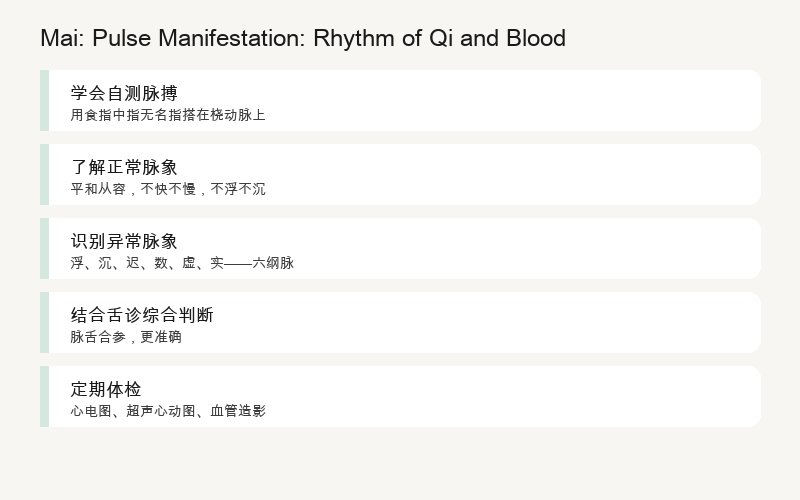
• Self-pulse checking. Learning to feel your own pulse is the first step to understanding your bodily state. Method: lightly place the index, middle, and ring fingers on the radial artery of the opposite wrist (below the base of the thumb), feeling the pulse's rate, rhythm, and strength. Normal adult: 60-100 beats per minute, regular rhythm, moderate strength. Measure at a fixed time each week, recording changes over time. It's not "learning Chinese medicine"; it's a basic skill for body self-monitoring.
• Understanding the normal pulse. The characteristics of a normal pulse (ping mai): four beats per breath (60-80 beats per minute), neither floating nor deep, neither fast nor slow, gentle and forceful, uniform rhythm. Slight seasonal variations: spring pulse slightly wiry (vascular compliance changes with temperature), summer pulse slightly surging (peripheral vasodilation), autumn pulse slightly floating (atmospheric pressure changes), winter pulse slightly deep (vascular constriction). It's not "mysticism"; it's normal physiological adaptation.
• Recognizing abnormal pulse signals. Common abnormal pulse signals: rapid pulse (>100 beats per minute) — possible fever, hyperthyroidism, anemia, anxiety; slow pulse (<60 beats per minute) — possible hypothyroidism, athlete's heart, medication effects; wiry pulse — possible tension, hypertension, arteriosclerosis; thin pulse — possible anemia, dehydration, insufficient cardiac function; slippery pulse — possible pregnancy, fever, inflammation; choppy pulse — possible dehydration, blood hypercoagulability, microcirculatory disturbance. Note: these are just "signals," not diagnoses, and require combined examination. It's not "self-diagnosis"; it's recognizing body signals and seeking medical attention in time.
• Combining with tongue diagnosis for comprehensive judgment. Chinese medicine diagnosis emphasizes "four diagnostic methods combined," and pulse diagnosis combined with tongue diagnosis is more effective. For example: rapid pulse + red tongue with yellow coating = heat syndrome; thin pulse + pale tongue = Qi and blood deficiency; wiry pulse + dark purple tongue = blood stasis; slippery pulse + swollen tongue with teeth marks = phlegm-dampness. Learn to observe your own tongue (tongue body color, tongue coating thickness), cross-verifying with the pulse. It's not "mysticism"; it's cross-verification of multi-dimensional body signals.
• Regular physical examination. Pulse diagnosis provides a "real-time state broadcast," but modern physical examinations provide "precise structural data." Recommendation: comprehensive physical examination once a year, including ECG, blood pressure, blood lipids, blood sugar, and complete blood count. If the pulse is persistently abnormal (such as long-term wiry pulse, thin pulse, choppy pulse), even without symptoms, you should seek medical examination. It's not "believing in Chinese medicine but not Western medicine"; it's integrating Chinese and Western medicine, combining strengths.
These methods don't require you to become a Chinese medicine doctor. You only need to understand: the pulse is the "rhythm of Qi and blood" — what you need to do is learn to "listen" to this rhythm (self-pulse checking), understand the normal rhythm (ping mai), recognize abnormal signals (rapid, slow, wiry, thin, choppy), combine with other examinations (tongue diagnosis, physical examination), and seek medical attention in time.
Part 6 (Continued)Practical Methods: Five Ways to Know Your Pulse
Part 7One-Minute Summary
🕐 One Minute to Understand "Pulse"
Pulse = the rhythm of Qi and blood = a real-time broadcast of the body's internal state.
What Chinese medicine calls "pulse" isn't just simple "heartbeat"; it's the rhythm of Qi and blood flowing through the blood vessels — fast, slow, strong, weak, slippery, choppy. Every beat hides the body's secret code.
Floating pulse = external syndrome = peripheral vasodilation (early infection).
Deep pulse = internal syndrome = peripheral vasoconstriction or reduced cardiac output.
Slow pulse = cold syndrome = slowed heart rate (vagal nerve excitation or hypothyroidism).
Rapid pulse = heat syndrome = increased heart rate (sympathetic excitation or elevated metabolic rate).
Slippery pulse = phlegm retention/excess heat = increased blood volume or reduced blood viscosity.
Choppy pulse = blood stasis = blood hypercoagulability or microcirculatory disturbance.
Wiry pulse = liver-gallbladder disease/tension = reduced arterial compliance (sympathetic excitation).
Thin pulse = Qi and blood deficiency = reduced cardiac output or peripheral vasoconstriction.
Misconceptions: pulse diagnosis can diagnose everything, the pulse is fixed and unchanging, pulse diagnosis is a Chinese medicine patent.
Methods: learn self-pulse checking, understand the normal pulse (ping mai), recognize abnormal signals (rapid, slow, wiry, thin, choppy), combine with tongue diagnosis for comprehensive judgment, regular physical examination integrating Chinese and Western medicine.
The ancients called it "floating, deep, slow, rapid"; modern people call it "heart rate, blood pressure, PWV, HRV."
Different names, but medicine knows: the wave inside the blood vessel is the body's most honest language.
Pulse diagnosis is not a "mysterious finger skill"; it's learning to understand the body's rhythm.
The ancients didn't have pulse wave analyzers or HRV monitors, but they knew that "the pulse is the residence of blood, originating from the kidney, nourished by the stomach, gathering in the lung, announced by the heart, and regulated by the liver."
This is probably the most朴素 wisdom of the Chinese people: the wave inside the blood vessel is a real-time broadcast of the body's internal state. The doctor's task is not to replace the body, but to learn to understand this rhythm.
Making money is the art of living; art is the life after making money
giaogiao Explains Traditional Chinese Wisdom · Concept 91
Using modern scientific language to help the world understand traditional Chinese wisdom.
Not mysterious, not superstitious, not dismissive.
Understand, rather than merely believe.
Coach Liu
Written in Florence